








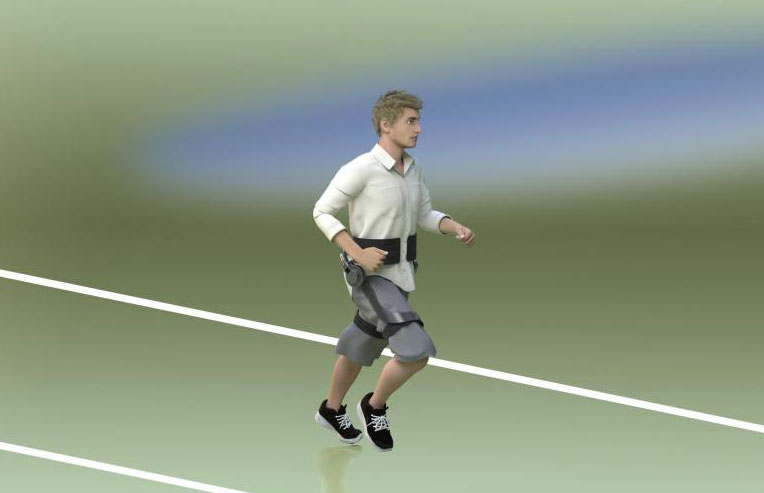
Image courtesy of NJIT.
A team of researchers from the New Jersey Institute of Technology (NJIT) have demonstrated a new method that leverages artificial intelligence (AI) and computer simulations to train robotic exoskeletons that can help users save energy while walking, running, and climbing stairs. The novel method rapidly develops exoskeleton controllers to assist locomotion without relying on lengthy human-involved experiments. Moreover, the method can apply to a wide variety of assistive devices beyond the hip exoskeleton demonstrated in this research.
“It can also apply to knee or ankle exoskeletons, or other multi-joint exoskeletons,” said Xianlian Zhou, PhD, associate professor and director of NJIT’s BioDynamics Lab. In addition, it can similarly be applied to transfemoral and transtibial prostheses, providing immediate benefits for millions of able-bodied and mobility-impaired individuals, he said.
This breakthrough holds promise for aiding individuals with mobility challenges, including the elderly or stroke survivors, without necessitating their presence in a laboratory or clinical setting for extensive testing. Ultimately, it paves the way for restoring mobility and enhancing accessibility for everyday in-home or community living.
“This work proposes and demonstrates a new method that uses physics-informed and data-driven reinforcement learning to control wearable robots in order to directly benefit humans,” said Hao Su, PhD, an associate professor of mechanical and aerospace engineering at North Carolina State University.
The researchers focused on improving autonomous control of embodied AI systems–which are systems where an AI program is integrated into a physical technology. This work focused on teaching robotic exoskeletons how to assist able-bodied people with a variety of movements, and expands on previous reinforcement learning based research for lower limb rehabilitation exoskeletons, also a collaborative effort between Zhou, Su, and several others.
Normally, users have to spend hours “training” an exoskeleton so that the technology knows how much force is needed–and when to apply that force–to help users walk, run, or climb stairs. The new method allows users to utilize the exoskeletons immediately because the closed-loop simulation incorporates both exoskeleton controller and physics models of musculoskeletal dynamics, human-robot interaction, and muscle reactions, thereby generating efficient and realistic data and iteratively learning better control policy in simulation. The unit is preprogrammed to be ready to use right away, and it’s also possible to update the controller on the hardware if researchers make improvements in the lab through expanded simulations. Future prospects for this project include developing individualized, custom-tailored controllers that assist users for various activities of daily living.