








 By Mathias B. Forrester, BS
Background: An estimated 46.5 million United States (US) households owned a cat in 2023-2024. Interactions with cats may result in injury. The objective of this study is to describe cat-related falls and hits affecting the lower extremity.
Methods: Cat-related falls (falls, trips, slips, jumped down) and hits (hit or other contact with an object) affecting the lower extremity during 2000-2023 were identified using the National Electronic Injury Surveillance System (NEISS), a database of consumer product- and activity-related injuries treated at a representative sample of US hospital emergency departments (EDs). Cases reported to the NEISS can be used to calculate national injury estimates. The distribution of cat-related falls and hits affecting the lower extremity was determined for patient demographics, injury circumstances, and management.
Results: There were an estimated 45,220 cat-related falls affecting the lower extremity, representing 19.3% of the cat-related falls affecting all body parts. There were an estimated 11,909 cat-related hits affecting the lower extremity, representing 31.9% of the cat-related hits affecting all body parts. The most affected body parts for falls were the ankle (28.2%) and knee (25.8%) and for hits were the foot (38.6%) and toe (34.7%). The most common types of injury for falls were strain or sprain (30.6%) and fracture (29.8%) and for hits were laceration (25.5%) and contusion or abrasion (24.2%). The average patient was age 65 years or older for 28.9% of falls and 12.5% of hits and was female for 75.5% of falls and 64.2% of hits. The most common activities in falls were tripped over the cat (63.4%), chasing/trying to catch the cat (9.9%), and feeding/watering the cat (4.2%), and in hits were chasing/trying to catch the cat (27.8%), cat knocked object over/turned object on (24.4%), and assaulted/teased/scared the cat (actual or attempted) (7.0%).
Conclusion: Numerous differences were found in the pattern of cat-related falls and hits affecting the lower extremity. These differences should be taken into consideration in efforts to prevent such injuries.
Cats are the second most popular pet in the United States (US). The 2023-2024 American Pet Products Association National Pet Owners Survey reported that 46.5 million US households owned a cat, as compared to 65.1 million US households that owned a dog.1
Interactions with cats may result in injury. Bites might be the first type of injury that comes to mind, and thousands of cat bites are treated at US hospital emergency departments (EDs) each year.2,3 However, cats are also a source of falls. A study using data from a sample of US hospital EDs during 2001-2006 found an estimated 62,000 nonfatal unintentional fall injuries involving cats.4 The most common type of injuries (diagnoses) were fractures, contusions or abrasions, strains or sprains, and lacerations. The falls occurred during a variety of circumstances: walking pet, caring for pet, playing with pet, chasing pet, running from pet, running with pet, breaking up pet fight, stepping over pet, and attacked by pet.
This previous study also reported that one-fifth of the cat-related fall injuries involved the leg or foot.4 The objective of the current study was to describe cat-related falls affecting the lower extremity treated at US hospital EDs. Cat-related hits affecting the lower extremity also were described and compared to cat-related falls.
Methods
 This study used data from the National Electronic Injury Surveillance System (NEISS), which are available at https://www.cpsc.gov/cgibin/NEISSQuery/home.aspx. The NEISS database has previously been described in detail in Lower Extremity Review.5 In brief, operated by the US Consumer Product Safety Commission (CPSC), NEISS is a database of consumer product- and activity-related injuries collected from a representative sample of approximately 100 US hospital EDs. National estimates are calculated from database records according to the sample weight assigned to each case based on the inverse probability of the hospital being selected for the NEISS sample.6,7 Data are publicly available and de-identified; thus, the study is exempt from institutional review board approval. The previous study that examined cat-related fall injuries used data from a related database (National Electronic Injury Surveillance System – All Injury Program or NEISS-AIP).4 The NEISS-AIP has been described previously in Lower Extremity Review.8
Cases were cat-related falls and hits affecting the lower extremity reported to NEISS during 2000-2023. The identification of cases was performed in stages. First, to identify as many cat-related injuries as possible, the NEISS database was searched for all records that mentioned a cat in the Narrative field (a text field that provides a brief summary of the circumstances and type of injury). A search for the letter group “cat” was not performed because the letter group is included in a number of different words (e.g., catch, dislocation, intoxication) and would have produced too many false positives. Instead, a search was performed for all records that included the following letter groups and spaces or punctuation in the Narrative field:
“ cat ” or “cat ” [at the beginning of the text] or “ cat” [at the end of the text] or “cat.” or “.cat” or “cat,” or “,cat” or “cat;” or “;cat” or “cat-” or “-cat” or “cat/” or “/cat” or “cat\” or “\cat” or “cat’s” or “cats” or “kitten” or “kitty”
It is acknowledged that some cat-related injuries will be missed, primarily due to misspellings.
Next, the resulting records were individually reviewed to identify those records that appear to involve a cat-related fall or hit. A record was classified as a fall if the record mentioned a fall, trip, slip, or jump down. The record did not need to state that the patient landed on the ground but could have landed on or contacted another object (eg, patient fell into a chair). A record was classified as a hit if the record mentioned a hit or other contact with an object (e.g., patient was playing with a cat and hit their hand on a table, patient was chasing the cat and stubbed their toe on a chair, patient was chasing the cat and stepped on a nail, cat knocked a vase off a shelf and the vase hit the patient in the head). If the patient hit or contacted an object and the record mentioned a fall, trip, slip, or jump down, the record was classified as a fall.
At the same time as the above action, the record was assigned to 1 of 44 activities or circumstances resulting in the injury (eg, tripped over the cat, chasing/trying to catch the cat, cat knocked object over/turned object on).
Finally, those cat-related falls and hits affecting the lower extremity were identified. The NEISS database contains 2 numeric fields for coding the affected body part (Body_Part and Body_Part_2) and 2 related numeric fields for coding the type of injury or diagnosis (Diagnosis and Diagnosis_2). The Body_Part_2 and Diagnosis_2 fields were added in 2018, although they do not appear to have been used until 2019.7 For consistency over the entire study period, the Body_Part and Diagnosis fields alone was examined for the analysis. Only those records where the Body_Part field contained codes for a lower extremity (upper leg, knee, lower leg, ankle, foot, toe) were included in the study.
The variables examined were body part, injury type (diagnosis), treatment year and month, location where the incident occurred, activity or circumstance resulting in the injury, patient age and sex, and disposition. Analyses were performed using Microsoft 365 Access and Excel (Microsoft Corporation, Redmond, Washington, US). National injury estimates were calculated by summing the values in the Weight numeric field in the publicly available NEISS database. The distribution of estimated injuries was calculated for each variable for falls and hits. The CPSC considers an estimate unstable and potentially unreliable when the estimate is <1,200.6
Results
 There were an estimated 45,220 cat-related falls affecting the lower extremity, representing 19.3% of the estimated 234,027 cat-related falls affecting all body parts. There were an estimated 11,909 cat-related hits affecting the lower extremity, representing 31.9% of the estimated 37,347 cat-related hits affecting all body parts.
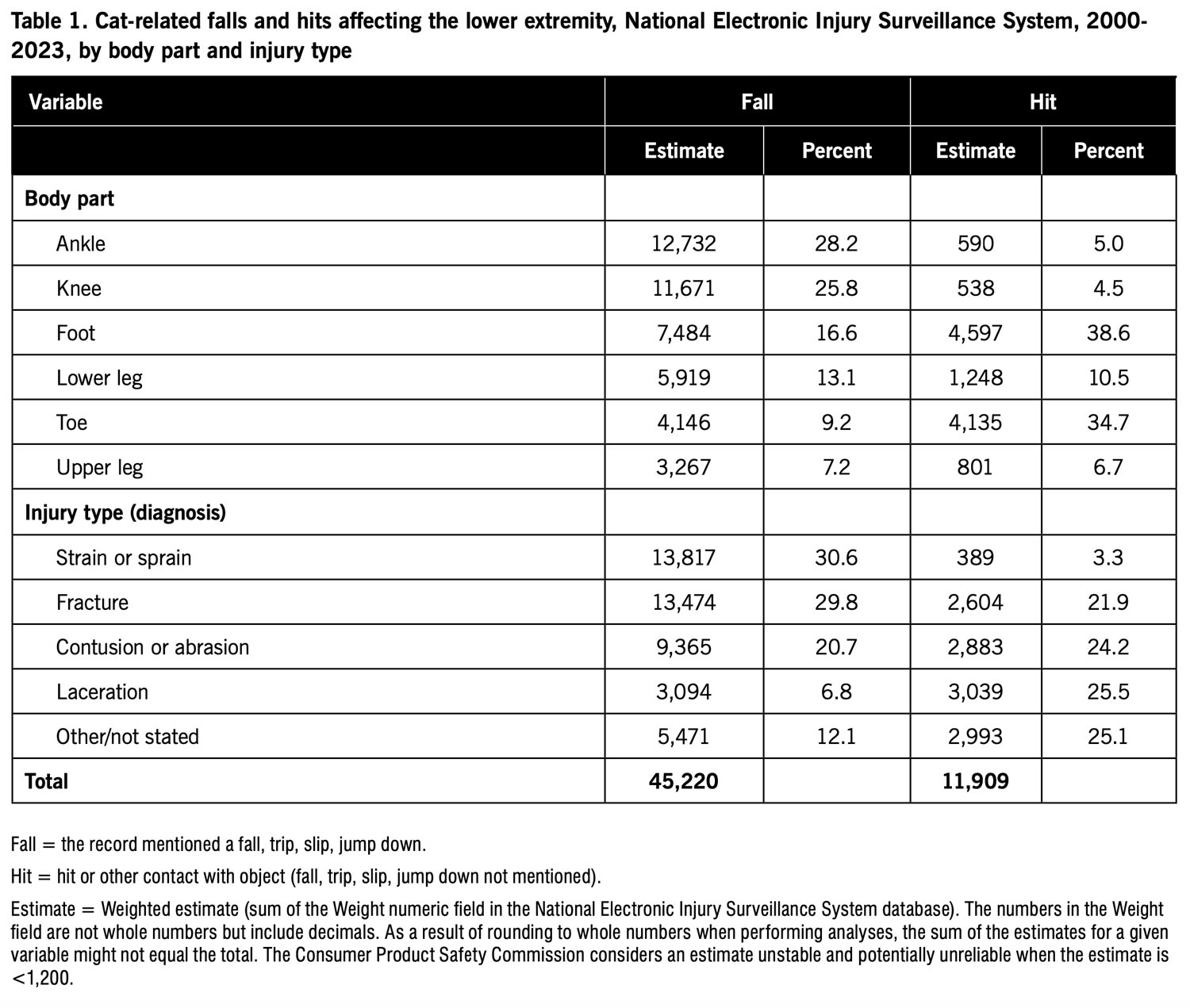
Table 1 presents the distribution of cat-related falls and hits affecting the lower extremity by body part and type of injury (diagnosis). For falls, the most affected body parts were the ankle and knee; for hits, the most affected body parts were the foot and toe. The most common type of injury for falls was strain or sprain followed by fracture, contusion or abrasion, and laceration. For hits, the order of the type of injury was reversed.

Supplemental Table 1 (which appears online only) shows the distribution of cat-related falls and hits affecting the lower extremity by time period and location of incident. For both falls and hits, the estimated number of injuries increased over the period of the study, the highest proportion of injuries were treated during July-September, and the majority of injuries occurred at home.
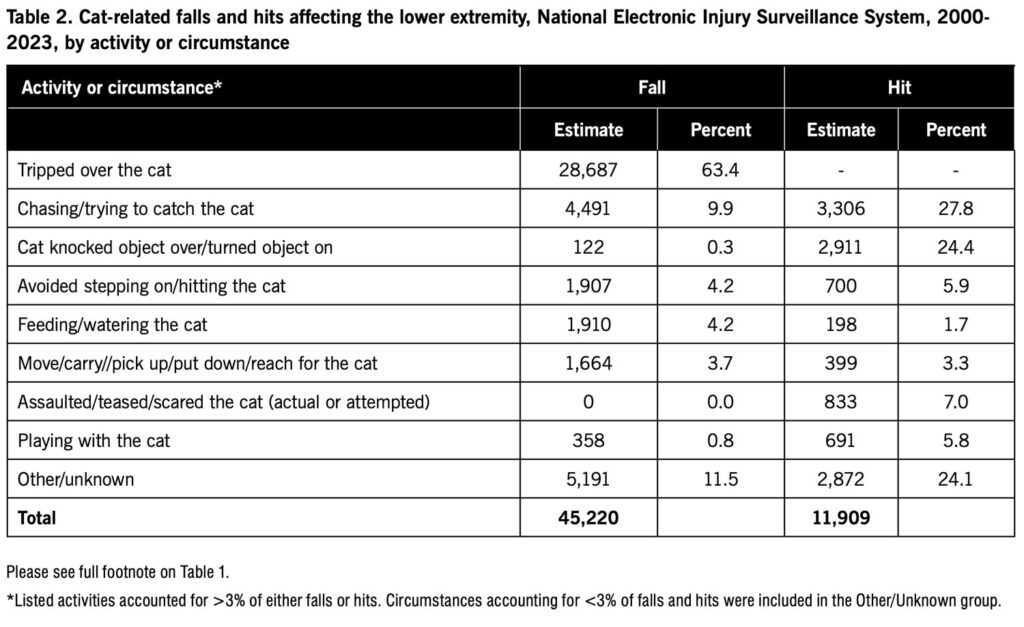
The most common activity or circumstance in cat-related falls affecting the lower extremity was tripped over the cat (Table 2). (By definition, none of the cat-related hits involved tripped over the cat.) The next most common activities or circumstances in falls were chasing/trying to catch the cat, feeding/watering the cat, and avoided stepping on/hitting the cat. The most common activities or circumstances in cat-related hits affecting the lower extremity were chasing/trying to catch the cat, cat knocked object over/turned object on, and assaulted/teased/scared the cat (actual or attempted).
When patient demographics and disposition were examined (Table 3), the highest proportion of cat-related falls affecting the lower extremity involved patients age 40-49 years, and 28.9% of the estimated injuries involved patients age 60 years or older. The highest proportion of cat-related hits affecting the lower extremity involved patients age 20-29 years, and 12.5% of the estimated injuries involved patients age 60 years or older. For both falls and hits, most patients were female, although this proportion was higher for falls than for hits. As for disposition, the majority of patients were treated or examined and released from the ED, although this proportion was greater for hits than for falls (Table 3). Patients were treated and admitted for hospitalization (within same facility) or treated and transferred to another hospital, for 10.6% of the estimated falls and 3.6% of the hits.
Discussion
The study examined cat-related falls and hits affecting the lower extremity treated at US hospital EDs. An estimated 46.5 million US households own a cat, making cats the second most popular pet in the US.1 With so many cats, cat-related injuries are likely to occur. Falls are a common cause of injury that can have serious consequences. A previous study reported that thousands of cat-related falls are treated at US hospital EDs each year.4 However, this previous study only examined a 6-year period and included injuries affecting all body parts. The current study examined a 24-year period and focused on injuries affecting the lower extremity. Moreover, in addition to investigating cat-related falls, the current study investigated cat-related hits. A search of the literature could not find a similar study.
Both cat-related falls and hits affecting the lower extremity increased over the 24-year study period. This increasing trend may be due to an increase in the number of cats in households. However, information on trends in the number of cats in the US is inconsistent. According to surveys by the American Veterinary Medical Association (AVMA), 31.6% of US households owned cats in 2001, 32.4% in 2006, 30.4% in 2011, and 25.4% in 2016. The estimated US cat population was 81,721,000 in 2006, 74,059,000 in 2011, and 58,385,725 in 2016. This suggests that the US household cat population is declining.9 However, another data source based on a national pet owners survey reported that the number of cats in the US increased from 73 million in 2000 to 94.2 million in 2017.10 Other potential explanations for the increase in cat-related falls and hits affecting the lower extremity include an increase in the overall number of cat-related falls and hits, an increase in in the tendency for people experiencing cat-related falls and hits to seek treatment at a hospital ED, and/or an increase in hospital coders mentioning that a cat was involved in a fall or hit when filling out the Narrative field in a NEISS record.
A slight seasonal pattern was observed among both cat-related falls and hits affecting the lower extremity, with the highest proportion of estimated injuries reported during July-September. It may be that, during the summer months, people are somewhat more likely to have interactions with cats that lead to falls and hits.
Aside from the time trends and the observation that the majority of injuries occurred at home, cat-related falls and hits affecting the lower extremity differed in a number of ways. While the most affected body parts for falls were the ankle and knee, the most affected body parts for hits were the foot and toe. In addition, the most common types of injury for falls were strain or sprain followed by fracture, contusion or abrasion, and laceration; for hits, the order of the injuries was reversed. These differences are likely due to differences in the mechanism of falls and hits that lead to injury.
The most common activities or circumstances in cat-related falls affecting the lower extremity were tripped over the cat (which, by definition, only apply to cat-related falls), chasing/trying to catch the cat, feeding/watering the cat, and avoided stepping on/hitting the cat. In contrast, the most common activities or circumstances in cat-related hits affecting the lower extremity were chasing/trying to catch the cat, cat knocked object over/turned object on, and assaulted/teased/scared the cat (actual or attempted). These suggest that certain cat-related activities are more likely to result in falls and others to result in hits.
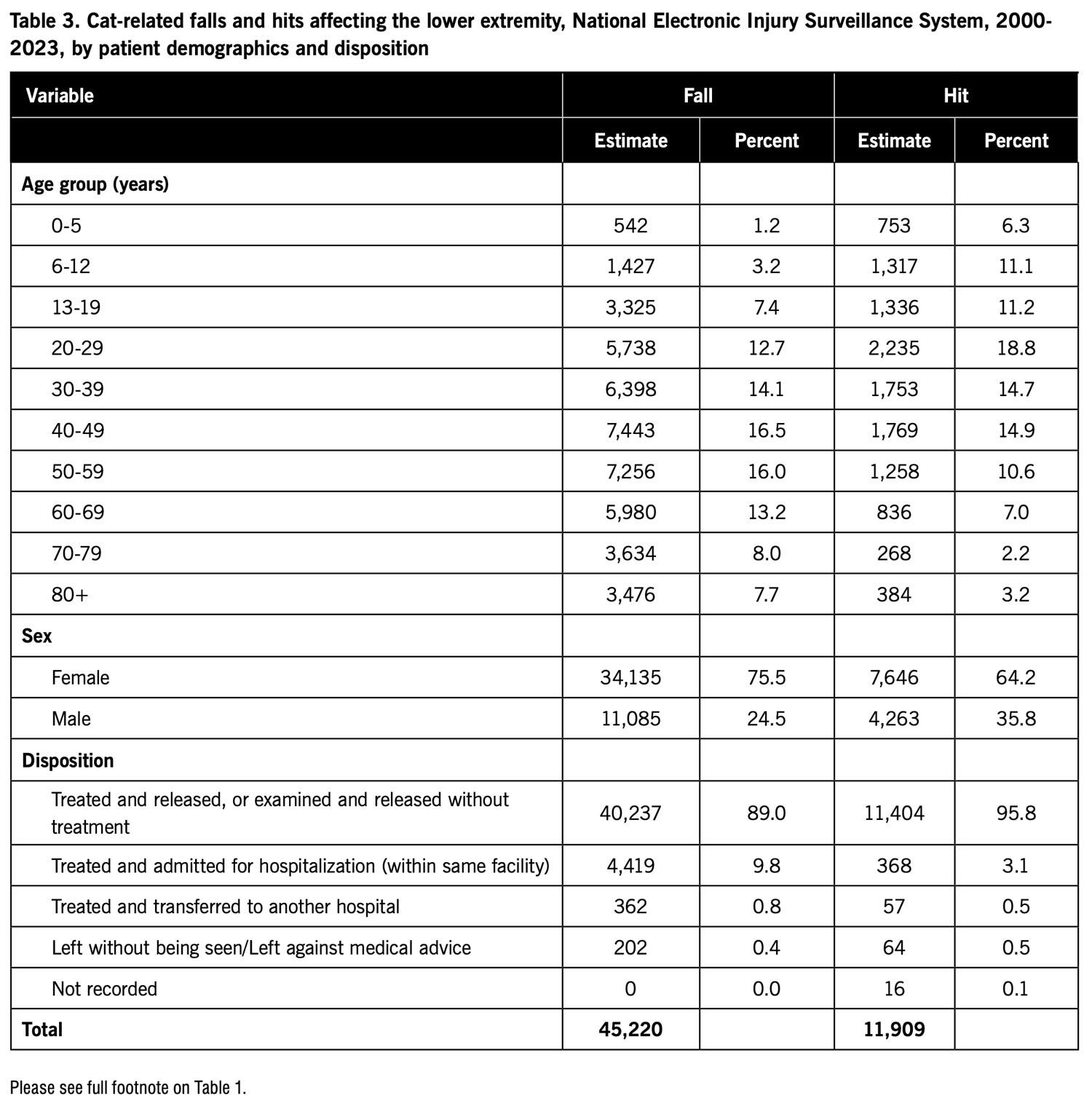 Patients with cat-related falls affecting the lower extremity tended to be older, with patients age 60 years or older comprising 29% of cat-related falls but only 12% of cat-related hits. Moreover, although the majority of patients with both cat-related falls and hits were female, this proportion was higher for falls than for hits. Age is one of the key risk factors for falls. Older adults have the greatest risk of serious injury or death relating to falls, and the risk increases with age.11,12 Furthermore, ED visits related to falls are more common in children younger than 5 years of age and adults age 65 years or older.13 Females also are at greater risk of falls than males.11,12 Similar information is not readily available on hits.
While most patients of cat-related falls and hits affecting the lower extremity were treated or examined and released from the ED, this proportion was greater for hits than for falls. In addition, a higher proportion of patients with cat-related falls than with hits (11% vs 4%) were treated and admitted for hospitalization (within same facility) or treated and transferred to another hospital. This is probably related to differences in the patterns of patients and injuries observed between falls and hits. Older patients and those with more serious injuries may be more likely to require hospital management beyond the ED.
A previous study published in Lower Extremity Review examined dog-related falls affecting the lower extremity.14 The dog-related falls were similar to cat-related falls in many respects. Cat-related falls affecting the lower extremity accounted for 19.3% of total cat-related falls; dog-related falls affecting the lower extremity accounted for 20.5% of total dog-related falls. For both cat-related and dog-related falls, the estimated number of injuries increased during 2000-2023, the highest proportion of injuries occurred during July-September, approximately one-quarter of the patients were age 60 years or older and three-quarters were female, and most of the incidents occurred at home. With respect to disposition, the majority of cat-related and dog-related fall patients were treated or examined at the ED and released (89.0% and 89.5%, respectively) although approximately 10% of the patients (10.6% and 9.6%, respectively) were treated and admitted for hospitalization (within same facility) or treated and transferred to another hospital. The most common types of injury with cat-related and dog-related falls were strain or sprain (30.6% and 33.1%, respectively), followed by fracture (29.8% and 28.8%, respectively), contusion or abrasion (20.7% and 19.1%, respectively), and laceration (6.8% and 5.5%, respectively). The only difference between cat-related and dog-related falls was the distribution of affected body parts. For cat-related falls, the most affected body part was the ankle (28.2%) followed by the knee (25.8%). For dog-related falls, the most affected body part was the knee (33.3%) followed by the ankle (29.3%).
There are ways to reduce the risk of cat-related falls and hits affecting the lower extremity. Prevention activities include increasing public awareness about situations that can lead to such falls and hits. Such prevention activities should take into account the differences between cat-related falls and hits.
There are limitations to this study. The data source was NEISS. NEISS primarily collects data on consumer product- and activity-related injuries treated at US hospital EDs. Therefore, only those cat-related falls and hits affecting the lower extremity considered to be related to consumer products or activities would be included in the study, a subset of all cat-related falls and hits affecting the lower extremity. However, the general pattern of cat-related falls affecting the lower extremity found in the present study was similar to the pattern of cat-related falls found in a study that used data from the NEISS-AIP database, which is not limited to consumer product and activity-related injuries.4
Another limitation was that cat-related falls and hits were first identified by searching the record Narrative field for specific letter groups and spaces or punctuation. If the Narrative field for a record of a cat-related fall or hit injury did not include any of these, it would not be included in the study. Also, further selection of records to be included in the study and the sorting of them into the various activities resulting in injury was performed by a single person and was based on the Narrative field, which contains a limited amount of information that at times was difficult to interpret. Errors in the selection and classification of records may have resulted in records being included or excluded erroneously or misclassified. Finally, only those cat-related falls and hits affecting the lower extremity treated at hospital EDs were included in the study. The number of such injuries not seen at EDs is unknown.
In conclusion, the estimated number of cat-related falls and hits affecting the lower extremity and treated at US hospital EDs has increased over the last 24 years. There were numerous differences in the pattern of cat-related falls and hits, which should be taken into consideration in prevention activities.
Mathias B. Forrester, BS, is an independent researcher in Austin, Texas. Now retired, he previously performed public health research for various university and government programs for 38 years.
- Megna M. Pet ownership statistics 2024. Forbes.com. January 25, 2024. Available at https://www.forbes.com/advisor/pet-insurance/pet-ownership-statistics/. Accessed July 27, 2024.
- Hareza D, Langley R, Haskell MG, King K. National estimates of noncanine bite and sting injuries treated in US hospital emergency departments, 2011-2015. South Med J. 2020;113(5):232-239.
- Langley R, Mack K, Haileyesus T, Proescholdbell S, Annest JL. National estimates of noncanine bite and sting injuries treated in US Hospital Emergency Departments, 2001-2010. Wilderness Environ Med. 2014;25(1):14-23.
- Stevens JA, Teh SL, Haileyesus T. Dogs and cats as environmental fall hazards. J Safety Res. 2010;41(1):69-73.
- Forrester MB. Pickleball-related injuries involving the lower extremity treated in emergency departments. Lower Extremity Review. 2021;13(5):24-30.
- United States Consumer Product Safety Commission. National Electronic Injury Surveillance System (NEISS). Available at https://www.cpsc.gov/Research–Statistics/NEISS-Injury-Data/Explanation-Of-NEISS-Estimates-Obtained-Through-The-CPSC-Website. Accessed May 16, 2024.
- United States Consumer Product Safety Commission. NEISS Coding Manual. January 2021. Available at https://www.cpsc.gov/s3fs-public/January-2021-NT-CPSC-only-NEISS-Coding-Manual.pdf?xa_nMM1kB4SGpuSMOwf0NHkkkIqNcn8F. Accessed May 16, 2024.
- Forrester MB. Dog bites of the lower extremity treated at hospital emergency departments. Lower Extremity Review. 2022;14(9):47-55.
- American Veterinary Medical Association. AVMA Pet Ownership and Demographics Sourcebook. 2017-2018 Edition. American Veterinary Medical Association; Schamburg, Illinois, 2018.
- Shahbandeh M. Number of cats in the United States from 2000 to 2017. statista. January 12, 2024. Available at https://www.statista.com/statistics/198102/cats-in-the-united-states-since-2000/. Accessed July 31, 2024.
- World Health Organization. Falls. April 26, 2021. Available at https://www.who.int/news-room/fact-sheets/detail/falls. Accessed July 28, 2024.
- Bergan G, Stevens MR, Burns ER. Falls and fall injuries among adults aged >65 years – United States, 2014. MMWR Morb Mortal Wkly Rep. 2016;65(37):993-998.
- Fuller GF. Falls in the elderly. Am Family Physician. 2000;61(7):3173-2174.
- Forrester MB. Dog-related falls affecting the lower extremity treated at United States hospital emergency departments. Lower Extremity Review 2024;16(6):22-29.