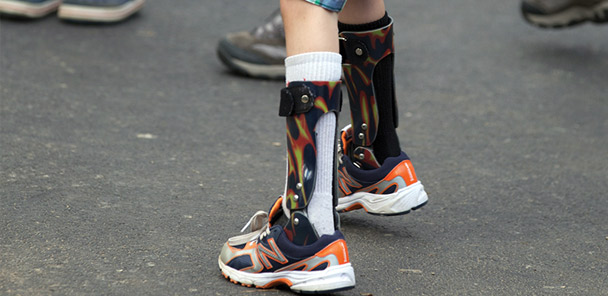
Allard USA’s TeamUP—the first national team of people with foot drop—took part in its inaugural event in April at the BB&T Gate City Half Marathon and 8K in Greensboro, NC. Allard USA, headquartered in Rockaway, NJ, formed the eight-person team of brace-wearing...
Lower Extremity Review
Hanger continues support of First Clinics
Hanger Clinic has signed on as a 2013 Bronze-level sponsor of the Orthotic & Prosthetic Activities Foundation (OPAF), the foundation announced in April. OPAF noted this sponsorship carries on a long tradition of support by Hanger since OPAF’s inception in 1995....
Loose links Cortical data distinguish unstable ankles
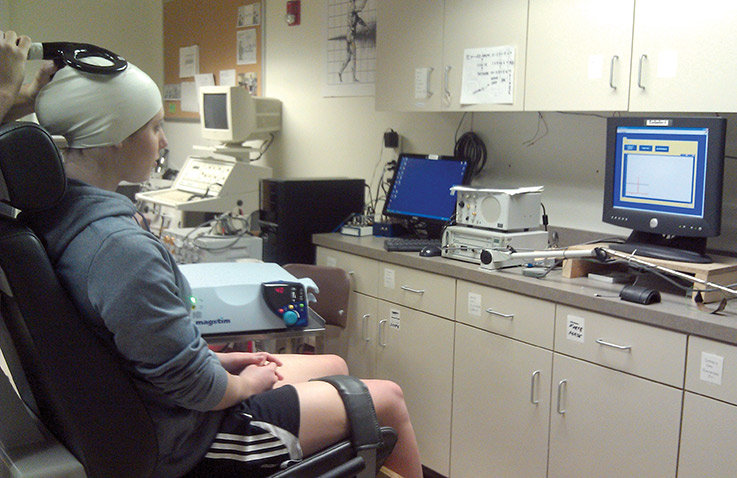
A small study points to a “decoupling” effect between neurological and mechanical aspects of the ankle joint among some people with recurrent sprains and resultant functional ankle instability (FAI), reported investigators in a Journal of Sport Rehabilitation paper e-published on April 9.
Barefoot running with nonrearfoot strike pattern may put Achilles at risk
Women who run barefoot with a midfoot or forefoot strike pattern have higher Achilles tendon (AT) loads—and, potentially, a higher risk of tendinopathy—than rearfoot strikers, according to research e-published May 3 in the Annals of Biomedical Engineering.
Study links concussion to increased incidence of lower extremity injury
College athletes who sustain a concussion are almost four times as likely as their counterparts who avoid the brain injury to subsequently injure lower extremity muscles, according to research presented at the 2013 American Medical Society for Sports Medicine conference held in April in San Diego.
Benefits of bracing: Studies find improvement in pain, gait
Studies presented at the 2013 World Congress on Osteoarthritis, held in April in Philadelphia, provide more evidence that knee bracing can improve pain and gait mechanics in patients with knee osteoarthritis (OA)—improvements that are magnified with increased wear time.
Nonoperated knee remains vulnerable after unilateral total joint arthroplasty
Unilateral total knee arthroplasty (TKA) does not reduce loading in the nonoperated knee, and the resulting asymmetry may help explain why many patients end up undergoing TKA in the contralateral knee within 10 years of the initial procedure, according to an Israeli study presented at the 2013 World Congress on Osteoarthritis.
Medial meniscal damage corresponds to decreased proprioceptive accuracy
Severity of meniscal abnormality in patients with knee OA is significantly associated with severity of proprioceptive impairment, according to research from the Netherlands presented at the 2013 World Congress on Osteoarthritis.
Adding exercise to diet improves pain, function in overweight knee OA patients
Adding exercise to a dietary program does not significantly increase weight loss or reduce loading in overweight patients with knee osteoarthritis (OA) compared to diet alone, but the addition of exercise is associated with significant improvements in pain and function, according to preliminary results of a large 18-month trial presented in April at the 2013 World Congress on Osteoarthritis.
Out on a limb: Yes, treat the symptoms
In the healthcare community there’s a lot of talk about the importance of treating the underlying cause of a disease rather than just the symptoms. But sometimes treating the symptoms can be pretty darned important too.
Jordana Bieze Foster, Editor
Medial shin pain in runners: Evidence for orthosis use
Studies of the kinematic variables associated with medial tibial stress syndrome suggest possible targets for prevention and intervention, including the use of foot orthoses.
By Janice K. Loudon, PT, PhD, SCS, ATC, and Michael P. Reiman, PT, DPT, OCS, SCS, ATC, FAAOMPT, CSCS
Orthotic management of Charcot-Marie-Tooth
Ankle foot orthoses can help compensate for muscle weakness and accommodate related structural deformities in patients with Charcot-Marie-Tooth disease, but practitioners are constantly looking for ways to improve suboptimal compliance rates.
By Cary Groner
Diabetes and altered gait: The role of neuropathy
Researchers have identified gait alterations in patients with diabetic peripheral neuropathy but also in diabetic patients with normal sensation, raising questions about the extent to which factors other than neuropathy might also be affecting gait.
By Cary Groner
Concussion assessment: Neuromuscular concerns
Balance testing is already recommended for concussion assessment in athletes, but research suggests the connections between concussion and neuromuscular variables are even more complex, and the opportunities for intervention more numerous.
By Brent Harper, PT, DPT, DSc, OCS, FAAOMPT
Artificial surfaces evolve, but safety debate persists
Artificial turf technology has advanced significantly, and some research suggests newer surfaces are as safe as grass, if not safer. But in other reports, including a high-profile NFL study, turf has been associated with higher rates of lower extremity injury.
By P.K. Daniel
Join
Subscribe For Updates
Stay in the loop with the latest news and updates! Subscribe now to receive exclusive content, special offers, and important announcements straight to your inbox. Don’t miss out – join our community today for all the latest updates delivered directly to you.