 By Adéla Andrýsková and Jung-Hoon Lee
The growing use of kinesiology tape requires guidelines for safe and effective application.
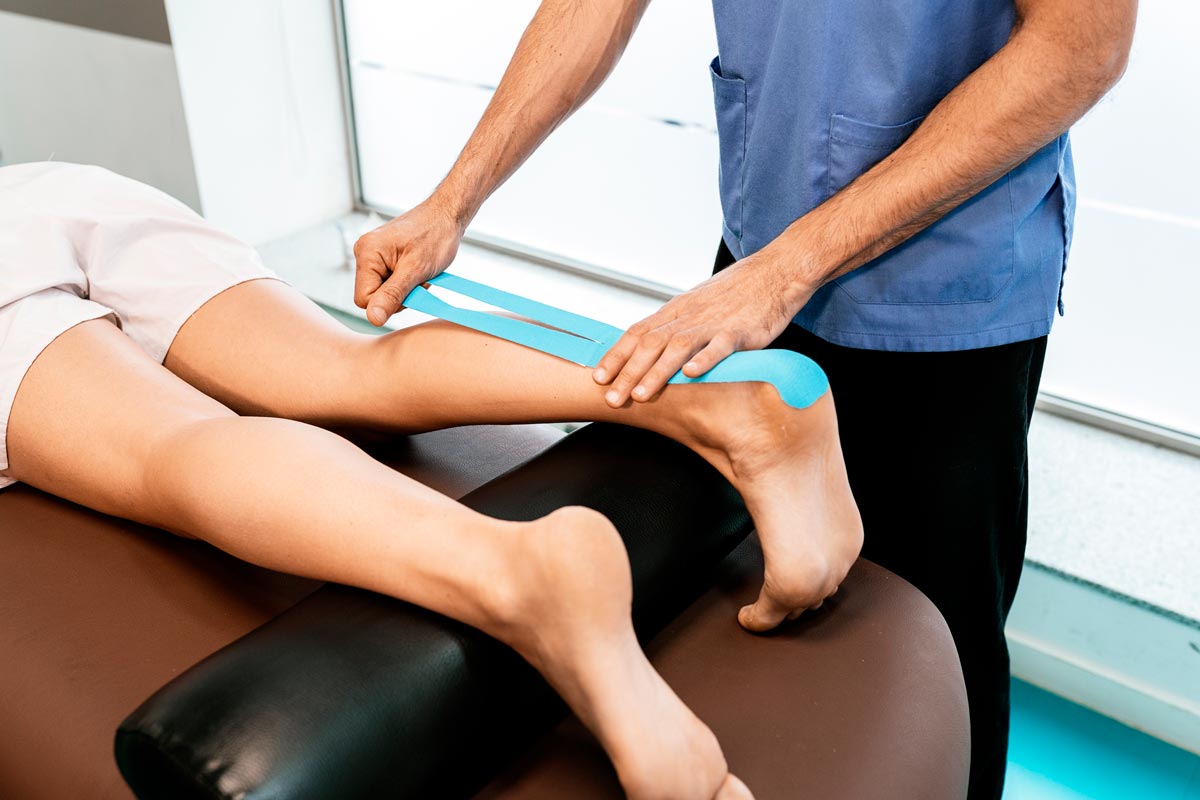
The popularity of kinesiology tape (KT) across the world is rising as witnessed by its common appearance on athlete’s bodies during the Olympic games or football leagues over the last decade. Therefore, the results of the application of KT will be important to sports physiotherapists, trainers, and sports medicine physicians. Originally developed and used for the treatment of injuries, joint stabilization, and pain reduction, nowadays, this elastic cotton fabric tape is particularly valued for its injury prevention and performance enhancement properties. Kinesiology taping, in comparison to many other treatments, is simple, affordable, not invasive, does not cause pain, and requires a relatively small amount of time for application.
While some recent studies have questioned its effectiveness, it is important to note that several techniques of kinesiology taping exist and the application of KT for certain pain, injury prevention, performance enhancement, etc., can differ significantly depending on each technique. Nevertheless, a basic set of rules for the application of KT to prevent any undesired side-effects should be strictly followed when using any techniques.
Avoid Skin Irritation
The most fundamental rule is that the skin of the taping subject must be clean, without any dirt, oils, or sweat. Also, longer body hairs, which could hinder proper adhesion, must be shaved prior to taping. Besides these well-known principles, there is another particularly important rule of kinesiology taping that is either unknown or not respected: keeping the tape on for a maximum of 24 hours. Subjects should never wear KT for more than a day. There are several reasons for this limitation: Skin troubles are the most frequent problems. This does not solely mean allergic reactions that can be provoked by the glue, which adheres the fabric to the skin. Skin problems may arise particularly due to perspiration, which is part of everyday activities. If KT contaminated by sweat is worn for more than a day, it may cause skin irritation. It is also recommended to remove the tape immediately after showering as the wet tape can provoke undesirable skin effects. If undesirable side-effects (as itchiness, skin irritation, etc.) appear, the successive application of kinesiology tape is impossible, and treatment must be ceased. Thus, increased attention needs to be paid to the condition of the skin. If itchiness or another undesirable effect appears, KT must be removed immediately.
Avoid Stretching – Skin and Tape
The 24-hour application rule is also recommended due to the constant movement of a subject. Where KT is applied, and the level of stretching of the tape may vary based on treatment progression. Therefore, taping techniques need to be modified day by day as the treatment continues.
Another fundamental factor is the skin’s adaptation to stimulation created by KT. To provide effective skin stimulation, it is necessary to apply new KT every day.
Not stretching the origin and insertion areas of KT is one of the basic rules of taping as well. Approximately 2–3 cm of the starting and ending points of the tape need to be applied to the skin without any stretching. Violation of this rule may cause skin problems leading to discontinuation of treatment.
Even though elasticity is a one of the biggest advantages of KT, it is not recommended to stretch the tape excessively. This principle also applies to skin stretching. The skin should not be stretched excessively before the application of tape. After the application of tape, it is necessary to assure that the tape adheres to the skin properly, but vigorous rubbing of the tape should be avoided. These recommendations are made to prevent skin irritation. For highly sensitive areas, apply hypoallergenic undertape (50 – 75 mm) to the origin and insertion areas before applying KT.
Timing
As for timing, it is essential to give at least 10 min for the body to adapt to the KT before any activity. If excessive perspiration during physical activity occurs, athletes should take a shower afterward and remove the KT when still wet.
Do not apply KT to the abdominal area immediately after food consumption; doing so may generate mild digestive troubles.
Whole Body Not Just Parts
Many practitioners focus only on the body part that needs to be fixed, but it is essential to see the body as a whole system. Segments of the human body are interconnected by the kinetic chain. Therefore, movement of one body part influences another one. In the case of athletes, physicians tend to concentrate on limbs, as those are perceived as a base for movement. However, since the core muscles serve as a stable foundation for limbs’ movement, it is necessary to stabilize the core muscles first to achieve improved limb movement. In other words, to improve the movement of distal body parts, the proximal parts must be stabilized first.
The same principle applies for chronic pain in limbs. In such a case, the physician should not concentrate only on the elevation of the pain but should find the origin of the pain, which may be located in proximal parts of the body. Otherwise, taping may be ineffective, or the pain will be relieved only temporally and reappear.
Many other factors need to be considered while choosing the appropriate taping technique to achieve desired results, but the principles described above should never be omitted. If a solid foundation of rules for taping is established and current techniques are enhanced (or substituted by new ones), treatment by KT may bring more various and effective results than is expected.
This article has been excerpted from “The Guidelines for Application of Kinesiology Tape for Prevention and Treatment of Sports Injuries.” Healthcare (Basel). 2020 May 26;8(2):144. doi: 10.3390/healthcare8020144. Editing has occurred, including the removal of references for brevity. Use is per CC 4.0 International License.