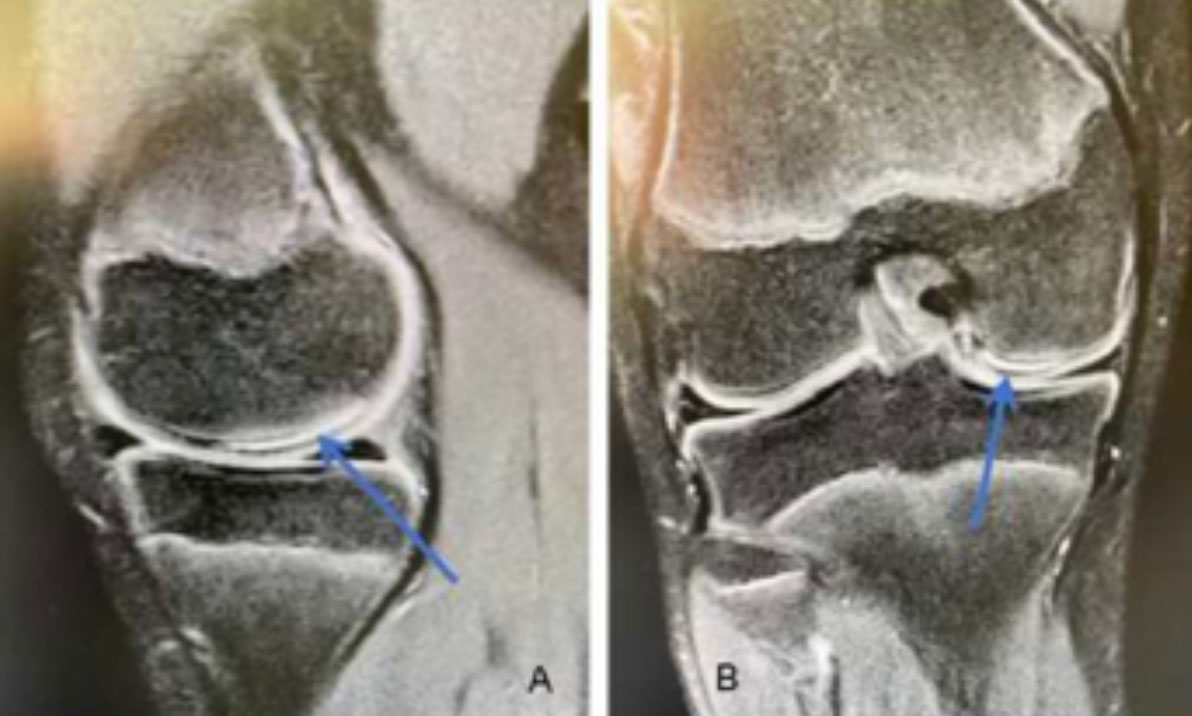








 When a cartilage surface is damaged, it often occurs via a rotational movement with a force coming from the side or as a direct force. In this type of injury, the forces affect the different layers in the cartilage so that the greatest weakness lies in the layer between the calcified cartilage and other cartilage. The damage goes deep down but usually does not expose the bone plate. A crush damage more or less destroys the various layers in the vertical direction. However, most injuries are a combination of rotation and direct vertical forces. Not so well-known but important is the damage that occurs between the calcified bone (in the calcified zone) and the bone plate. This is called chondral delamination. It is difficult to diagnose and if noticed late, a more severe chondral lesion may develop with eruption to an open lesion. The intact superficial cartilage layer will be unstable and strong shearing forces on the edges of the delamination may lead to either enlargement of the delamination or fissuring. Finally, such a delamination develops into a full thickness defect ICRS grade 3c. Many full thickness defects could have been localized chondral delaminations initially.
Patients seeking orthopedic evaluation due to joint pain, post-trauma or without traumatic history are most often examined by MRI. If nothing is found on MRI, the patients are scheduled for physiotherapy. However, if in spite of long-time training, the patient still is in pain, often the next step is an arthroscopy. Prior to an arthroscopy, one may add a scintigraphic evaluation like a pure technetium scan or a SPECT. Such a scan may show an increased uptake locally in the joint which will help the surgeon performing the arthroscopy to focus on the area of scintigraphic uptake. The incidence of chondral delamination injuries of the knee has not been reported in the literature. Already in 1985, Hopkinson et al described a group of patients presenting with meniscal symptoms who, on arthroscopic examination, had chondral fractures of the medial or lateral femoral condyle. The authors felt it was important to discuss the chondral fracture so that the orthopedic surgeon could be aware of this injury type. Since then, better diagnostics have been introduced with different MRI sequences but still chondral delaminations may be difficult to diagnose. Delamination injuries of cartilage can lead to significant morbidity if they are not treated early. This means that delay in finding such lesions may lead to early osteoarthritis and more aggressive treatments. If a patient is claiming a significant pain in certain degrees of joint flexion, suspicion of local delamination is adequate and an arthroscopy is indicated, though the MRI is negative.
Source: Brittberg M. Knee chondral delaminations and blisters. J Cartilage & Joint Preserv. 2022;2(3):100056.