







 Knee osteoarthritis (KOA) is the most prevalent form of arthritis among adults and a leading cause of disability worldwide. The condition affects hundreds of millions of individuals and represents a substantial burden on healthcare systems. Chronic knee pain is the primary symptom and frequently prompts individuals to seek medical care. However, the management of chronic osteoarthritis pain remains challenging. Conventional therapies, including pharmacologic management, rehabilitation, and lifestyle interventions, do not always provide sufficient relief. As a result, many patients experience persistent pain and functional limitations, which can ultimately lead to surgical interventions such as knee replacement. Consequently, there is increasing interest in novel therapeutic strategies aimed at improving pain management in patients with refractory KOA.
One emerging intervention is transcranial pulse stimulation (TPS), a non-invasive neuromodulation technique that uses focused ultrasound shockwave pulses to stimulate targeted regions of the brain. TPS has previously demonstrated therapeutic potential in neurological disorders, particularly Alzheimer’s disease, where it has been associated with improvements in cognitive and neuropsychiatric symptoms. Researchers have hypothesized that similar neuromodulatory mechanisms may influence brain regions involved in pain perception and regulation, potentially providing relief for patients with chronic osteoarthritis pain.
To explore this possibility, researchers conducted a prospective case series involving 8 patients with primary knee osteoarthritis who experienced persistent pain despite conventional treatment. All participants were female and ranged in age from 63 to 77 years, with a mean age of approximately 69 years. Each participant met the clinical and radiographic diagnostic criteria for KOA and reported moderate to severe pain lasting at least 3 months. The study was conducted in a tertiary rehabilitation outpatient clinic at a university hospital.
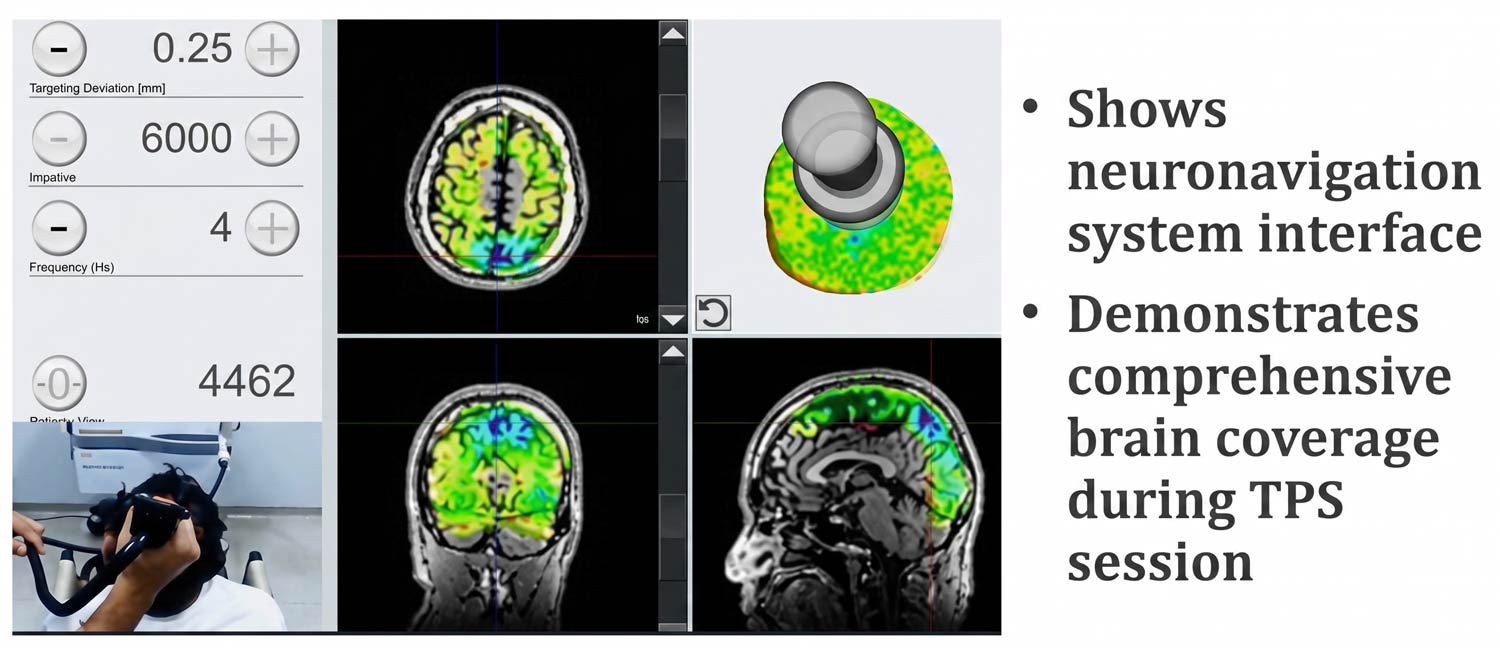
Participants underwent 6 TPS treatment sessions. During each session, ultrasound gel was applied to the scalp, and a specialized device delivered focused shockwave pulses to specific cortical regions. Targeted brain areas included the precuneus and the primary motor cortex, which are associated with pain processing and modulation. Additional stimulation was applied across broader cortical regions, including the frontal, temporal, parietal, and occipital areas, with the aim of influencing interconnected neural networks involved in pain perception. Each treatment session lasted approximately 26 minutes and delivered around 6,000 pulses.
In total, 8 female patients were evaluated for the Visual Analogue Scale score (VAS), a widely used 10-point scale in which 0 represents no pain and 10 indicates the worst possible pain before and after therapy. The mean initial (before therapy) VAS score for the right knee was 6.4 (± 2.5) across the patients, and that score reduced to an average of 1.1 (± 1.6) by the end of the therapy. Similarly, the average for the left knee reduced from 7.2 (± 1.4) to 1.4 (± 1.8). Pain scores were recorded before the first treatment session and again after completion of the final session. This resulted in an average reduction in pain of 5.3 points for the right knee and of 5.8 points for the left knee. All patients improved their scores. Proper adherence and tolerance to the transcranial pulse stimulation protocol was observed, with no severe side effects. All participants experienced improvement in their pain scores, and statistical analysis confirmed that these reductions were significant.
Transcranial pulse stimulation was delivered in 6 sessions per participant, diagnosed with knee osteoarthritis using the American College of Rheumatology and the Kellgren-Lawrence radiographic grading criteria, with a nominal weekly interval but an adaptive schedule that accommodated individual and logistical constraints.
TPS was generally well tolerated by the participants. No serious adverse events were reported during the treatment course. One patient reported a mild, transient headache during a session, which resolved without intervention. Overall, the treatment demonstrated a favorable safety profile in this small cohort.
Several mechanisms may explain the potential analgesic effects of TPS. Mechanical stimulation produced by ultrasound shockwaves can trigger cellular responses through mechanotransduction, a process in which mechanical forces activate biochemical signaling pathways. These responses may promote the release of neurotrophic factors that support neuronal survival, growth, and synaptic plasticity. Additionally, TPS may influence inflammatory pathways and enhance communication between brain regions involved in pain modulation, potentially contributing to reduced pain perception.
Despite these promising findings, several limitations should be acknowledged. The study involved a small sample size and lacked a control group, limiting the ability to draw definitive conclusions regarding treatment efficacy. Furthermore, long-term follow-up data were not available, making it difficult to determine the durability of the observed improvements. Future research should include larger randomized controlled trials and extended follow-up periods to better evaluate the long-term therapeutic potential of TPS for KOA.
In summary, this preliminary investigation suggests that transcranial pulse stimulation may represent a promising neuromodulation approach for patients with chronic knee osteoarthritis who do not respond adequately to conventional therapies. The significant reduction in pain observed after a relatively short treatment course highlights the potential of TPS as an adjunctive intervention within comprehensive rehabilitation strategies aimed at improving patient outcomes and quality of life.
Source: Imamura M, Shinzato GT, Yoshioka LH, et al. A novel application of transcranial pulse stimulation in rehabilitation: pain management in refractory knee osteoarthritisa case series. J Rehabil Med. 2025 Sep 23;57:jrm42403. doi: 10.2340/jrm.v57.42403.