







 By Mathias B. Forrester, BS
Background: Millions of families in the United States (US) own dogs, and with these dogs comes an assortment of dog items (gates, beds, toys, etc.). Tens of thousands of falls associated with dogs are treated at US hospital emergency departments (EDs) each year, a portion of which involve dog items. The objective of this study is to describe dog-item-related falls affecting the lower extremity treated at US hospital EDs.
Methods: Dog-item-related falls affecting the lower extremity during 2000–2023 were identified using the National Electronic Injury Surveillance System (NEISS), a database of consumer product- and activity-related injuries treated at a representative sample of US hospital EDs. Cases reported to the NEISS can be used to calculate national injury estimates. The distribution of dog-item-related falls affecting the lower extremity was determined for patient demographics, injury circumstances, and management.
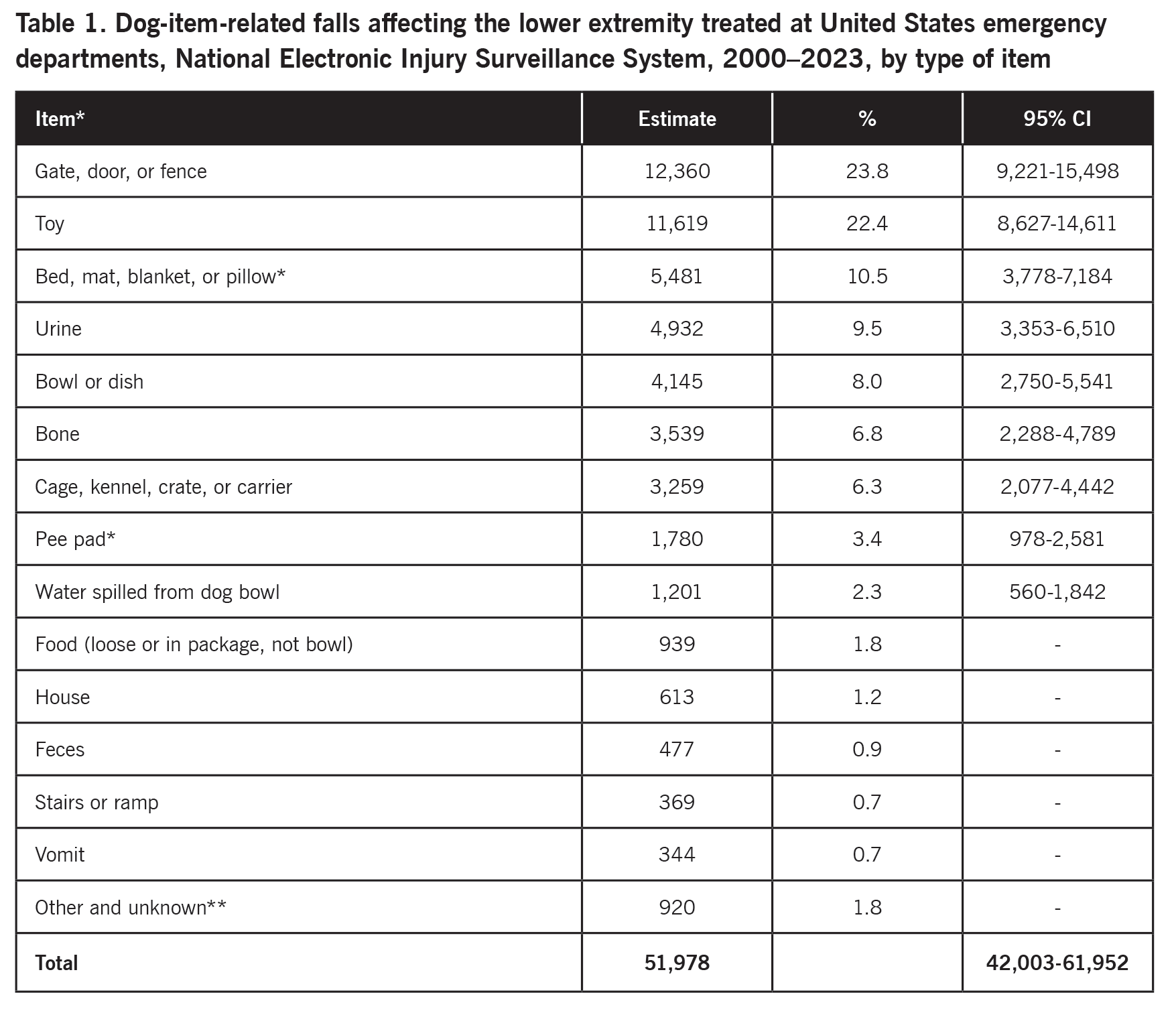
Results: Of an estimated 175,451 total dog-item-related falls treated at US hospital EDs during 2000–2023, 51,978 (29.6%) affected the lower extremity. The specific item was 23.8% gate, door, or fence; 22.4% toy; 10.5% bed, mat, blanket, or pillow; 9.5% urine; 8.0% bowl or dish; and 25.9% other and unknown. The patients were 76.9% female, and 31.4% were aged 60 years or older. Strain or sprain was reported in 34.2% of the estimated falls, followed by fracture (30.9%), contusion or abrasion (15.0%), laceration (4.8%), and other or not stated (15.2%). The patient was treated or evaluated and released in 88.5% of the estimated injuries.
Conclusion: The dog items involved in almost 75% of falls affecting the lower extremity were gate, door, or fence; toy; bed, mat, blanket, or pillow; urine; and bowl or dish. Over three-quarters of the patients were female, and over 30% of patients were aged 60 years or older. The most frequently reported injuries were strain or sprain, fracture, and contusion or abrasion. Most patients were treated or evaluated at the ED and released. The information in this study may assist healthcare providers and others to identify those individuals most at risk for dog-item-related falls affecting the lower extremity and creating plans to manage and prevent these injuries.
According to the 2025 American Pet Products Association (APPA) National Pet Owners Survey, 68 million United States (US) households owned a dog,1 although dog ownership declined from 54% in 2020 to 44% in 2024.2 With dogs comes an assortment of related items, such as gates or fences, beds, toys, cages or kennels, food, and dishes, as well as urine and feces.
Tens of thousands of falls associated with dogs are treated at US hospital emergency departments (EDs) each year. According to one study, 9% of all dog-related falls involved a pet item.3
The objective of this study is to describe dog-item-related falls affecting the lower extremity treated at US hospital EDs.
Methods
*If record Narrative mentions pad but not pee pad, it is included in the Bed, mat, blanket, or pillow category.
**Includes tie or anchor for dog leash, hair, saliva, exercise equipment, fluid from birth, grooming device, medication, urine and feces combined, bath, tunnel.
Estimate = Weighted estimate (sum of the Weight numeric field in the National Electronic Injury Surveillance System database). The numbers in the Weight field are not whole numbers but include decimals. As a result of rounding to whole numbers when performing analyses, the sum of the estimates for a given variable might not equal the total. The Consumer Product Safety Commission considers an estimate unstable and potentially unreliable when the number of records used is <20 or the estimate is <1,200.
95% CI = 95% confidence interval. Not calculated if the estimate is <1,200.
The data source for this descriptive epidemiologic study was the National Electronic Injury Surveillance System (NEISS), available at: https://www.cpsc.gov/cgibin/NEISSQuery/home.aspx. The NEISS database has been described in detail in Lower Extremity Review previously.4 To summarize, operated by the US Consumer Product Safety Commission (CPSC), NEISS is a database of consumer product- and activity-related injuries collected from a representative sample of approximately 100 US hospital EDs. National estimates are calculated from database records according to the sample weight assigned to each case based on the inverse probability of the hospital being selected for the NEISS sample.5,6 Since the data are publicly available and de-identified, the study is exempt from institutional review board approval. The NEISS database has been used for previous dog-item-related injury investigations,4,7-10 including a previous study published in Lower Extremity Review that examined dog-related falls affecting the lower extremity.11 However, this previous study did not include dog-item-related injuries, except for leashes. The present study includes the dog-item-related injuries excluded from the previous study.
Cases were dog-item-related falls affecting the lower extremity reported to the NEISS database during 2000–2023. The NEISS database includes 3 numeric fields for coding the product or activity involved in the injury. The database has a product code field 1715 (Pet supplies). However, preliminary analysis indicated that this product code was not used in almost one-quarter of potential cases. Moreover, the code does not distinguish between dog supplies and supplies for other pets nor does it indicate the specific type of pet supply. Instead, the Narrative text field (a text field that provides a summary of the circumstances and type of injury) was used to identify cases in a manner like that used in the previous dog-related fall article.11
The identification of cases was performed in stages. First, to identify as many dog-item-related injuries as possible, the NEISS database was searched for all records that included the following letter groups in the Narrative field:
“dog,” or “pup,” or “airdale,” or “Akita,” or “Malamute,” or “shep,” or “hound,” or “beagle,” or “terrier,” or “collie,” or “doodle,” or “poodle,” or “boxer,” or “spaniel,” or “mastiff,” or “Corso,” or “chihuahua,” or “corgi,” or “dachshund,” or “dalmatian ,” or “dober,” or “labrador,” or “retriever,” or “dane,” or “Pyrenees,” or “husky,” or “ setter,” or “Maltese,” or “schnauzer,” or “dalmatian,” or “Pomeranian,” or “pug,” or “rottw,” or “rotw,” or “Bernard,” or “shar p,” or “sharpie,” or “shih,” or “tzu,” or “weim,” or “whippet,” or “pitbull,” or “pit bull”
These letter groups were used because the dog might have been identified solely as a puppy or by breed. The letter groups were included in the names of some of the more common dog breeds and are not considered to be comprehensive.
Second, to identify as many falls as possible, this subset of records was searched for all records that included the following letter groups in the Narrative field:
“fall,” or “fell,” or “trip,” or “slip,” or “knoc,” or “nock,” or “down,” or “push,” or “pull,” or “foos,” or “T’D&F,” or “TD&F,” or “S’D&F,” or “SD&F,” or “bump,” or “ran into,” or “run into,” or “stumb,” or “jump,” or “land,” or “crash,” or “collid,” or “collis”
Third, the Narrative fields of the resulting second subset of records were individually reviewed to determine whether they appeared to represent dog-item-related falls. If so, the specific dog item was noted. Items used for or by the dog as well as items produced by the dog, such as urine, feces, and vomit, were classified as dog items. Records were included if the Narrative indicated a trip or slip even if a fall was not explicitly stated. In addition, records were included if the person fell into or onto something other than the ground (eg, wall, stairs, furniture). Records were excluded if the dog item was a leash, because injuries involving a leash were included in the previous dog-related fall study.11
 Finally, dog-item-related falls affecting the lower extremity were identified. The NEISS database contains 2 numeric fields for coding the affected body part (Body_Part and Body_Part_2) and 2 numeric fields for coding the type of injury or diagnosis (Diagnosis and Diagnosis_2). The Body_Part_2 and Diagnosis_2 fields were added in 2018, although they do not appear to have been used until 2019.6 For consistency over the entire study period, the Body_Part and Diagnosis fields alone was examined for the analysis. Only those records where the Body_Part field contained codes for a part of the lower extremity (upper leg, knee, lower leg, ankle, foot, toe) were included in the study.
The variables examined were dog item, treatment year and month, location where the incident occurred, patient age and sex, type of injury (diagnosis), affected body part, and disposition. Analyses were performed using Microsoft 365 Access and Excel (Microsoft Corporation, Redmond, Washington, US). National injury estimates were calculated by summing the values in the Weight numeric field in the publicly available NEISS database. The 95% confidence intervals (CIs) were calculated for the estimates. The distribution of estimated injuries was calculated for each variable. The CPSC considers an estimate unstable and potentially unreliable when the estimate is <1,200.5 For those variable subgroups where the estimate was <1,200, 95% CIs were not calculated.
Results
Please see full footnote on Table 1.
A total of 1,132 dog-item-related falls affecting the lower extremity were identified, resulting in a national estimate of 51,978 dog-item-related falls affecting the lower extremity. These represented 29.6% of the estimated 175,451 dog-item-related falls affecting all body parts. In comparison, the previous study of dog-related falls found an estimated 335,446 falls affecting the lower extremity.11 Thus, if the estimated dog-related and dog-item-related falls affecting the lower extremity were combined, dog-item-related falls would account for 15.5% of the estimated total.
Table 1 shows the distribution of dog-item-related falls affecting the lower extremity by type of item. The most frequently reported items were gate, door, or fence; toy; bed, mat, blanket, or pillow; urine; and bowl or dish. Together, these 5 groups accounted for 74.1% of all dog-item-related falls affecting the lower extremity.
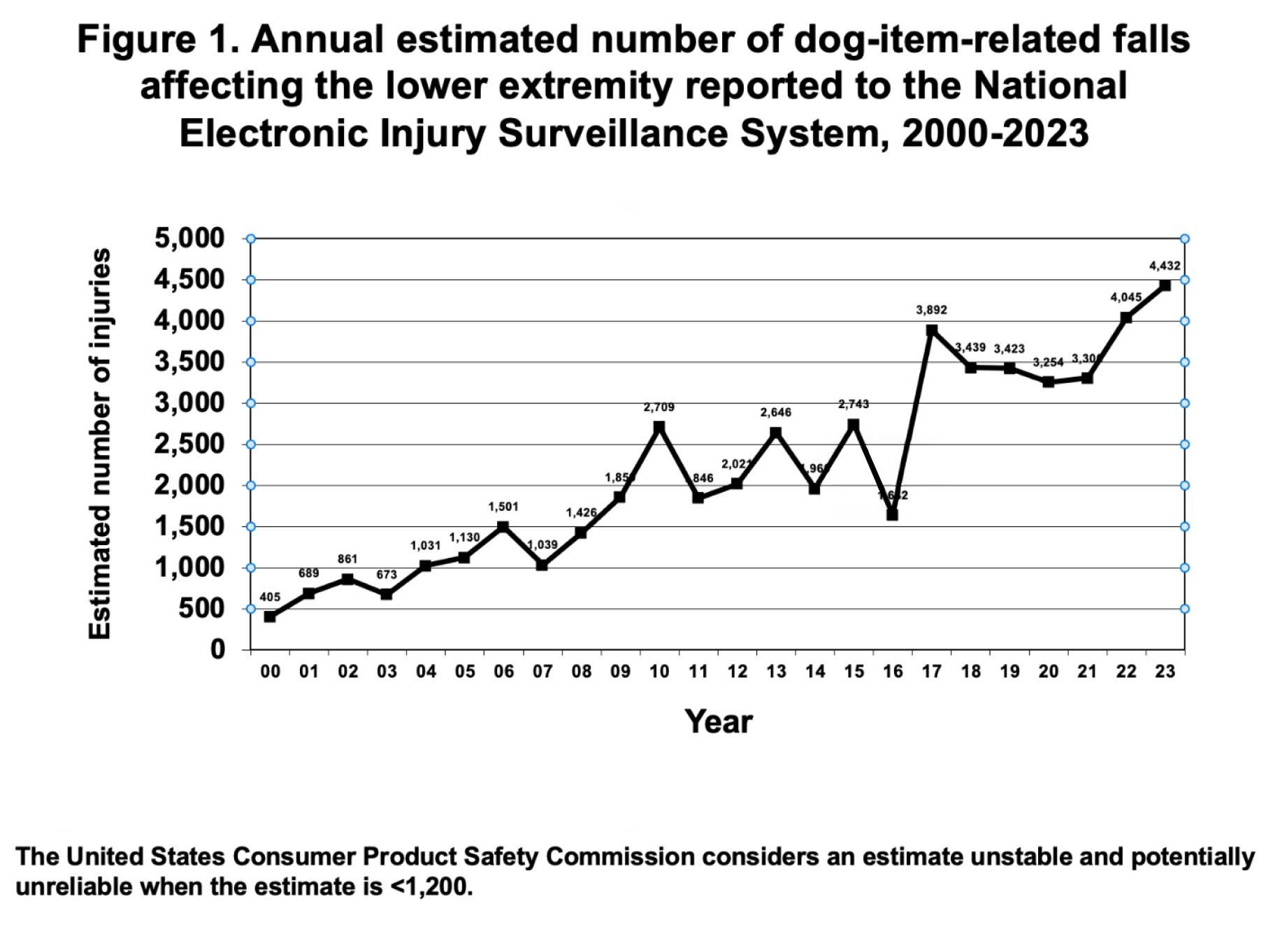
Although the annual estimated number of dog-item-related falls affecting the lower extremity varied from year to year, the general trend was an increase over the 24-year period (Figure 1). The estimated number of dog-item-related falls affecting the lower extremity in 2023 was 11 times that in 2000. The seasonal distribution of dog-item-related falls affecting the lower extremity was 11,249 (21.6%) in January–March, 13,555 (26.1%) in April–June, 13,218 (25.4%) in July–September, and 13,955 (26.8%) in October–December.
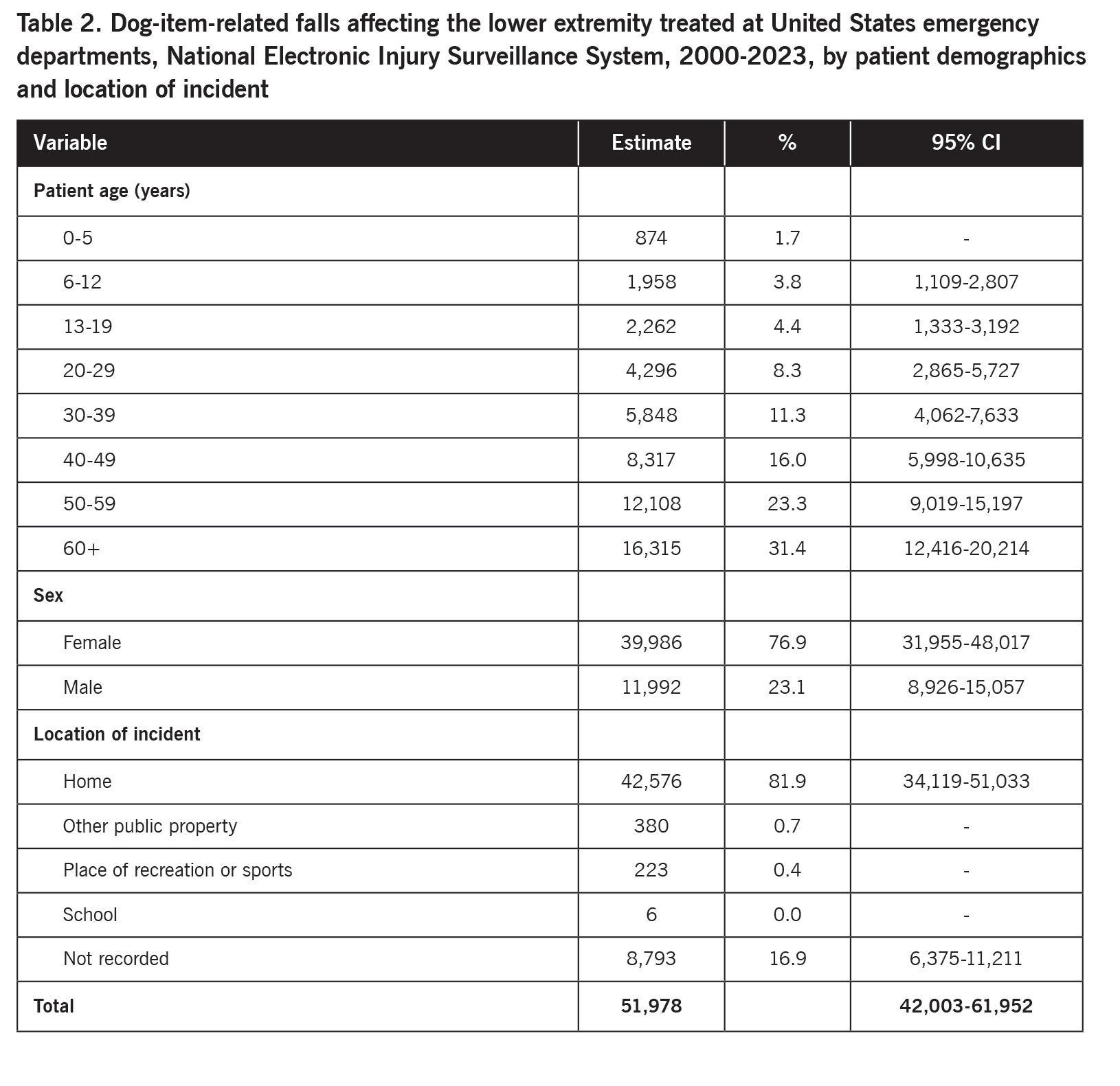
Table 2 presents the estimated number of dog-item-related falls affecting the lower extremity by patient demographics and location of the incident. The estimated number of falls increased with older age groups with 31.4% occurring in patients 60 years and older. Most of the patients were female. The majority of falls occurred at home.
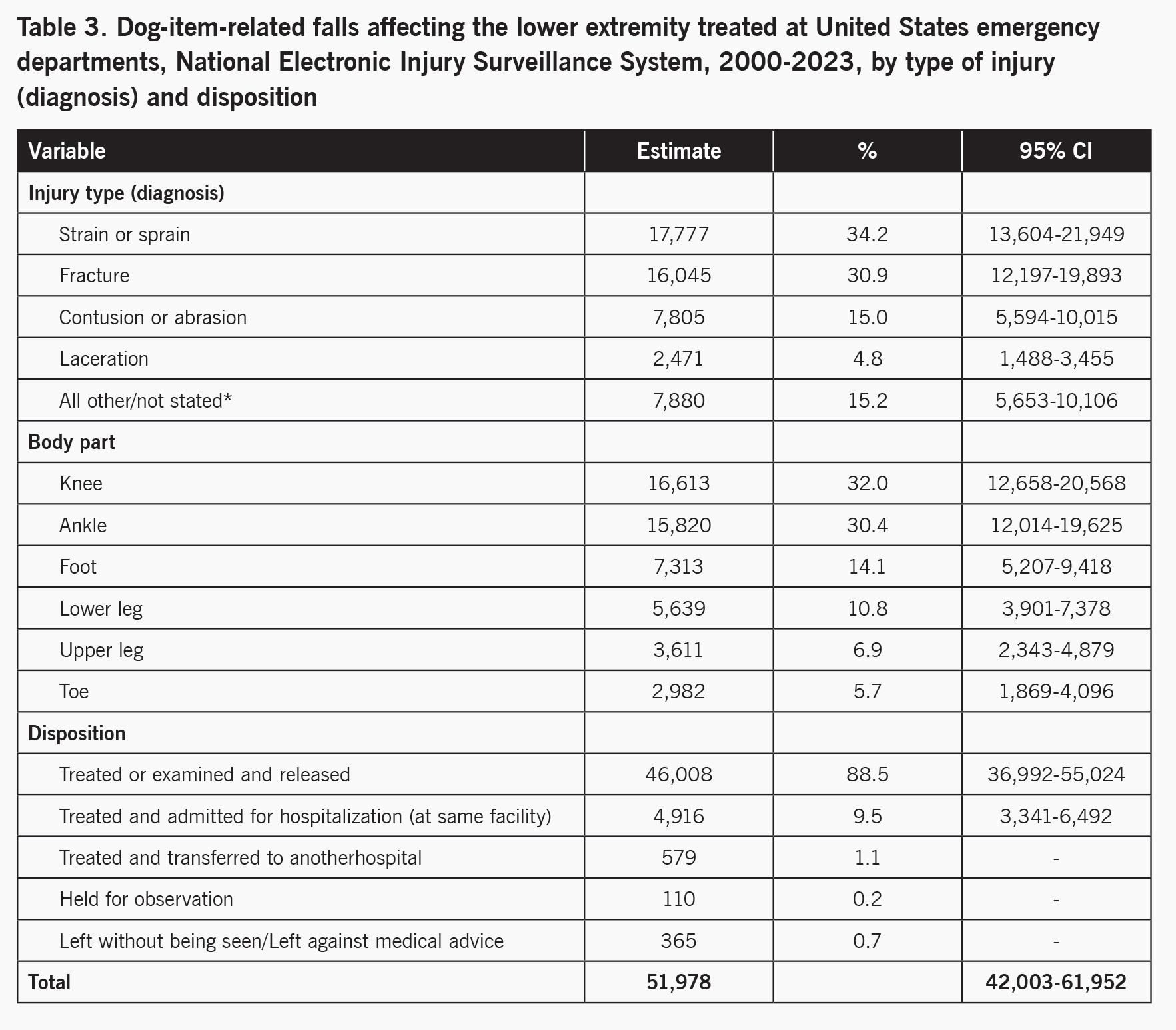
Table 3 shows the estimated number of dog item-related falls affecting the lower extremity by injury type (diagnosis) and disposition. The most frequently reported injuries were strain or sprain, fracture, contusion or abrasion, and laceration. The most commonly affected body part was the knee followed by the ankle and foot. Most patients were treated or evaluated at the ED and released; however, over 10% were treated and admitted for hospitalization at the same hospital or treated and transferred to another hospital.
Discussion
*Includes crushing, dislocation, hematoma, nerve damage, puncture, avulsion. Please see full footnote on Table 1.
Dog-item-related falls affecting the lower extremity account for roughly 16% of all dog- and dog-item-related falls affecting the lower extremity.11 Nevertheless, such dog-item-related falls affecting the lower extremity result in hundreds to thousands of US hospital ED visits each year.
Moreover, the number of US hospital ED visits due to dog-item-related falls affecting the lower extremity is growing; this study found that the estimated annual number of these falls has increased by more than an order of magnitude between 2000 and 2023. The previous study of dog-related falls affecting the lower extremity likewise observed an increase in US hospital ED visits.11 Additional studies found increases in dog leash-related injuries, including those affecting the lower extremity, leash-dependent dog walking-related injuries, and fractures in elderly adults while walking leashed dogs.4,8,9,12 The increase in injuries may be due to an increase in dog ownership in the US. The estimated number of pet dogs increased from 72.1 million in 2006 to 76.8 million in 2016.13 However, this 7% increase in dogs between 2006 and 2016 is much smaller than the observed increase in dog-item-related falls affecting the lower extremity. Furthermore, the percent of US dog ownership has declined between 2020 and 2024.2 It may be that the number of dog items per household with a dog has increased or people are becoming more likely to experience dog-item-related falls that result in a US hospital ED visit.
Although a variety of items were involved in dog-item-related falls affecting the lower extremity, all items were not equally likely to result in falls. Two of the categories–gate, door, or fence and toy–accounted for 46% of the estimated injuries, and 5 types of items–gate, door, or fence; toy; bed, mat, blanket, or pillow; urine; and bowl or dish–accounted for almost three-quarters of the estimated injuries. Healthcare providers and other organizations may want to focus injury prevention activities on these types of items.
Dog-item-related falls affecting the lower extremity increased with patient age, with over 30% of the falls involving patients aged 60 years or older. Over three-quarters of the patients were female. This demographic pattern was like that found for dog-related falls affecting the lower extremity.11 Moreover, a prior study of dog-related falls reported 68% of the patients to be female and 24% aged 65 years or older,3 and other studies of dog-leash related injuries also observed the majority of patients to be female and 15–32% aged 60 years or older.4,8,9,12 Females and older adults may be at particular risk of dog-item-related falls.
The most common injury type (diagnosis) in dog-item-related falls affecting the lower extremity was strain or sprain followed by fracture, contusion or abrasion, and laceration, a pattern similar to that observed for dog-related falls affecting the lower extremity.11 Most such injuries might not be expected to require extensive hospital intervention. This is consistent with the observation that 89% of the patients were treated or evaluated and released from the hospital ED. However, it should be noted that over 10% of the patients were treated and admitted within the same hospital or transferred to another hospital.
The results of this study suggests ways to reduce the risk of dog-item-related falls. Care should be taken when around dog items, particularly dog gates, doors, or fences; toys; beds, mats, blankets, or pillows; urine; and bowls or dishes. Effort should be made to train the dog to only urinate outside or in a particular place inside, such as on pee pads. If the dog urinates on the floor, it should cleaned up as soon as possible.
There are limitations to this study. NEISS collects data on consumer product- and activity-related injuries treated at US hospital EDs. Thus, dog items might be expected to meet NEISS inclusion criteria; the NEISS database even has a product code for pet supplies. In fact, the NEISS database has been used for previous dog-item-related injury investigations.4,7-10 However, certain items, such as dog urine and feces might not fit into this inclusion criteria; as such, some dog items might only be incidentally reported to NEISS.
In addition, dog-item-related falls involving injuries were first identified by searching the record Narrative field for specific letter groups. If the Narrative field for a record of a dog-item-related fall injury did not include these letter groups, it would not be included in the study. Moreover, the further selection of records to be included in the study and the sorting of them into the various dog items was performed by a single person and was based on the Narrative field, which contains a limited amount of information. Errors in the selection and classification of records may have resulted in records being included or excluded erroneously or misclassified. Finally, only those dog-item-related falls affecting the lower extremity treated at hospital EDs were included in the study. The number of such injuries not seen at EDs is unknown.
In conclusion, the estimated number of dog-item-related falls affecting the lower extremity and treated at US hospital EDs has increased over the last 24 years. The majority of these injuries were due to dog gates, doors, or fences; toys; beds, mats, blankets, or pillows; urine; and bowls or dishes. Over three-quarters of the patients were female, and over 30% of patients were aged 60 years or older. The most frequently reported injuries were strain or sprain, fracture, and contusion or abrasion. Most patients were treated or evaluated at the ED and released. The information in this study may be useful for healthcare providers and others to identify those individuals most at risk for such injuries and to create plans to manage and prevent these injuries.
Mathias B. Forrester, BS, is an independent researcher in Austin, Texas. Now retired, he previously performed public health research for various university and government programs for 38 years.
- American Pet Products Association. Industry Trends and Stats. Available at: https://americanpetproducts.org/industry-trends-and-stats. Accessed June 23, 2025.
- Suni J. Post-pandemic shifts in pet ownership. GlobalPETS. September 6, 2024. Available at: https://globalpetindustry.com/article/post-pandemic-shifts-in-pet-ownership/#:~:text=The%20pandemic%20had%20a%20profound,30%25%20at%20the%20same%20time. Accessed June 26, 2025.
- Stevens JA, Teh SL, Haileyesus T. Dogs and cats as environmental fall hazards. J Safety Res. 2010;41(1):69-73.
- Forrester MB. Dog leash-related injuries of the lower extremity treated at hospital emergency departments. Lower Extremity Review. 2022;14(6):41-49.
- United States Consumer Product Safety Commission. National Electronic Injury Surveillance System (NEISS). Available at https://www.cpsc.gov/Research–Statistics/NEISS-Injury-Data/Explanation-Of-NEISS-Estimates-Obtained-Through-The-CPSC-Website. Accessed June 23, 2025.
- United States Consumer Product Safety Commission. NEISS Coding Manual. January 2021. Available at https://www.cpsc.gov/s3fs-public/January-2021-NT-CPSC-only-NEISS-Coding-Manual.pdf?xa_nMM1kB4SGpuSMOwf0NHkkkIqNcn8F. Accessed June 23, 2025.
- Forrester MB. Publicly available database: National Electronic Injury Surveillance System (NEISS): Changes in dog leash-related injuries treated at emergency departments during the COVID-19 pandemic. Tex Public Health J. 2022;74(2):8-12.
- Forrester MB. Dog leash-related injuries treated at emergency departments. Am J Emerg Med. 2020;38(9):1782-1786.
- Pirruccio K, Yoon YM, Ahn J. Fractures in elderly Americans associated with walking leashed dogs. JAMA Surg. 2019;154(5):458- 459.
- Loder RT, Yaacoub AP. Injuries to cyclists due to a dog-bicycle interaction. Vet Comp Orthop Traumato. 2018;31(3):170-175.
- Forrester MB. Dog-related falls affecting the lower extremity treated at United States hospital emergency departments. Lower Extremity Review. [In press]
- Maxson R, Leland CR, McFarland EG, Lu J, Meshram P, Jones VC. Epidemiology of dog walking-related injuries among adults presenting to U.S. emergency departments, 2001-2020. Med Sci Sports Exerc. 2023;55(9):1577-1583.
- American Veterinary Medical Association. AVMA Pet Ownership and Demographics Sourcebook. 2017-2018 Edition. American Veterinary Medical Association; Schamburg, Illinois, 2018.