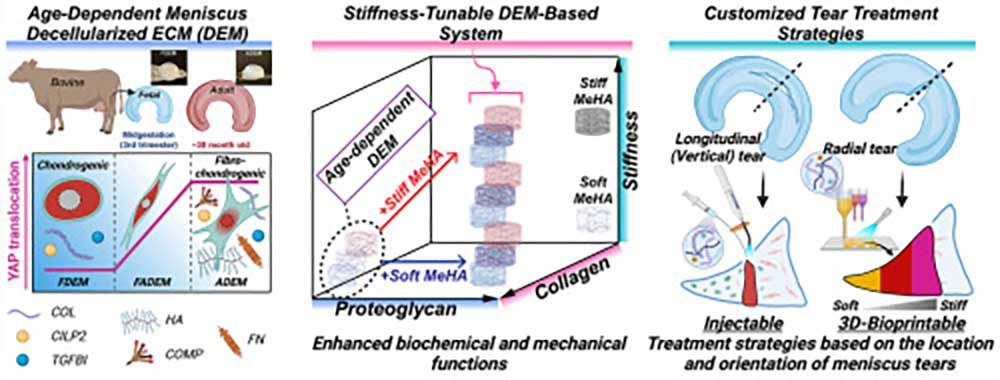
 Through creating a treatment adaptable to the different needs of patients—using a new 3D-printed hydrogel made from cow meniscus—researchers in the Perelman School of Medicine at the University of Pennsylvania (Penn) believe they may have unlocked a better fix no matter where an injury occurs in a meniscus. “We developed a hydrogel that can be adjusted based on the patient’s age and the stiffness requirements of the injured tissue, which is important because the meniscus has different biochemical and biomechanical properties that vary depending upon the location in the tissue,” said researcher Su Chin Heo, PhD, an assistant professor of Orthopaedic Surgery in the McKay Orthopaedic Research Lab at Penn.
The specialized hydrogel was developed by first extracting proteins from donor cow meniscus tissue. Those proteins then directed new cells to become the right types of repair cells for the damaged meniscus and were used as the basis for the treatment’s structures. To prevent rejection, the team removed cellular components from the cow tissue while preserving its structural framework. To further customize the hydrogels, Heo and his fellow researchers used 3D-printing techniques to account for the variation in the meniscus tissue. That way, they could more closely match the tissue in the areas they were trying to repair.
“In our animal studies, we’ve seen the hydrogel integrate well with the surrounding tissue, potentially offering patients a more complete recovery,” said Se-Hwan Lee, PhD, a post-doctoral fellow in the McKay Lab. “It’s a more precise, biologically matched solution. We believe this could outperform current treatments.”
The team is now transitioning from small mammal studies to large animal models.