







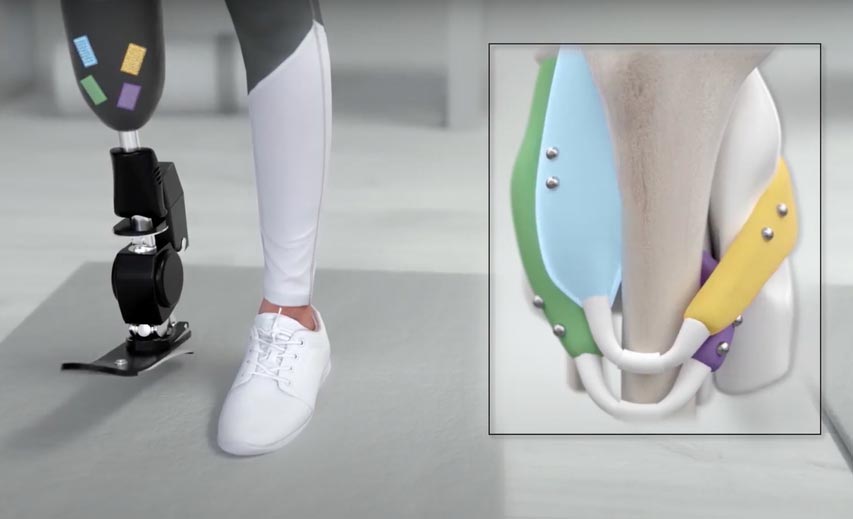
Using a simple set of magnets, MIT researchers have come up with a sophisticated way to monitor muscle movements, which they hope will make it easier for people with amputations to control their prosthetic limbs. Image courtesy of the researchers.
Massachusetts Institute of Technology (MIT) researchers have developed a sophisticated way to monitor and measure muscle movements using magnets, which they hope will make it easier for people with amputations to control their prostheses in a way that more closely mimics natural limb movement. Their approach is called magnetomicrometry. This strategy takes advantage of the permanent magnetic fields surrounding small beads implanted in a muscle. Using a credit card–sized, compass-like sensor attached to the outside of the body, the system can track the distances between the 2 magnets. When a muscle contracts, the magnets move closer together, and when it flexes, they move further apart.
In a study last year, the researchers showed that this system could accurately measure small ankle movements when the beads were implanted in the calf muscles of turkeys. In 1 of the new studies, the researchers set out to see if the system could make accurate measurements during more natural movements. To do that, they created an obstacle course of ramps for the turkeys to climb and boxes for them to jump on and off. The researchers used their magnetic sensor to track muscle movements during these activities and found that the system could calculate muscle lengths in less than a millisecond.
In the second study, the researchers found that the magnets did not generate tissue scarring, inflammation, or other harmful effects. Nor did the implanted magnets alter the turkeys’ gaits, suggesting they did not cause discomfort. Additionally, it was shown that the implants remained stable for 8 months and did not migrate toward each other if they were implanted at least 3cm apart.