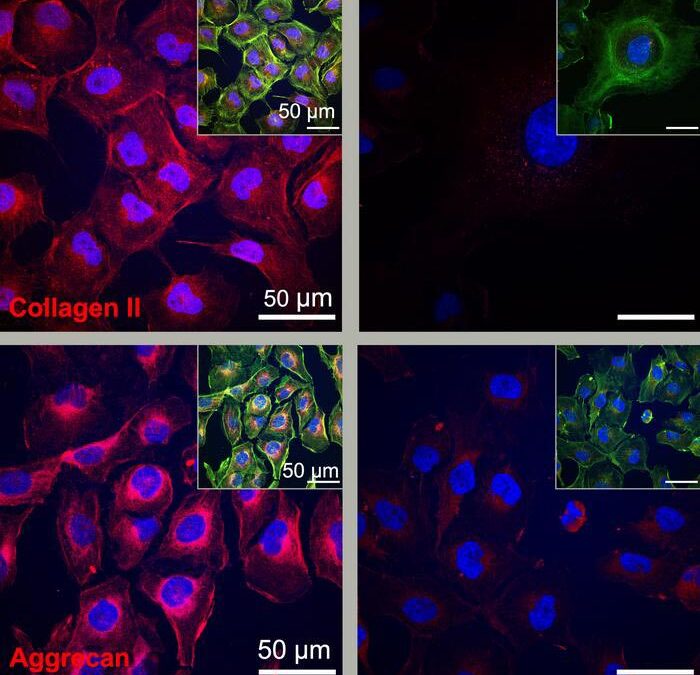








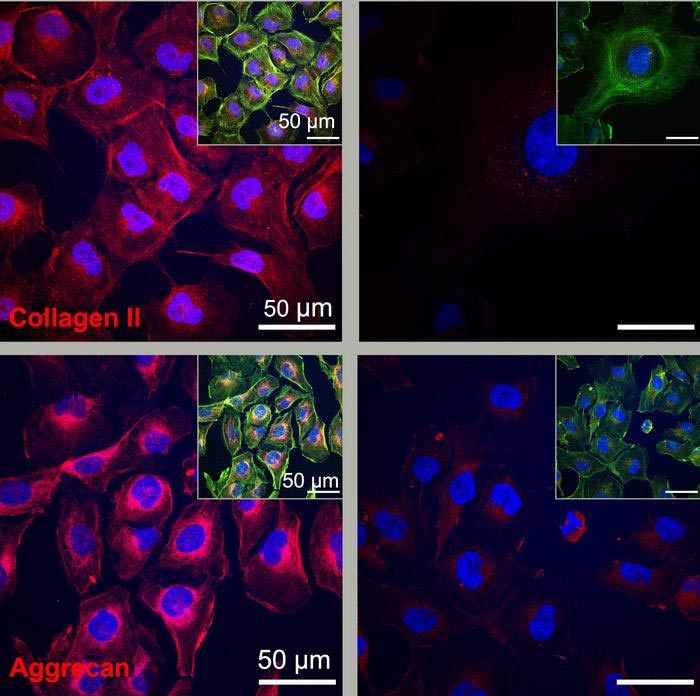
Cartilage cells generate more protein components (collagen II and aggrecan) for regeneration when treated with fast-moving dancing molecules (left) compared to slower moving molecules. Image courtesy of Stupp Research Group/Northwestern University.
In November 2021, Northwestern University researchers introduced an injectable therapy, which harnessed fast-moving “dancing molecules,” to repair tissues and reverse paralysis after severe spinal cord injuries. Now, the same research group has applied the therapeutic strategy to damaged human cartilage cells. The treatment was shown to activate the gene expression necessary to regenerate cartilage within 4 hours. And, after 3 days, the human cells produced protein components needed for cartilage regeneration. Their work has implications for patients suffering from osteoarthritis.
The researchers also found that, as the molecular motion increased, the treatment’s effectiveness also increased. In other words, the molecules’ “dancing” motions were crucial for triggering the cartilage growth process. Dancing molecules are assemblies that form synthetic nanofibers comprising 10s to 100s of thousands of molecules with potent signals for cells. By tuning their collective motions through their chemical structure, the researchers discovered the moving molecules could rapidly find and properly engage with cellular receptors, which also are in constant motion and extremely crowded on cell membranes. Once inside the body, the nanofibers mimic the extracellular matrix of the surrounding tissue. By matching the matrix’s structure, mimicking the motion of biological molecules and incorporating bioactive signals for the receptors, the synthetic materials are able to communicate with cells.
The researchers are currently testing these systems in animal studies and adding additional signals to create highly bioactive therapies. They are also testing the ability of dancing molecules to regenerate bone—and already have promising early results.