
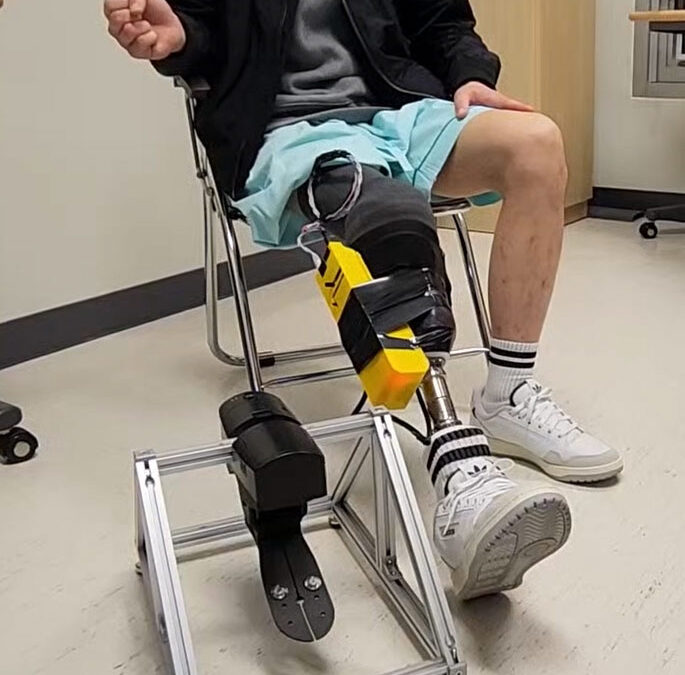








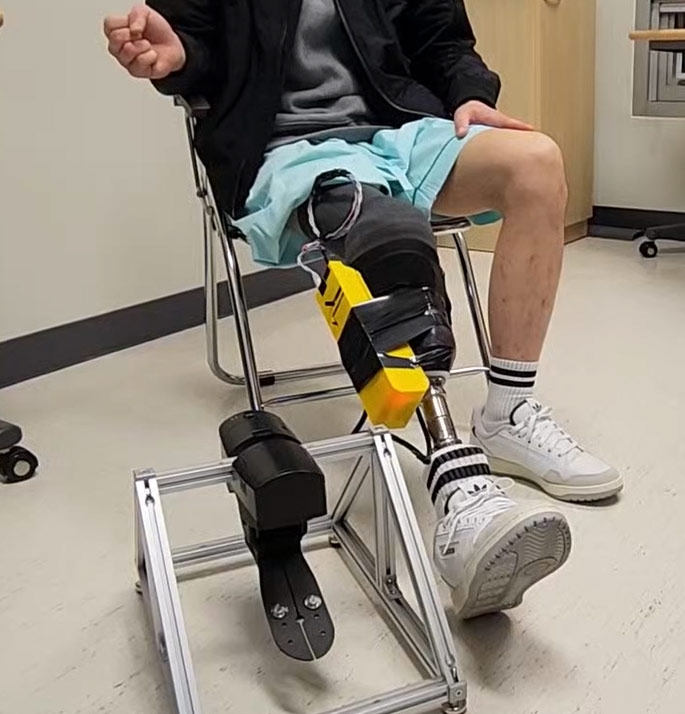
A subject demonstrates robotic control of a prosthetic foot using a Raspberry Pi4 system. Robotic control was also demonstrated with Bluetooth and with the subject wired to the prosthetic foot. Image courtesy of Daegu Gyeongbuk Institute of Science and Technology.
A research team led by Professor Sang-hoon Lee at the Department of Robotics and Mechatronics Engineering, Daegu Gyeongbuk Institute of Science and Technology. South Korea, has successfully developed an imperceptive surface electromyography (sEMG) sensor. The sensor is crucial in allowing people with lower limb amputations to control robotic prosthetic legs as they want and is expected to contribute greatly to rehabilitation and a better quality of life.
This imperceptive sEMG sensor mimics a serpentine structure to provide flexibility and elasticity while achieving breathability and adhesion. Hence, the sensor can be applied to various amputated parts of the body and can be used repeatedly over an extended period of time. Furthermore, combined with a wireless module, the sensor obtains real-time signals generated when it is used to walk with robotic prosthetic limbs, sockets, and silicone liners.
To verify the sensor’s function, the research team attached the imperceptive sEMG sensor to the residual limb of a study subject and evaluated the sensor’s function by recording the subject’s muscle signals. The results demonstrated that the sensor successfully acquired high-quality, real-time muscle signals of the subject walking in various environments (on flat ground, up and down slopes, and on stairs) and transmitted the signals wirelessly to assist the individual in walking, as verified from the motion analysis sensor embedded in the robotic prosthetic leg.
Furthermore, by analyzing muscle signals generated from plantarflexion and dorsiflexion in people with lower limb amputations, the research team confirmed that the selective signal acquisition performance of the imperceptive sEMG sensor is better than that of other commercial sensors. In this regard, the research team expects the sensor to be applied across various wearable technologies, in addition to precise control of robotic prosthetic legs and hands based on bio-signals.