







 By Ana Sofia Tavera Pelaez, Nader Farahpour, Ian B. Griffiths, and Gabriel Moisan
A better understanding of how the medial arch stiffness of foot orthoses can be modulated by changing structural factors is necessary to better customize them for patients.
It is postulated that foot orthoses (FOs) provide their effects through the production of reaction forces at the foot-FOs interface. An important parameter to provide these reaction forces is medial arch stiffness, as greater stiffness is correlated with greater pronatory control of the foot and ankle during locomotion. Rearfoot and forefoot extrinsic posts are among the most commonly used extrinsic additions to increase FOs medial arch stiffness and consequently enhance their ability to change lower limb biomechanics through greater resistance to deformation. FOs with posts decrease ankle eversion angles/moments and tibialis posterior muscle activity during locomotion. However, even though these FOs extrinsic additions have been used for a few decades, their utilization to modify medial arch stiffness remains an emerging rather than a proven concept.
A better understanding of how the medial arch stiffness of FOs can be modulated by changing structural factors is necessary to better customize FOs for patients. The objectives of this study were to compare FOs stiffness and force required to lower the FOs medial arch in 3 thicknesses and 2 models (with and without medially wedged forefoot-rearfoot posts).
Methods
Two models of FOs, 3D printed in Polynylon-11, were used: (1) without extrinsic additions (mFO), and (2) with forefoot-rearfoot posts and a 6-degree medial wedge (FO6MW). For each model, 3 thicknesses (2.6mm, 3mm, and 3.4mm) were manufactured. FOs were fixed to a compression plate and vertically loaded over the medial arch at a rate of 10mm/minute. Two-way ANOVAs and Tukey post-hoc tests with Bonferroni corrections were used to compare medial arch stiffness and force required to lower the arch across conditions.
Results
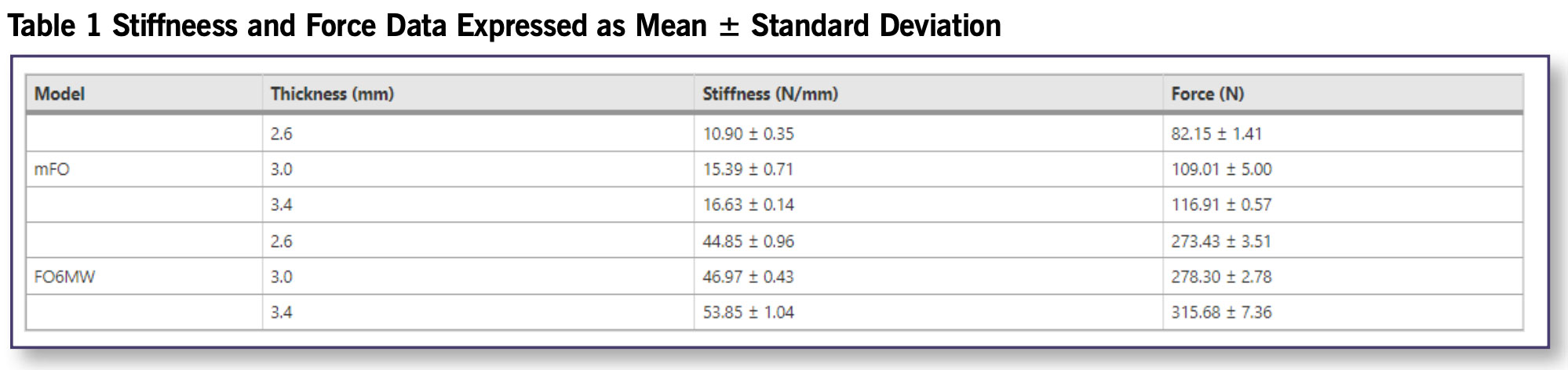 Regardless of the differing shell thicknesses, the overall stiffness was 3.4 times greater for FO6MW compared to mFO (P < 0.001). FOs with 3.4mm and 3mm thicknesses displayed 1.3- and 1.1-times greater stiffness than FOs with a thickness of 2.6mm. FOs with a thickness of 3.4mm also exhibited 1.1-times greater stiffness than FOs with a thickness of 3mm. Overall, the force to lower the medial arch was up to 3.3 times greater for FO6MW than mFO and thicker FOs required greater force (P < 0.001).
Discussion
The most important findings of this study were that, according to the authors’ hypothesis, 3D-printed FOs in Polynylon-11 with greater thickness presented greater medial arch stiffness, and that FO6MW were significantly stiffer than mFO.
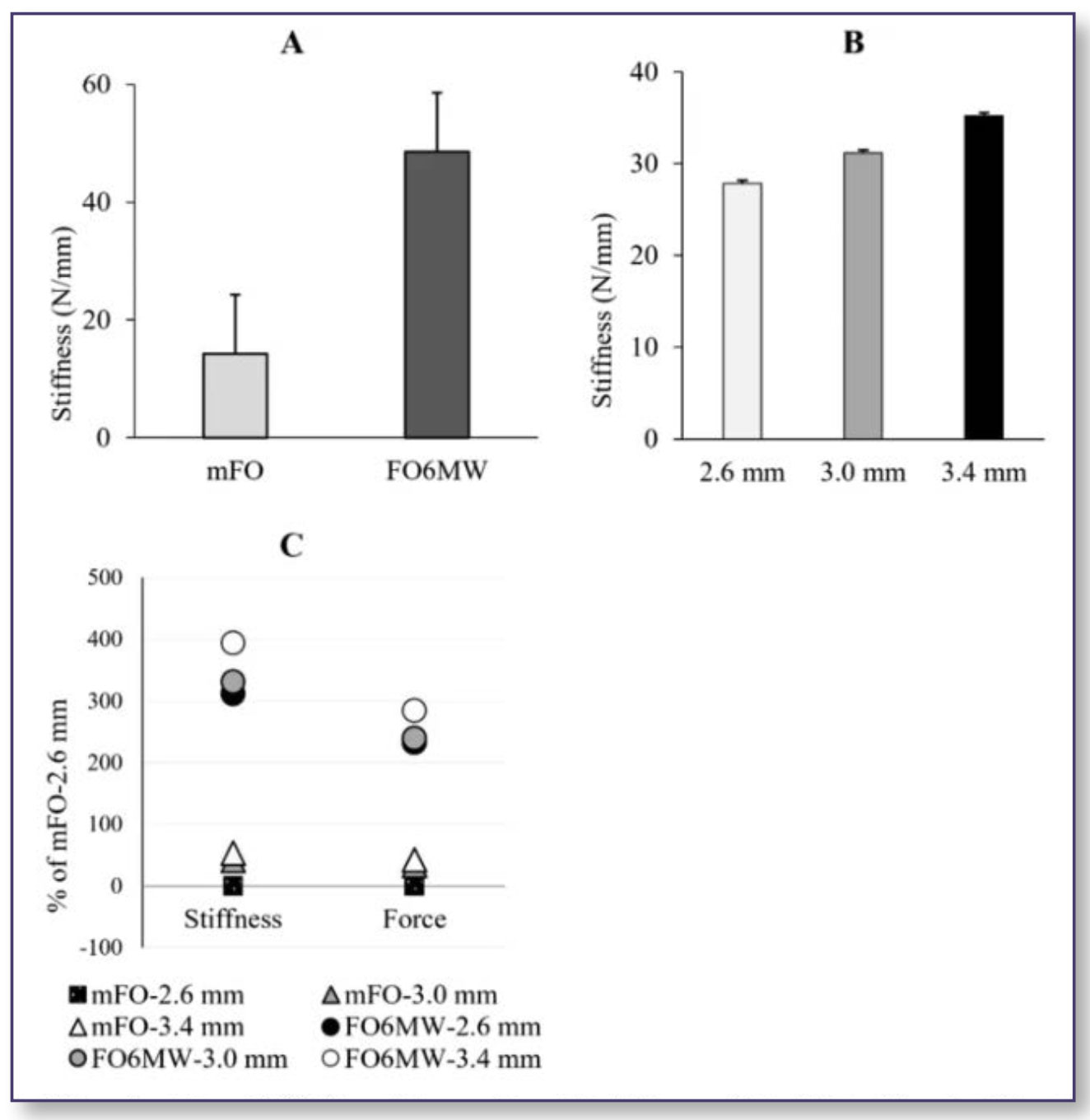
Figure 1. A) Stiffness in mFO and FO6MW models regardless of the thickness effects. B) FOs stiffness in different thicknesses, regardless of models. C) The ratio (%) of increased stiffness and force as a result of adding medially wedged forefoot-rearfoot posts, and increasing the thickness.
FOs thickness in the 2 models (mFO and FO6MW) was increased by 0.4mm (15% relative increase) between the first and the second thickness and by 0.4mm (13% relative increase) between the second and third thickness. For mFO, the first increase in thickness, from 2.6mm to 3.0mm, increased arch stiffness by 41%. The additional increase in thickness, from 3mm to 3.4mm, reflected an additional 11% increase of stiffness, for a total 52% increase between the 2.6mm and 3.4mm shells. For FO6MW, the first increase in thickness, from 2.6mm to 3mm, only increased arch stiffness by 5%, and the additional increase in thickness, from 3mm to 3.4mm, resulted in an additional increase of 15%, for a total increase in arch stiffness of 20% between the 2.6mm and 3.4mm shells (See Table 1 and Figure 1C). These results reveal that the importance of FOs thickness to increase stiffness is highly dependent on the presence or absence of forefoot-rearfoot posts with a 6-degree medial wedge. As forefoot-rearfoot posts provide additional support underneath the proximal and distal part of the FOs arch, the proportional importance of shell thickness is lower than for mFO.
The study authors also found that to increase FOs medial longitudinal arch stiffness and peak force required to lower the arch, adding medially wedged forefoot-rearfoot posts was significantly more efficient than increasing shell thickness. For example, by increasing the thickness of mFOs from 2.6mm to 3.4mm, the force required to lower the arch and the arch stiffness were only 1.4 times (117 vs 82 N) and 1.5 times (16.6 vs 10.9 N/mm) greater, respectively. However, by adding medially wedged forefoot-rearfoot posts on the 2.6mm mFO, the force required to lower the arch and the arch stiffness were 3.3 times (273 vs 82 N) and 4.1 times (44.8 vs 10.9 N/mm) greater, respectively. These results suggest that to significantly increase FOs medial arch stiffness, medially wedged forefoot-rearfoot posts should be used rather than only changing shell thickness.
Conclusions
An increased medial longitudinal arch stiffness is seen in FOs following the addition of 6-degree medially inclined forefoot-rearfoot posts, and when the shell is thicker. Overall, adding forefoot-rearfoot posts to FOs is significantly more efficient than increasing shell thickness to enhance these variables should that be the therapeutic aim.
This article has been excerpted from “Thick Shells and Medially Wedged Posts Increase Foot Orthoses Medial Longitudinal Arch Stiffness: An Experimental Study,” Journal of Foot and Ankle Research. 2023;16:11. https://doi.org/10.1186/s13047-023-00609-z. Editing has occurred, including the renumbering or removal of tables and figures, and references have been removed for brevity. Use is per CC 4.0 International License.