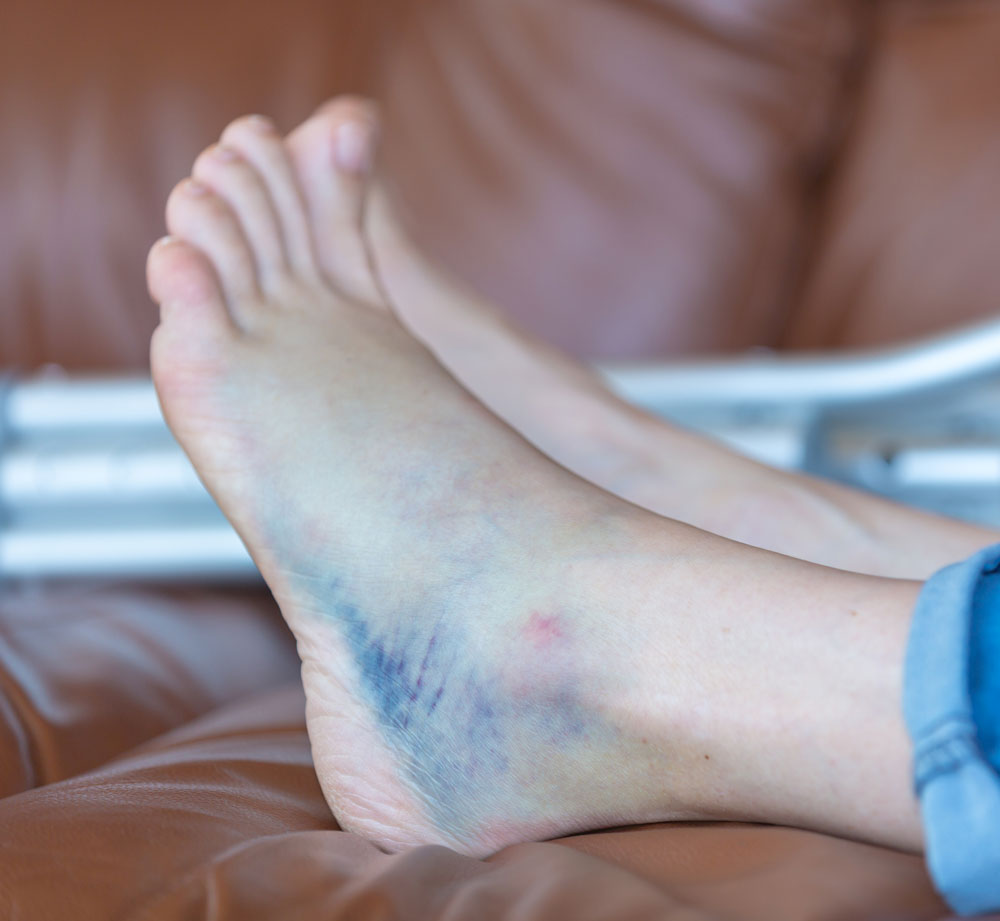








 Background: A 13-year-old male athlete with no history of injuries, was playing in a middle school football game when he was tackled while running the ball and the opposing player landed on his left foot. He had immediate pain in his ankle and was unable to walk after the incident. He described a sharp pain on the medial aspect of his ankle and had swelling over this area as well. Upon initial exam there was notable swelling over the medial ankle, without bruising. TTP over the tibiotalar joint, also over the deltoid ligament distribution and the ATFL distribution. ROM was limited in all planes and strength was also limited in all planes. Negative bump test, negative anterior drawer, although this caused pain. Unable to ambulate. Sensation intact, distal pulses intact.
Differential Diagnosis: Triplane Ankle Fracture, Deltoid ligament tear, Pilon Fracture, Tibial Fracture, Maisonneuve fracture, Juvenile Tillaux fracture, ATFL Sprain
Intervention & Treatment: We were able to get the athlete seen by a Sports Medicine Physician the day following the injury. The physician was able to perform an exam with similar findings to the athletic trainer and sent the patient for a 3-view ankle X-ray and bilateral weight bearing X-rays of the ankle. Findings showed a Juvenile Tillaux fracture of the left distal tibial epiphysis and physis. The patient was recommended to be non-weight bearing and his case was discussed with a pediatric orthopedic surgeon who recommended getting a CT scan as well. The CT scan confirmed the X-ray findings of Juvenile Tillaux Fracture. The athlete was placed in a cast for 4 weeks, then was transitioned to a walking boot for 4 weeks. Following this he was able to start physical therapy and return to football specific exercises at 12 weeks.
Uniqueness: A Juvenile Tillaux fracture is a traumatic ankle injury in the pediatric population – a Salter-Harris III fracture of the anterolateral distal tibia epiphysis. This is usually seen in children that are nearing skeletal maturity, so in a slightly older age range around 12–14. This type of fracture is caused by an avulsion of the anterior inferior tibiofibular ligament. The typical mechanism of action for this injury is a supination-external rotation injury. Management depends on level of displacement, if there is less than 2mm of displacement it can be treated non-operatively; however if there are more than 2mm, then it will need surgery. This is a very rare injury, accounting for only 3%–5% of pediatric ankle fractures.
Conclusions: The 13-year-old male, middle school football athlete had an in-game injury to his left ankle. It was important that an athletic trainer was present even at this middle school event to provide an initial evaluation and get the athlete quickly in to see a Sports Medicine physician. This athlete had a difficult to diagnose ankle fracture at the growth plate that could have required surgery, making this a can’t miss diagnosis. Growth plate injuries are common in this patient population and it’s important to be able to distinguish between a possible fracture and an ankle sprain.
Source: Gray PA. When an Ankle Injury Isn’t Just a Sprain. J Athl Train. 2023;58(6S):163. Used with permission; all rights reserved.