









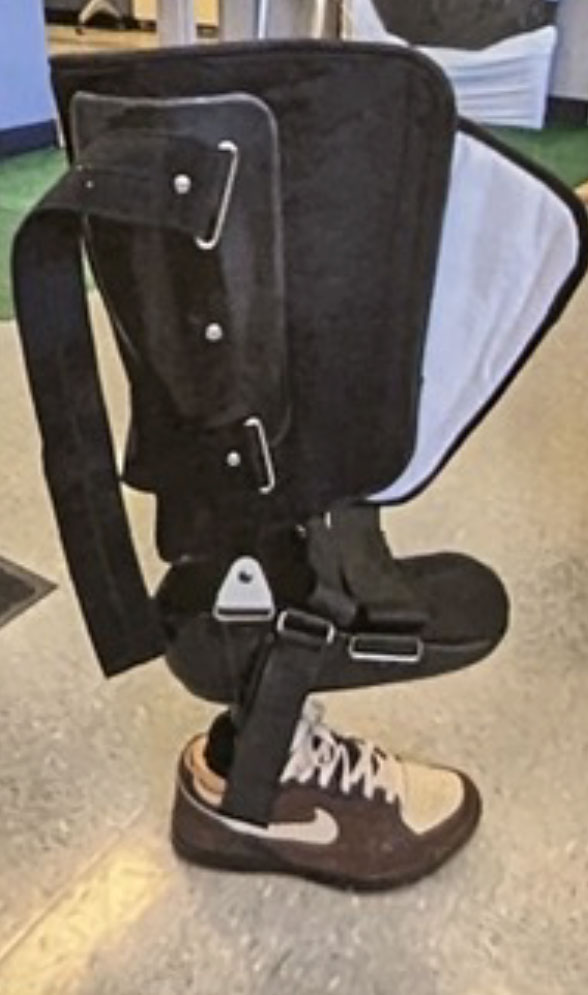
Figure. Typical trans-tibial pseudo prosthesis design.
Prosthetic device users have a wide range of needs and prosthetists need to be aware of varying product offerings to meet those needs. Pseudo-prostheses allow able-bodied users to understand ambulation in a specific device, providing critical education about new products as well as ongoing training for evolving products.
But how does walking on a transtibial pseudo-prosthesis compare to walking on an actual transtibial prosthetic limb? That’s the question researchers from the University of Pittsburgh School of Health and Rehabilitation Sciences asked in a study that was presented as a poster at the 50th Annual Meeting and Scientific Sessions of the American Academy of Orthotists and Prosthetists.
Researchers had 10 able-bodied volunteers perform a battery of outcome tests—6-minute walk test (6MWT), Hill assessment index (HAI), and Stair Assessment Index (SAI)—wearing 2 different prosthetic feet, a Solid Ankle Cushion Heel (SACH) foot and an Energy Storage and Return (ESAR) foot. The 2 options were selected to cover a range of activities.
Two of the 5 test results—the 6MWT and SAI incline/decline—compare well to mobility tests performed with a real prosthetic device. Two other tests—HAI ascending/descending—differed from previous published findings, which the researchers attributed to potential differences in the ramp dimensions.
The team concluded that pseudo-protheses offer a more versatile approach to testing component parts as well as teaching prosthetists.
Source: Daniels CJ, Fiedler G. Quantifying the Accuracy of Pseudo-prosthese in Relation to Prosthetic Devices Using Different Feet. Poster presented at 50th Annual Meeting & Scientific Symposium of the American Academy of Orthotics and Prosthetics. Chicago, IL. March 6-9, 2024.