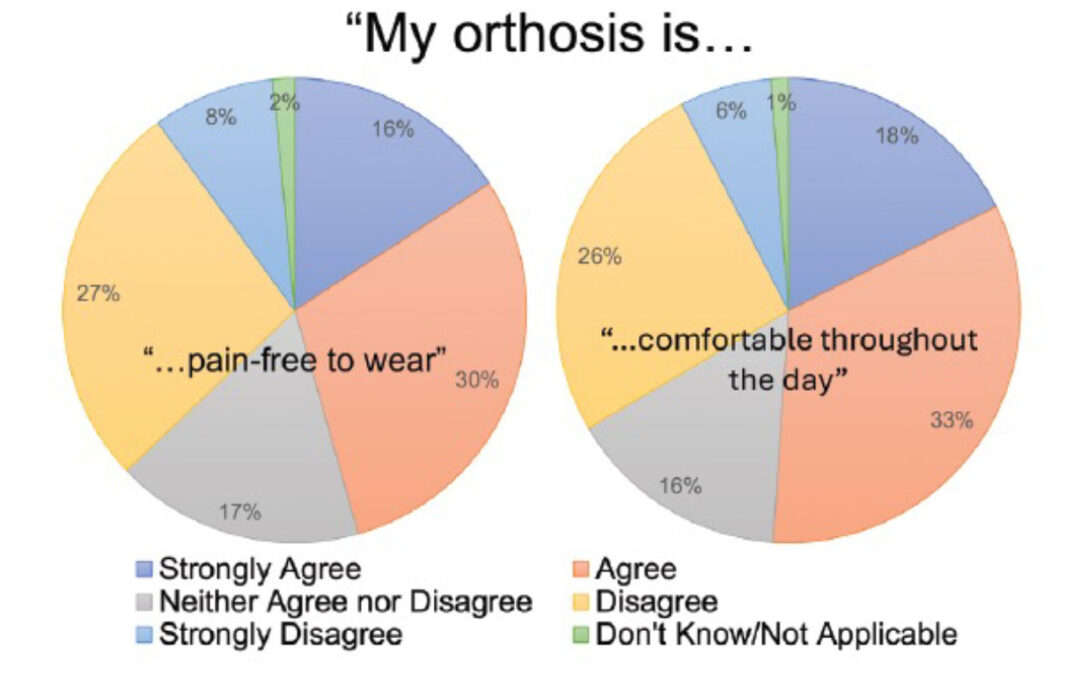








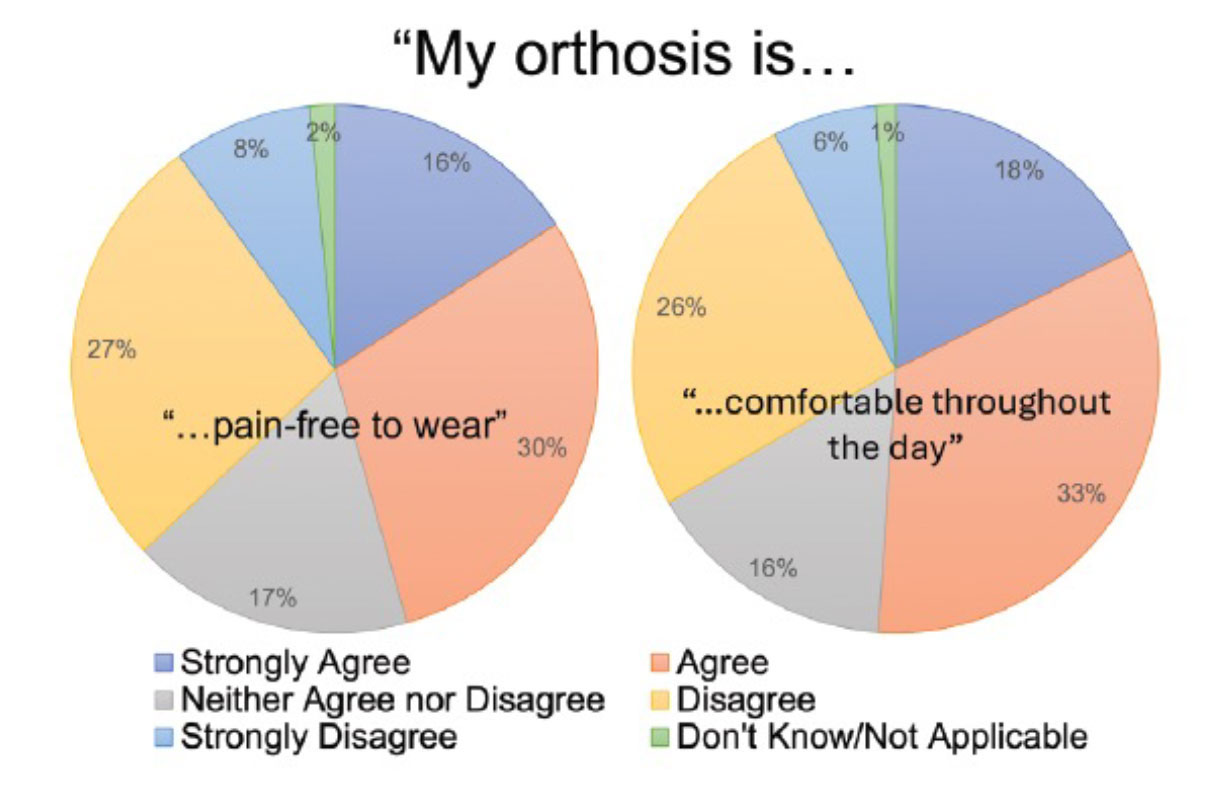
Figure: To gain insight into satisfaction with daily use, 329 individuals with CMT who use an AFO were queried utilizing a questionnaire that included 11 device-specific questions and 10 service-related questions. Patients rated their level of agreement to statements using a six-level Likert scale. Less than half of participants strongly or very strongly agreed that their orthosis was pain-free to wear, and only half similarly agreed that their orthosis is comfortable to wear throughout the day. These findings suggest the need to further enhance AFO related care to overcome the weakness, pain, and impaired function associated with CMT. (Expanded from Zuccarino et al. 2021).
Noting a lack of evidence-based guidance on mobility challenges in individuals with neuropathic conditions, in particular Charcot-Marie-Tooth (CMT) disease and Cerebral Palsy (CP), researchers from the University of Iowa in Iowa City identified a critical need for a better understanding of how surgical correction affects mobility, balance confidence, and gait compared to ankle-foot-orthosis (AFO) bracing.
They propose using prospective studies in select patient cohorts to compare conservative vs. surgical management, 2) objective laboratory-based evaluations of patient mobility, balance, and gait using reliable methods, and 3) use of patient-centric outcome measures related to health and mobility.
Among their initial findings was this:
Other findings include a discussion of morphologic measurements using weight-bearing CT scans, and dual fluoroscopy (DF), which leverages 2 orthogonally-placed X-ray videos to measure 3D bone movement.
They conclude by noting that “There is variation in orthotics services, and clinicians report problems with acceptance and use of AFOs amongst people with these conditions, possibly due to a mismatch between patient needs and device provision.”
Source: Chrea B, Anderson DD, Roach K, Wilken J. Research toward understanding the benefits and limitations of orthotic use to improve mobility and balance for individuals with neuropathic conditions. Iowa Orthop J. 2024;44(1):37-45.