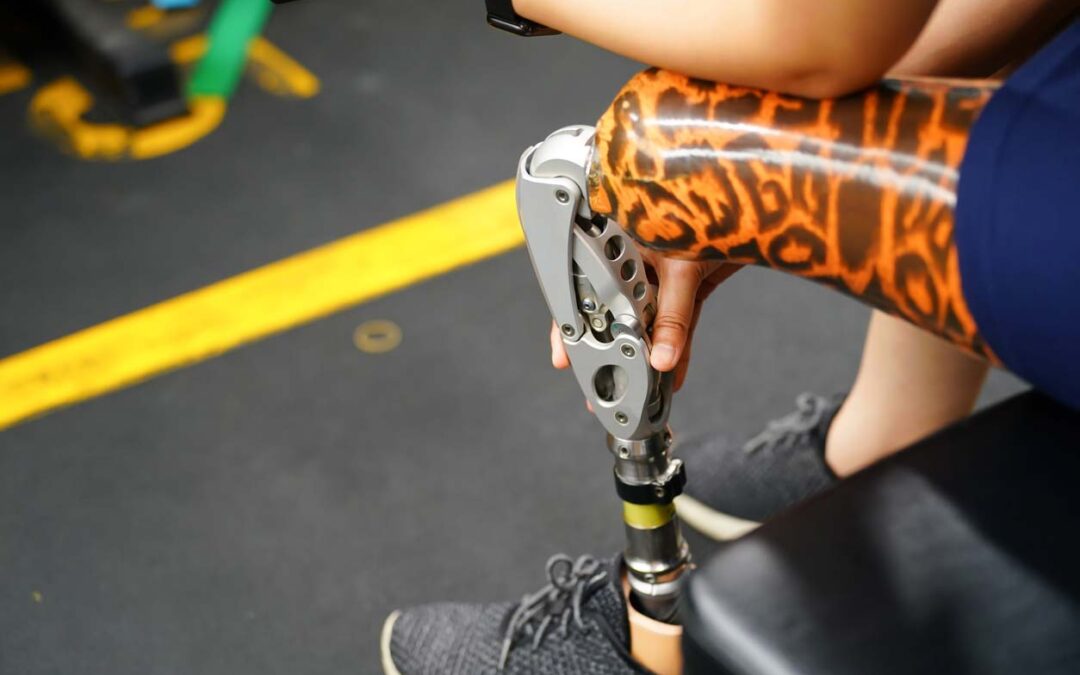








 Below-knee amputations significantly affect quality of life by eliminating the critical biomechanical functions of the ankle joint, which is essential for gait stability and propulsion. While prostheses aim to restore mobility, passive prostheses fail to replicate ankle dynamics, leading to gait asymmetry and musculoskeletal issues This study evaluates the long-term biomechanical and energy efficiency effects of a high-torque, lightweight robotic ankle-foot prosthesis (RAF Pro) in a transtibial amputee, focusing on its potential to enhance gait symmetry and functionality.
A 6–month longitudinal case study was conducted on a 51-year-old male transtibial amputee transitioning from a passive prosthesis to the RAF Pro. Comprehensive gait analyses, including motion capture and force plate assessments, were performed at 4 intervals: initial fitting, 3 months, 4 and a half months, and 6 months. The participant received continuous, tailored rehabilitation training throughout the study.
Over the adaptation period, notable improvements were observed in plantarflexion during toe-off and in the coordination of hip and knee joint movements, contributing to enhanced gait symmetry. By the 6-month mark, the subject achieved near-symmetrical gait mechanics with significantly reduced energy expenditure during walking, approaching the biomechanical efficiency observed in non-amputees.
This case study highlights the potential of long-term adaptive rehabilitation combined with advanced robotic prostheses to restore natural, energy-efficient gait mechanics in transtibial amputees. The findings emphasize the importance of a minimum 6-month adaptation period for optimizing prosthetic function, offering valuable insights for personalized rehabilitation strategies and future prosthetic development.
Source: Kim J, Yi H, Hwang D, Jung J, Lee HJ, Cho JH, Bok SK, Lee Y. Prolonged adaptation to a robotic prosthesis enhances gait symmetry: A case study in a transtibial amputee. Ann Phys Rehabil Med. 2025;68(5):101981. doi: 10.1016/j.rehab.2025.101981