







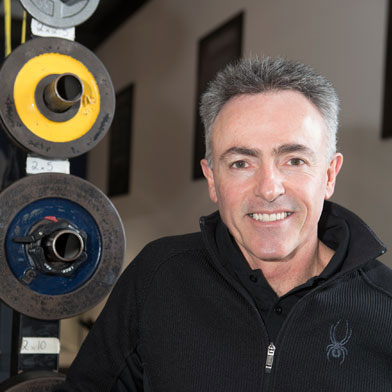
 By Adrian Faccioni, MS
We typically lose proprioception as we age, which can negatively affect balance. But why do we lose proprioception simply because we age?
Proprioception was originally defined as “the perception of joint and body movement as well as position of the body, or body segments, in space.” At present, proprioception can be defined as the cumulative neural input to the central nervous system from mechanoreceptors. The mechanoreceptors, specialized nerve endings, are located in the joint, capsules, ligaments, muscles, tendons, and skin.1
Normal aging is associated with slower cognitive processing, slower postural reactions, and decreased muscle strength, all of which are essential for optimal proprioception/balance.2 Typically, age-related proprioception issues begin to present themselves in persons 50 or older. We exhibit slower reaction times and are at increased risk of falling since we respond slower under unfamiliar postural situations.
A decrease in proprioception leads to the decline of motor coordination and balance and could lead to abnormal joint biomechanics during functional activities such as walking. As such, over a period of time, degenerative joint disease may result. Colledge et al3 studied the relative contributions to balance from vision, proprioception, and the vestibular system in different age groups. They found that all age groups were more dependent on proprioception than on vision for the maintenance of balance. Thus, impaired proprioception could be a contributing factor to falls.
Like many aspects of aging physiology, exercise has been found to ameliorate most of the effects of aging upon a person’s proprioception/balance loss. Below I outline some of the key findings with proprioception/balance and aging and the 3 main decrements linked to this attribute: strength, central nervous system (CNS), and peripheral adaptation.
Strength
Research by Fukagawa et al4 highlighted that their elderly subjects with a history of falls had less than half of the knee and ankle strength of non-falling subjects. The differences were more prominent at the ankle than the knee, and were most pronounced in the ankle dorsiflexors, where they were one-tenth that of controls.
Physical activity improving muscle strength can also improve proprioception. The improvement in muscle strength with exercise might yield better control of movement, which, as a consequence, could enhance joint proprioception under weight-bearing conditions.5
 Central Nervous System
At the CNS level, aging induces progressive loss of the dendrite system in the motor cortex, losses in the number of neurons and receptors, and neurochemical changes in the brain. Age-related changes in spindle sensitivity decreases these mechanoreceptors in both sensing positioning change, but also in the speed at which they are able to respond to any such change (a key factor).1
It has been shown that the older adult has fewer, but on average larger and slower motor units, resulting in motor unit reorganization. Therefore, this age-related alteration of the number and function of motor units has profound implications in muscle force production and control. This lack of control also has repercussions in proprioceptive ability.1
At a CNS level, physical activity might modify proprioception by modulating the mechanoreceptor gain and inducing plastic changes in the CNS. Muscle spindle is the one mechanoreceptor whose gain can be modulated by the CNS.2 Increased muscle spindle output may occur during exercise. In this way, repeated practice of a motor skill is thought to increase muscle spindle output, which could bring about plastic changes in the CNS, such as an increased strength of synaptic connections and/or structural changes in the organization and number of connections among neurons.6 Indeed, repetitive afferent inputs from the mechanoreceptors could modify the cortical maps of the body over time. Plastic changes in the cortex can be induced by repeated positioning of body and limb joints in specific spatial positions as demanded by exercise.7 Regular physical activity over time can increase cortical representation of the joints leading to enhanced joint proprioception.
Robbins et al8 reported that proprioception decreases with aging in part because of changes in muscle spindle function. In addition, advancing age leads to deficits in the processing of sensory input (myelin abnormalities, axonal atrophy, and declined nerve conduction velocity).
Peripheral Adaptation
(Postural sensors within joints, muscles, tissues)
Peripheral neuropathy is a true risk factor for falls in the elderly. Relatively greater impairment in vibratory sense and ability to maintain unipedal stance may identify those within the peripheral neuropathy group who are at a higher risk for falls.9
Slower postural reaction and movement time and reduced medial–lateral control of the centre of mass during voluntary sway movements are associated with increased fall-risk in community-living older people.10 Studies showed a relationship between aging and decline in several aspects of proprioceptive sensitivity, namely a decrease in joint position sense and an increase in movement detection threshold. In particular, the lower limb, knee joint position sense, and ankle joint position sense are negatively affected by aging.
Of the many receptors that mediate proprioception, only muscle spindles demonstrate an ability to modulate sensitivity to muscle stretch, thereby representing the most promising avenue for training-related improvements to occur.1,11
Exercise to Improve Proprioception
Gauchard et al12 investigated the effects of different types of exercise on postural control and balance of adults over age 60 and concluded that proprioception can be “trained” and that regular exercise of a proprioceptive nature might be beneficial to retain or regain balance.
Peripheral level improvements in proprioception were linked to alterations in muscle spindle sensitivity. There is no evidence that training changes the number of mechanoreceptors, but there is evidence that training induces morphological adaptations in these major mechanoreceptors (muscle spindles). Training can induce muscle spindle adaptations

- At a microlevel: the intrafusal muscle fibers may show some metabolic changes, and
- At a more macro level, the latency of the stretch reflex response decreases and the amplitude increases.13
Tai Chi: Previous studies14 showed that experienced Tai Chi practitioners had better joint proprioception and balance control during weight shifting despite the known aging effects in these specific sensorimotor functions.
 BOSU and Swiss Ball: In a 2013 study,15 patients (age 60–90 years) were submitted to a 12-week proprioception training program, 2 sessions of 50 minutes every week. This program includes 6 exercises with the BOSU and Swiss ball as unstable training tools that were designed to program proprioceptive training. The training program improved postural balance of older adults in mediolateral plane with eyes open and anterior–posterior plane with eyes closed. Significant improvements were observed in Romberg quotient (measurement of limb proprioceptive positioning) with speed but not with distance. These results indicate that a 12-week proprioception training program in older adults is effective in postural stability and static and dynamic balance, and could lead to an improvement in gait and balance capacity, and to a decrease in the risk of falling in adults age 65 years and older.
Wobble-board and Mini-trampoline: Two studies were found to follow traditional proprioceptive training programs focusing on wobble-board or mini-trampoline training in older adults with both demonstrating improvements in actively replicated joint positioning sense (JPS) at the ankle16 and knee.17
Visuals, Variety, Velocity: Tasks within the study by Westlake et al11 included standing or walking on various support surfaces (eg, a rocker board, foam, narrow beam) and standing in a tandem or semi-tandem position, standing on one leg, or standing with feet together. To alter visual cues, participants were instructed to close their eyes or to engage vision by reading or tracking a secondary task, or by performing balance tasks with a distracting background such as a checked pattern or moving people. To modify vestibular cues, participants were instructed to tilt their head backward or quickly move the head side to side and up and down to focus on a target. This research found that velocity sense was sensitive to targeted interventions and may represent an additional important consequence in terms of functional tasks. Considering that velocity information is crucial and more accurate than position information for the small postural corrections required during quiet stance, the possibility to reverse age-related changes in velocity sense is encouraging.
Moreover, impairments in postural control and fear of falling in older adults that remain unexplained by muscle weakness may potentially be alleviated by improvements in velocity discrimination following balance interventions. Nevertheless, it is important to note that despite the post-intervention improvements in velocity discrimination, these changes were not retained at the 8-week follow-up session. Thus, to maintain improvements in velocity discrimination, a regular targeted exercise regimen must be continued.
These results suggest that short-term improvements in velocity sense, but not movement and position sense, may be achieved following a balance exercise intervention.
Take Home Points
- Maintenance of quality muscle (reducing sarcopenia) is key to maintaining many youthful aspects of physiological performance including proprioception/balance.
- Appropriate training methods are crucial to the maintenance (or improvement) of proprioception/balance.
- These training methods can include a combination of strength/hypertrophy training and balance training with a focus on the ankle/knee joints as key areas of weakness for balance as we age.
- I suggest that all training programs include exercises that combine strength and balance which will lead to better functional fitness for the long term (exercises including single leg Romanian deadlifts, single leg shoulder presses, etc.).
Adrian Faccioni, MD, is a Senior Lecturer in Exercise Physiology and Rehabilitation at the University of Canberra in Australia. He has been involved in sport and fitness/conditioning for more than 30 years. After developing and commercializing the first Sport GPS, he ultimately moved back into strength and conditioning with a focus on translating the latest in sport science into training targeting those age 40+. This Perspective is an edited update of a recent blog post from his website, fatchfitness.com.
- Ribeiro F, Oliveira J. Aging effects on joint proprioception: the role of physical activity in proprioception preservation. Eur Rev Aging Phys Act. 2007;4:71–76.
- Morrison S, Colberg SR, Mariano M, Parson HK, Vinik AI. Balance training reduces falls risk in older individuals with type 2 diabetes. Diabetes Care. 2010;33(4):748-50.
- Colledge NR, Cantley P, Peaston I, Brash H, Lewis S, Wilson JA. Ageing and balance: the measurement of spontaneous sway by posturography. Gerontology. 1994;40(5):273-8.
- Wolfson L, Judge J, Whipple R, King M. Strength is a major factor in balance, gait, and the occurrence of falls. J Gerontol A Biol Sci Med Sci. 1995;50(Spec Is):64-7.
- Petrella RJ, Lattanzio PJ, Nelson MG. Effect of age and activity on knee joint proprioception. Am J Phys Med Rehabil. 1997;76(3):235-41.
- Schumway-Cook A, Wollacott MH. Motor Control: Theory and Practical Applications. Lippincott Williams & Wilkins. Baltimore, MD: 2000.
- Tsang WW, Hui-Chan CW. Effects of tai chi on joint proprioception and stability limits in elderly subjects. Med Sci Sports Exerc. 2003;35(12):1962-71.
- Robbins S, Waked E, McClaran J. Proprioception and stability: foot position awareness as a function of age and footwear. Age Ageing. 1995;24(1):67-72.
- Richardson JK, Hurvitz EA. Peripheral neuropathy: a true risk factor for falls. J Gerontol A Biol Sci Med Sci. 1995;50(4):M211-5.
- Tucker MG, Kavanagh JJ, Morrison S, Barrett RS. Voluntary sway and rapid orthogonal transitions of voluntary sway in young adults, and low and high fall-risk older adults. Clin Biomech (Bristol, Avon). 2009;24(8):597-605.
- Westlake KP, Wu Y, Culham EG. Sensory-specific balance training in older adults: effect on position, movement, and velocity sense at the ankle. Phys Ther. 2007;87(5):560-8.
- Gauchard GC, Jeandel C, Tessier A, Perrin PP. Beneficial effect of proprioceptive physical activities on balance control in elderly human subjects. Neurosci Lett. 1999;273(2):81-4.
- Hutton RS, Atwater SW. Acute and chronic adaptations of muscle proprioceptors in response to increased use. Sports Med. 1992;14(6):406-21.
- Tsang WW, Hui-Chan CW. Effects of exercise on joint sense and balance in elderly men: Tai Chi versus golf. Med Sci Sports Exerc. 2004;36(4):658-67.
- Martínez-Amat A, Hita-Contreras F, Lomas-Vega R, Caballero-Martínez I, Alvarez PJ, Martínez-López E. Effects of 12-week proprioception training program on postural stability, gait, and balance in older adults: a controlled clinical trial. J Strength Cond Res. 2013;27(8):2180-8.
- Waddington GS, Adams RD. The effect of a 5-week wobble-board exercise intervention on ability to discriminate different degrees of ankle inversion, barefoot and wearing shoes: a study in healthy elderly. J Am Geriatr Soc. 2004;52(4):573-6.
- Diracoglu D, Aydin R, Baskent A, Celik A. Effects of kinesthesia and balance exercises in knee osteoarthritis. J Clin Rheumatol. 2005;11(6):303-10.