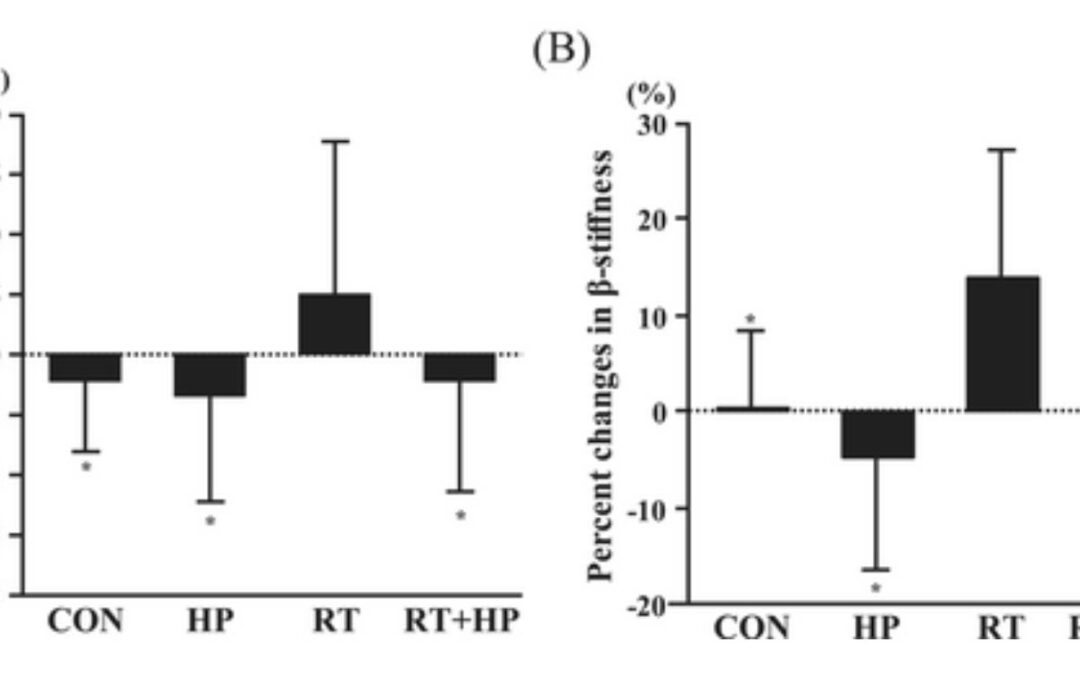








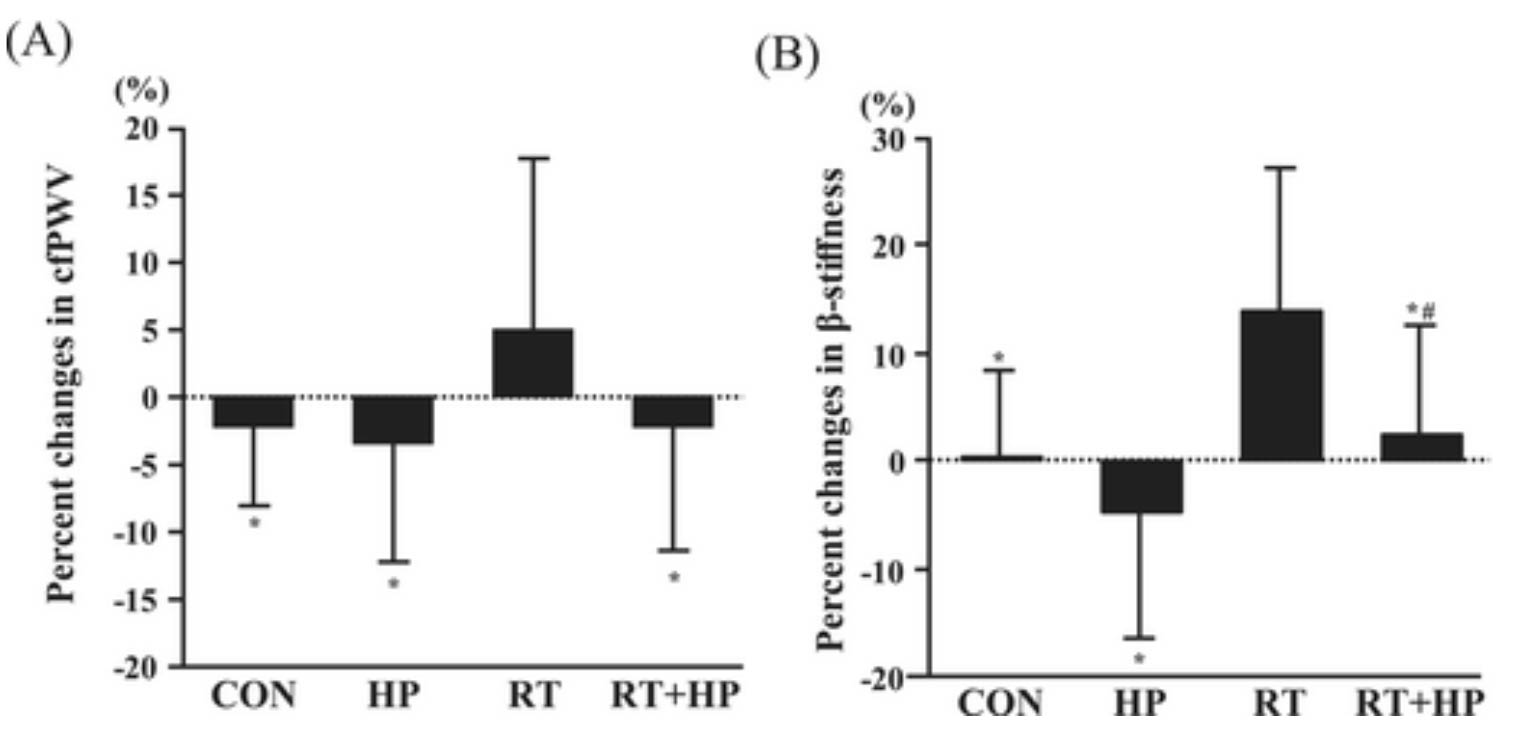
Figure: Comparison of percent changes in carotid-femoral pulse wave velocity (cfPWV; A) and carotid β–stiffness (B) before and after each intervention among the sedentary control (CON), high-protein intake (HP), resistance training (RT), and combination of RT + HP (RT + HP) groups. Data are expressed as means ± SD. *P < 0.05 vs. RT. #P = 0.05 vs. HP.
Resistance training is a well-known exercise therapy for preventing and improving lack of muscle mass, strength, and quality with advances in age; however, its effects on arterial stiffness are not beneficial. Additionally, a higher intake of protein, which is an effective nutrient for muscle health, results in lower arterial stiffness. Researchers hypothesized that the combination of resistance training and high protein intake would improve muscle mass, strength, and quality and cancel the resistance training-induced increase in arterial stiffness in elderly women. To test the hypothesis, they assessed the effects of resistance training combined with regular intake of steamed chicken breast, a high-protein food, on muscle mass, strength, quality, and arterial stiffness in elderly women.
Ninety-three elderly women (67.2 ± 5.3 years) were randomly divided into four groups; sedentary control (CON), higher dietary animal protein intake (HP), resistance training (RT), and combination of RT and HP (RT + HP) groups. Participants in the RT and RT + HP groups completed 12 weeks of resistance training (exercise intensity at 70% of 1 repetition maximum (1–RM), 3 sets with 10 repetitions of leg extension and curls, 3 days/week). In addition to the daily diet, the HP and RT + HP groups consumed steamed chicken breast as a high-protein diet.
Percentage changes in thickness (indices of muscle mass) and echo intensity (index of muscle quality) in the quadriceps muscle, 1–RM of leg extension and curls (index of muscle strength) and circulating C1q levels (a potential biomarker of muscle fibrosis) in the RT and RT + HP groups significantly improved after both RT and RT + HP interventions (P < 0.05). Percentage changes in carotid-femoral pulse wave velocity (cfPWV) and carotid β–stiffness (indices of arterial stiffness), and circulating angiotensin II (a vasoconstrictor peptide hormone) levels via each intervention were significantly higher in the RT group (4.9 ± 12.7%, 13.8 ± 13.5%, 94.9 ± 132.7%, respectively), as compared with the CON group (−2.5 ± 5.9%, 0.2 ± 8.1%, 21.2 ± 79.3%, respectively) (P < 0.05). Of note, no significant differences in the cfPWV, carotid β–stiffness and circulating angiotensin II levels between the RT + HP (−2.4 ± 9.3%, 2.4 ± 10.3%, −5.7 ± 29.6%, respectively) and CON groups were observed. Furthermore, significant positive relationships between the percentage changes in circulating angiotensin II levels, and cfPWV (r = 0.438, P < 0.01) and carotid β–stiffness (r = 0.328, P < 0.01) were observed.
The combination of moderate to high-intensity resistance training and regular intake of steamed chicken breast as a high-protein food could increase muscle mass, strength, and quality and could cancel resistance training-induced increases in arterial stiffness in elderly women.
Source: Fujie S, Horii N, Kajimoto H et al. Impact of resistance training and chicken intake on vascular and muscle health in elderly women. J Cachexia Sarcopenia Muscle. 2025;16(1):10.1002/jcsm.13572. doi: 10.1002/jcsm.13572.