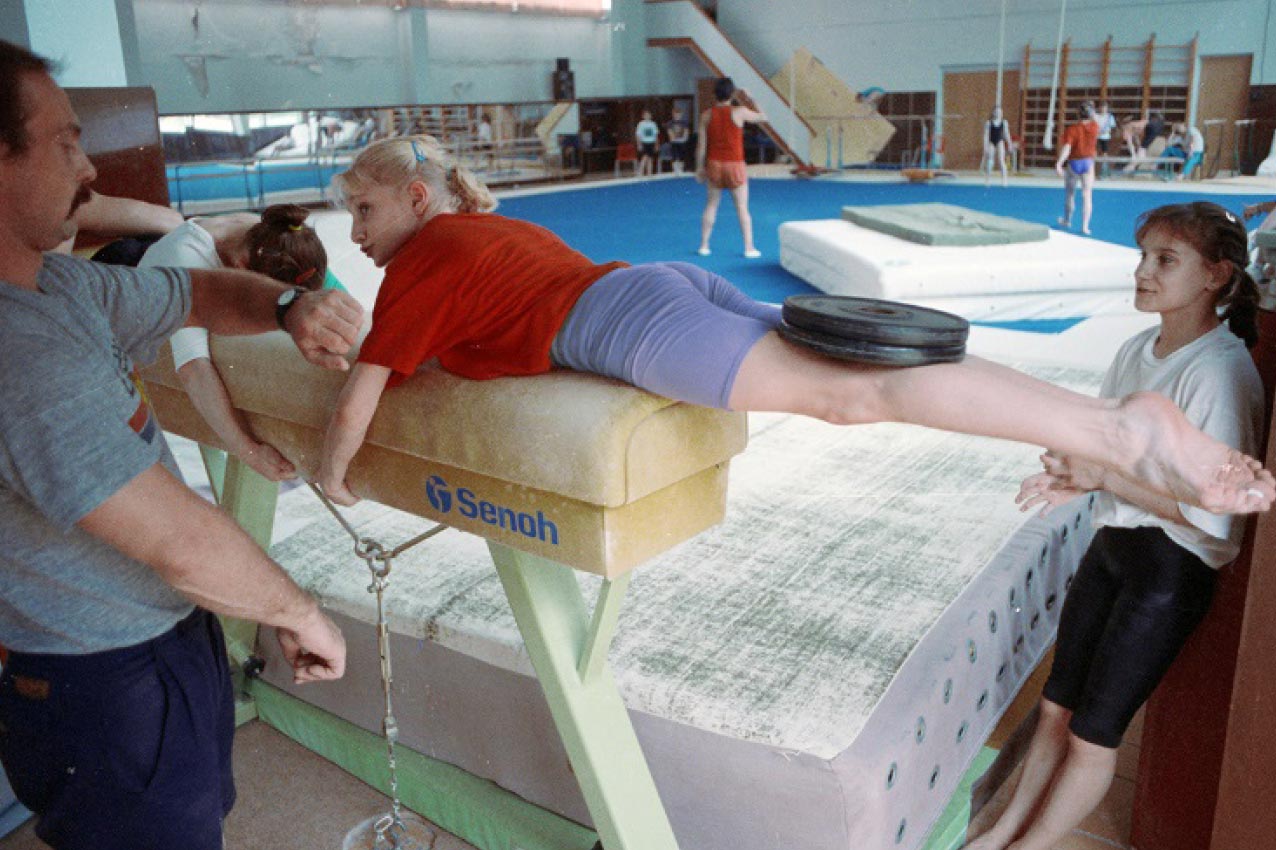
Too much training? Members of the Soviet women’s gymnastics team training in 1991 in Moscow.
By Robert Weil, DPM
What do I mean by the prodigy sports? Specifically, I’m talking about sports that involve adolescents and younger who are already focusing on and playing only one sport. It’s a key chapter in my co-authored book, #HeySportsParents.1 Sports like gymnastics and figure skating are good examples, but we could add soccer, tennis, volleyball, swimming, etc.! Most doctors, therapists, and trainers are unanimous in frowning on specializing in one sport too early, citing increased repetitive motion injuries from using the same muscles and movements compared to playing multiple sports that provide a variety of demands on their growing bodies.
Overuse injuries – both physical and mental – are already an epidemic in youth sports. Early specialization often increases these problems leading to mental burnout, stress, anxiety, and eating disorders from these pressures and demands. Surgeries can become a definite reality in physically grueling sports such as gymnastics. Many high-level gymnasts have surgical histories that make headlines: “Elbow Surgery Helps Young Gymnast Reach for Her Dreams” (age 12);2 “Castaic teen gymnast receives cutting-edge hip surgery from Children’s Hospital LA” (age 17);3 “The Injured Should in High-Level Male Gymnasts, Part 2: Can Athletes Return to Competition After Surgery? (age range 16-23)”4 and “Young Gymnast First To Undergo Experimental Spine Surgery In Colorado”.5 Pain and problems later on in their 30s and older are not uncommon, including in these other prodigy sports. Dealing with these long-term post injury and surgery problems often becomes the future reality for serious young athletes.
Some parents and coaches think that young athletes will fall behind in development if they don’t spend all their time and energy on that single sport. This has not proven true. A great example is the former women’s Gold Cup soccer team where over 75% of players grew up playing multiple sports, not just soccer! There are many other examples of sports stars in many sports with their history of variety. LeBron James wanted to play football at Ohio State University, but chose that other sport. Remember those letter sweaters? Ideally, young athletes can participate in different sports with their different experiences and physical demands, and then decide which is best for them by mid-teens or later. Then…it can be off to the races! Of course, I said ideally. Too often, club and traveling team coaches and parents push this specialization early idea, disregarding its potential negative consequences. Sometimes it’s the parent’s goals, other times the club’s financial interest. The prodigy sports again are a different challenge: everyone can tell the kid to play other sports but kids love their Fav! If that’s the reality, I respect it. But there should be some new rules and challenges regarding schedules, training, and the importance of rest, recovery, and time off.
But Then, Later On…
Regarding pain and problems later on when their career is over, an interesting recent study looked at hundreds of former college gymnasts involving many with early injuries, many requiring surgery. Researchers found that those who started earlier had greater risk for surgery. Many later in their 30s dealt with pain and early arthritis or disability concerns. Other prodigy sports mentioned above might not have as many surgical injuries as gymnastics but often have the same future pain and wear-and-tear problems. The study also showed that even with early injuries that required surgery in these young gymnasts, it didn’t necessarily relate to their later painful problems compared to those without surgery. They had been trained to accept and tune out pain—and they were still doing it! I asked a couple of my youth sports and gymnastics experts to chime in:
Robert Andrews, MA, LMFT, from Texas’s Institute of Sports Performance in Houston, is a mental training specialist who’s worked with the Olympic women’s Gold Medalist gymnastics teams as well as other sports. He specializes in post injury and surgery mental challenges. He uses an “injury assessment” that takes a look at emotional and mental discomfort related to injury. It measures several different factors – anxiety, fear of re-injury, anger, frustration, and more. Interestingly, he often sees less future pain and problems when the athlete is aware of these factors and pays attention to them later in life.
Gina Pongetti, PT, MPT, MA, CSCS, of Illinois’s Achieve Orthopedic Rehab Institute & Sports Medicine in the Chicago area, is a former high-level gymnast, award-winning physical therapist and performance consultant to these same Olympians and young stars. She also feels that “pain in the long-term is often associated with the psychology of the injury and how it was handled.” Was the athlete yelled at, belittled by the coach, by their parents or teammates? She says these high-level gymnasts expect and are trained and schooled on ignoring and handling post injury or surgery pain.
This attitude of no pain no gain, push through it, suck it up, etc., by coaches, parents and the young athletes themselves has been a big contributor to the above-mentioned epidemic of youth sports overuse injuries both those that are physical and those that are mental. The reliance on pain medicine to stay in the game, playing while hurt, and often masking injury problems is a nightmare we also addressed in the book.1 My message to parents and coaches is this: if your young athlete needs pain meds to continue to participate at the same schedule and intensity – then the line has been crossed and everyone needs to back off for a reset. The injury needs to be examined by a doctor, trainer, or therapist and treatment needs to be initiated. Insisting on rest and recovery is crucial for the long-term health of the young athlete. So many minor overuse injuries can become chronic, even surgical, all because someone doesn’t want to back off the schedule or intensity. Too often, it’s “Doc – he’s/she’s got to play!”
There’s no doubt that today’s youth sports is too often big business with all the stresses and pressures we’ve mentioned. It ain’t for everyone! Remember that the reality of a college scholarship, let alone a professional or Olympic career is very slim. Sports parents, coaches and the kids themselves need to be aware of this. When these young athletes, their parents and coaches become educated and are made aware of the challenges involved, everybody wins!
Robert A. Weil is a sports podiatrist in private practice in Aurora, Illinois. He hosts The Sports Doctor, a live weekly radio show on bbsradio.com. His book, #HeySportsParents, written with Sharkie Zartman, is available on Amazon.com and ranks among the seller’s top 100 books in both Children & Youth Sports (#59) and Children’s Sports Coaching (#62). Dr. Weil was inducted into the prestigious National Fitness Hall of Fame in April 2019.
- Zartman S, Weil R. #HeySportsParents: An Essential Guide for any Parent with a Child in Sports. Spoilers Press: 2018.
- Duke Health Blog. Elbow Surgery Helps Young Gymnast Reach for Her Dreams. Updated March 29, 2018. Available at https://www.dukehealth.org/blog/elbow-surgery-helps-young-gymnast-reach-her-dreams. Accessed Aug. 1, 2022.
- Dador D. Castaic Teen Gymnast Receives Cutting-Edge Hip Surgery from Childen’s Hospital LA. ABC Eyewitness News. Posted Oct. 25, 2019. Available at https://abc7.com/hip-displaysia-surgery-pain-sharp-near/5642919/. Accessed Aug. 1, 2022.
- Gendre P, Boileau P. The Injured Shoulder in High-Level Male Gymnasts, Part 2: Can Athletes Return to Competition After Surgery? Orthop J Sports Med. 2021;9(10):23259671211043468. doi: 10.1177/23259671211043468.
- CBS Colorado. Young Gymnast First To Undergo Experimental Spine Surgery In Colorado. Posted June 19, 2019. Available at https://www.cbsnews.com/colorado/news/vertebral-body-tethering-gymnast-spine-surgery-colorado-scoliosis-rmhc/. Accessed Aug. 1, 2022.