








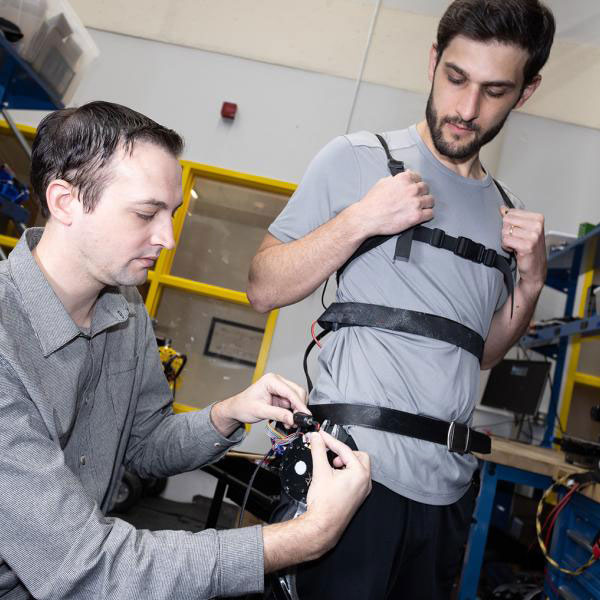
Aaron Young makes adjustments to an experimental exoskeleton worn by then-PHD student Dean Molinaro. The team used the exoskeleton to develop their unified control framework for robotic assistance devices. Image courtesy of Candler Hobbs, Georgia Tech.
Researchers are working on real-life robotic assistance that could protect workers from painful injuries and help stroke patients regain their mobility. So far, they have required extensive calibration and context-specific tuning, which keeps them largely limited to research labs. Mechanical engineers at Georgia Institute of Technology may be on the verge of changing that, allowing exoskeleton technology to be deployed in homes, workplaces, and more.
A team of researchers in Aaron Young’s lab have developed a universal approach to controlling robotic exoskeletons that requires no training, no calibration, and no adjustments to complicated algorithms. Instead, users can don the device and go. Their system uses a kind of artificial intelligence called deep learning to autonomously adjust how the exoskeleton provides assistance, and they’ve shown it works seamlessly to support walking, standing, and climbing stairs or ramps.
“The goal was not just to provide control across different activities, but to create a single unified system. You don’t have to press buttons to switch between modes or have some classifier algorithm that tries to predict that you’re climbing stairs or walking,” said Young, PhD, associate professor in the George W. Woodruff School of Mechanical Engineering.
Most previous work in this area has focused on 1 activity at a time, like walking on level ground or up a set of stairs. The algorithms involved typically try to classify the environment to provide the right assistance to users. The Georgia Tech team, however, focused on the human—what’s happening with muscles and joints—which meant the specific activity didn’t matter.
With the controller delivering assistance through a hip exoskeleton developed by the team, they found that users expended less energy and their joints didn’t have to work as hard compared to not wearing the device at all, even with the extra weight added by the device itself. The control system in this study is designed for partial-assist devices, which support movement rather than completely replacing it.