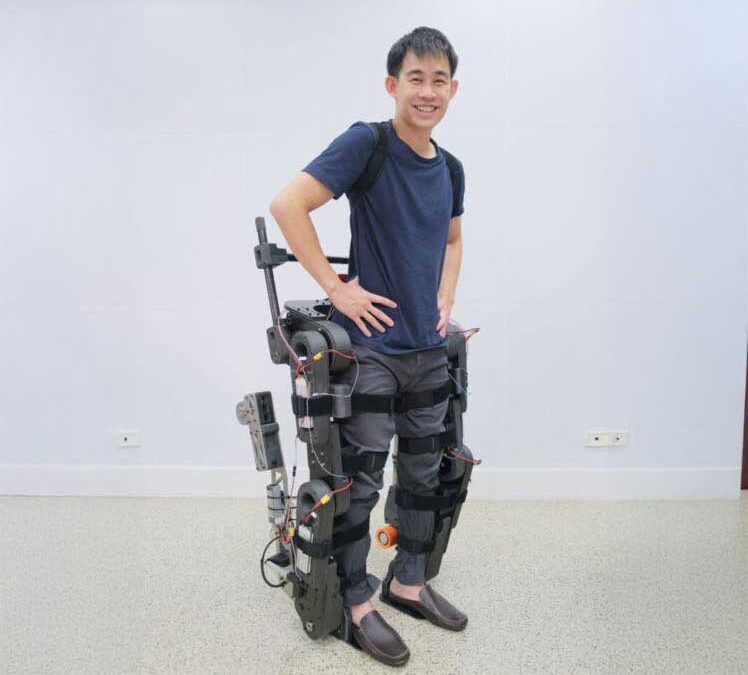









Image courtesy of Chaichaowarat and Chulalongkorn University.
Associate Professor Ronnapee Chaichaowarat, PhD, faculty of engineering, Chulalongkorn University, Thailand, has developed an Exoskeleton Wheelchair prototype for the elderly and people with mobility problems so they can leave their wheelchair behind to stand and walk with 1 robot. The “Transformable Wheelchair-Exoskeleton Hybrid Robot for Assisting Human Locomotion” was designed by Chaichaowarat and fabricated with carbon fiber because of its light weight and because it can be fabricated by 3D printers. The motion control is divided into 2 parts. The first part is the wheels, which have a group of students programming the front wheel speeds to make the robot travel straight or turn. The second part is the hip and knee joint motors’ control, which is programmed by Chaichaowarat.
“The lower leg can change mode between sitting and walking using a motor to help with the movement of the hip and knee joints,” said Chaichaowarat. “The ankle joint is a free joint with no drive. The left and right wheels can be retracted to the lower leg area to transform into a walking posture or get over obstacles.”
He further explained that he used kinematics compatibility in the design with linkage knee joints so that the motion of the rotational center can mimic the actual bone. For the joints supporting lots of leg bending and flexion, a 4-bar linkage allows the pivot point to change with the joint. He also applied his biomechanical knowledge to calculate the torque generated from around the ankles, knees, and hips to create robots that fit a person’s physiology.