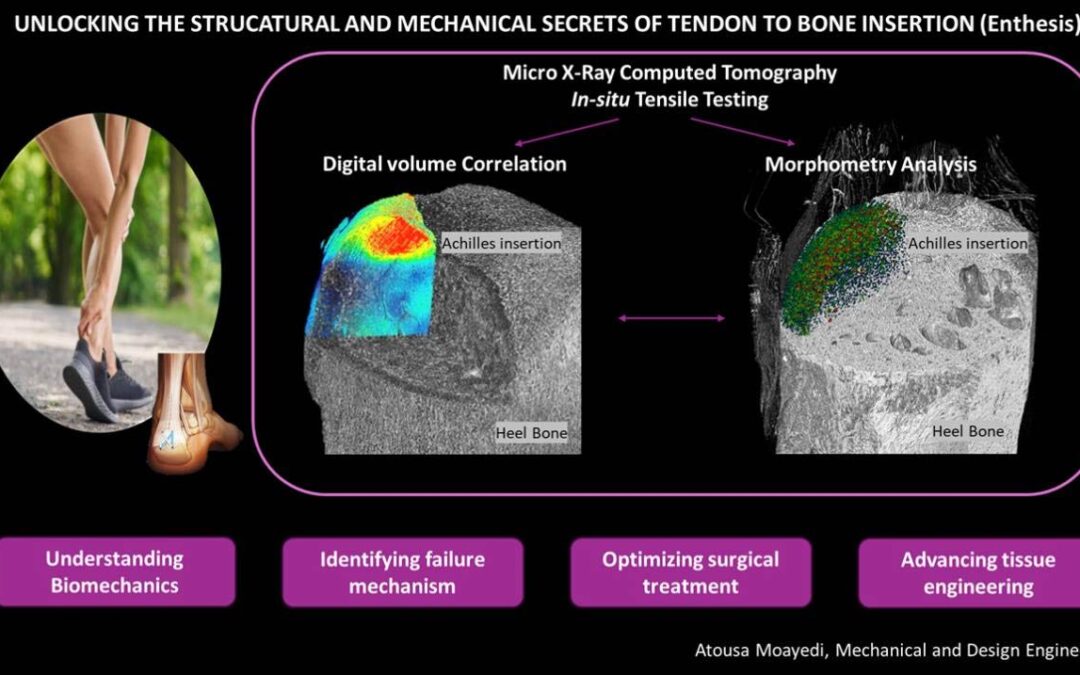








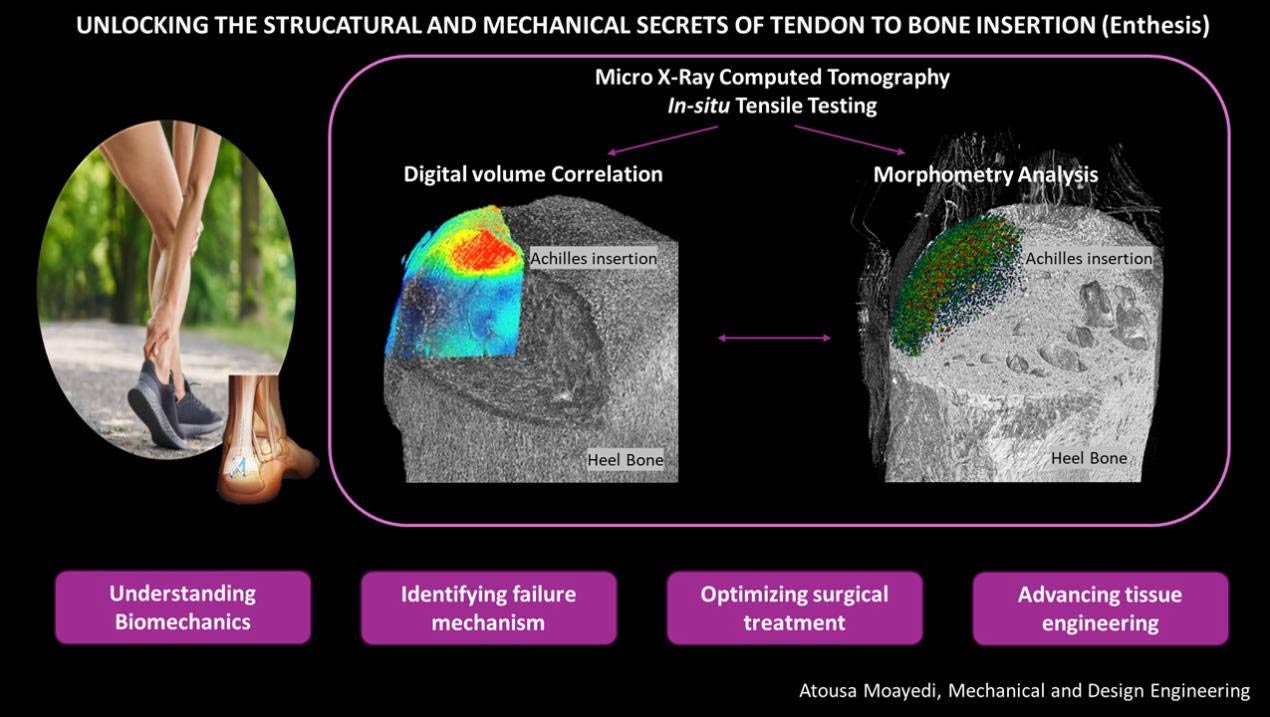
Image courtesy of University of Portsmouth.
Scientists at the University of Portsmouth, England, have created the first detailed 3D map of how a crucial piece of connective tissue, called calcified fibrocartilage (CFC), in our bodies responds to the stresses of movement and exercise. CFC acts like a biological shock absorber where tendons attach to bone. Damage to the CFC tissue–common in sport-related injuries–does not mend well. To improve healing treatments, scientists need to better understand the structure of this tissue and how it reacts to varying types of pressure.
Research by Atousa Moayedi, a PhD student in the university’s school of electrical and mechanical engineering, has been able to demonstrate that the center of the CFC tissue changes shape more than the surrounding areas, when stressed at different angles. In areas where the microscopic cavities within the tissue were more densely packed, the distortion was greater. This means that the way the tissue layers are arranged, and how thick they are, strongly influences how stretching (strain) is dispersed where the tendon meets the bone.
The research team used high resolution 3D scanning and artificial intelligence–powered image reconstruction to map the way in which CFC tissue behaves under pressure in a mouse model, as well as how and where it might fail. Importantly, they were also able to identify the features that would be important for healing.
Overseeing the study, was Professor Gordon Blunn, PhD, from the University’s School of Medicine, Pharmacy and Biomedical Sciences. “The weak link in the way that load is transferred from muscle to the skeleton is where the tendon joins with the bone,” he said. “After injury this region is slow to heal and difficult to repair. Importantly, Atousa’s work identifies the way that load is naturally transferred in this region and serves as a model for the repair and regeneration of tissues at this site.”