







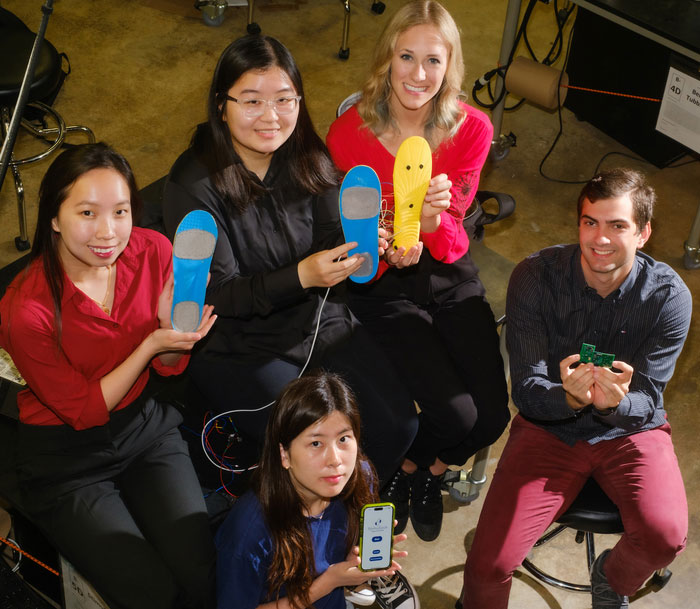
StimuSock team members (clockwise, from left) Yannie Guo, Kelly Xu, Abby Dowse, Andrei Mitrofan, and Sarah Park display their device. Photo courtesy of Jeff Fitlow/Rice University.
A wearable electrical-stimulation and vibration-therapy system designed by a team of Rice University (Rice) engineering students could help people experiencing foot pain and balance loss due to diabetic neuropathy. The team designed a sock, dubbed the StimuSock, with a smart insole that can deliver both transcutaneous electrical nerve stimulation (TENS) and vibration therapy that blocks pain signals to the brain and provides haptic feedback to help with balance issues, respectively. The device is also user-controllable and easy-to-use.
A lot of the team’s effort went into making the device as low-profile as possible. “The intent is for the patient to be able to wear the device for the whole day,” said team member Yannie Guo. “Even when everything’s off and they don’t want the electrostimulation or haptics effect, they can still wear their device.”
Patients use a smartphone app to control the type, intensity, and duration of the desired therapeutic stimulus. The system has 3 regions that allow users to target a specific area of the foot—the front of the insole, the middle of the insole, and the back of the insole.
The team anticipates the device’s final form will have sufficient battery life to provide the recommended maximum of 4 30-minute sessions of TENS therapy per day and operate on standby the rest of the day.