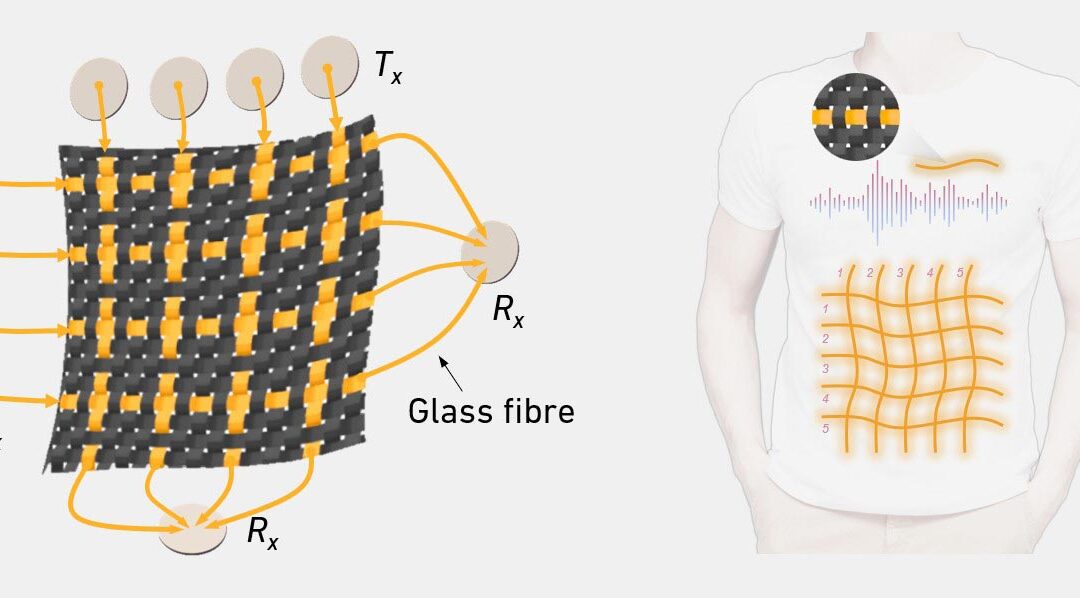








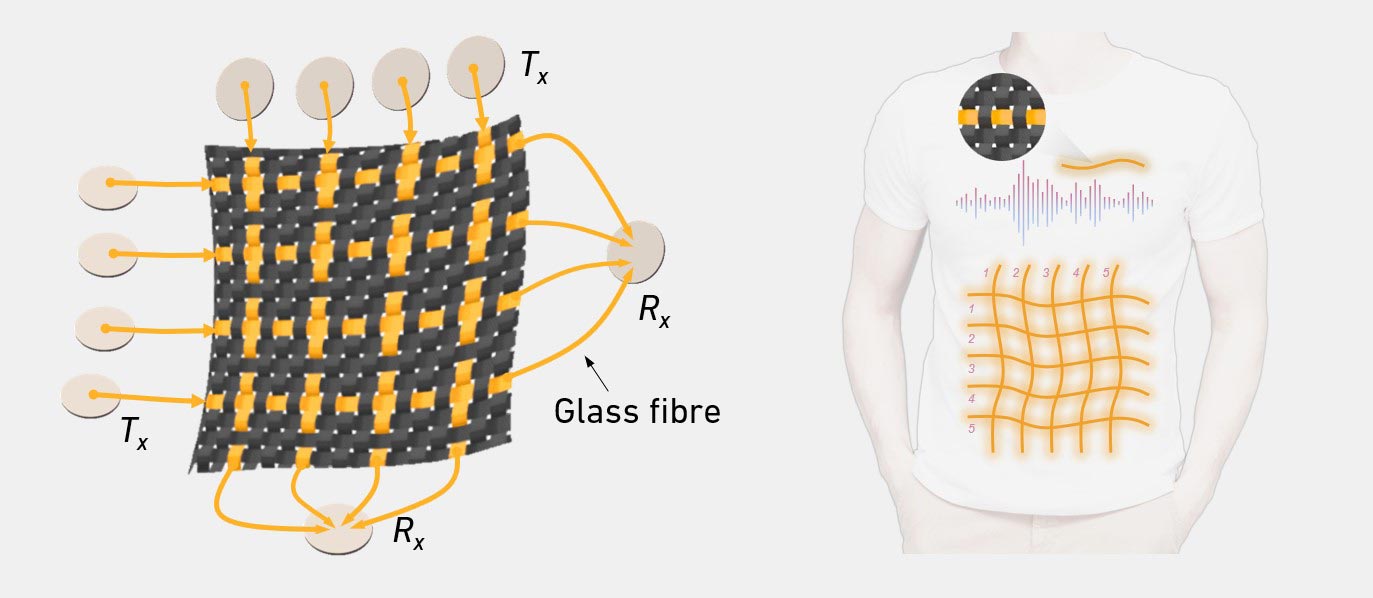
The glass fibers are woven through the fabric at regular intervals (left). A transmitter (T) passes acoustic waves through the glass fibers, while the receiver (R) measures the waves at the other end. Integration of SonoTextiles for creating smart T-shirts (right). Image courtesy of Yingqiang Wang / ETH Zurich.
Smart textiles developed by researchers at ETH Zurich, Switzerland, use acoustic waves and glass fibers to help make precise measurements. They are light, breathable, easy to wash, and inexpensive, and offer great potential for medicine, sports and everyday life.
The researchers call their development SonoTextiles. They have transformed normal fabrics into smart sensors that react to touch, pressure, and movement. “While research has already been conducted into smart textiles based on acoustics, we are the first to explore the use of glass fiber in combination with signals that use different frequencies,” explained doctoral student and researcher Yingqiang Wang.
The researchers have woven glass fibers into the fabric at regular intervals. At 1 end of each glass fiber is a small transmitter that emits sound waves. The other end of each of the glass fibers is connected to a receiver that measures whether the waves have changed. Each transmitter works at a different frequency, meaning it requires little computing power to determine which fiber the sound waves have changed on. Previous smart textiles often struggled with data overload and signal processing issues, since each sensor location had to be evaluated individually.
When a glass fiber moves, the length of the acoustic waves passing through it changes, as they lose energy. In the case of a t-shirt, this can be caused by body movement or even breathing. The researchers have shown that their concept works in the lab.
In the future, SonoTextiles could be used in a variety of ways: as a shirt or t-shirt, they could monitor the breathing of asthma patients and trigger an alarm in an emergency. In sports training and performance monitoring, athletes could receive real-time analysis of their movements, to optimize their performance and prevent injuries. The textiles also have potential for sign language: gloves with this technology could simultaneously translate hand movements into text or speech. They could also be used in virtual or augmented reality environments.