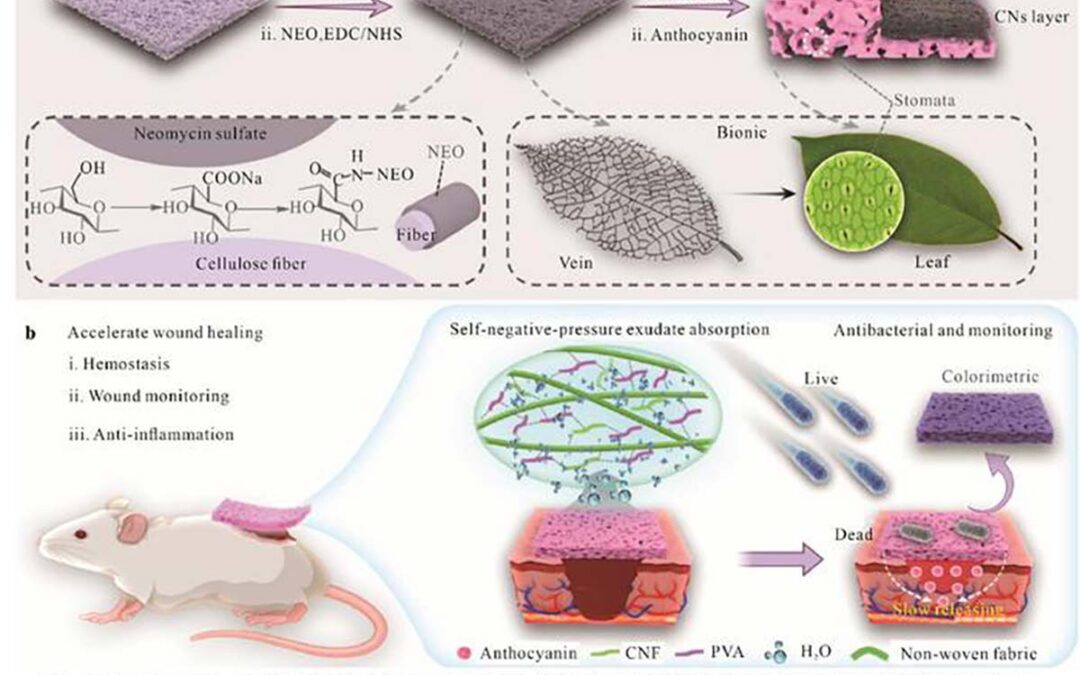









Image courtesy of the School of Biomedical Engineering and Informatics, Nanjing Medical University, China.
A multidisciplinary team from Nanjing Forestry University, Nanjing Medical University, and the University of Bayreuth has unveiled a next-generation wound dressing that behaves like a living leaf yet fights like a miniature pharmacy. The “dual-network gel” (DNG) bandage combines neomycin-grafted cellulose nonwovens with a polyvinyl alcohol/cellulose-nanofiber aerogel that is dyed with blueberry anthocyanins.
When the dressing contacts wound fluid its color shifts from pink to brown, providing an instant visual alert if pH rises above 8–a hallmark of bacterial infection. Simultaneously, the aerogel swells into a hydrogel, generating a gentle negative pressure of -1.44 mmHg that continuously draws out exudate without external pumps. Laboratory assays show the material eliminates over 99.99% of Staphylococcus aureus (S. aureus) and Escherichia coli within 30 minutes and maintains this potency for at least 180 days of shelf storage.
In a mouse model of S. aureus–infected full-thickness wounds, animals treated with the DNG bandage achieved 88% wound closure after 7 days, outperforming a leading commercial dressing that achieved 80% closure. Histology revealed denser new blood vessels and hair follicles beneath the experimental dressing, while real-time polymerase chain reaction tests showed sharply lower levels of the inflammatory markers TNF-α and IL-1β. Despite its aggressive antimicrobial action, the dressing exhibited minimal cytotoxicity and hemolysis below 3%, and it fully biodegraded in soil within 90 days.
The researchers said the innovation combines infection control, exudate management, and smart monitoring in a single, low-cost platform that could be scaled for chronic diabetic ulcers and battlefield injuries alike.