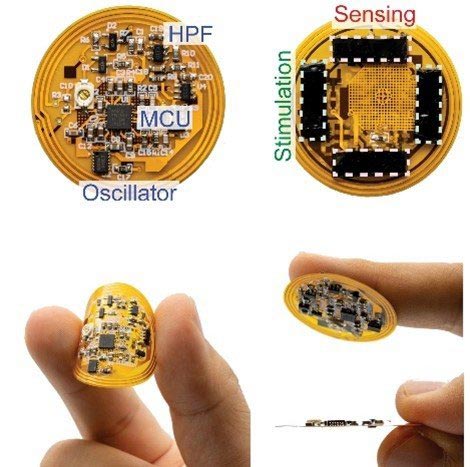
Photographs of the smart bandage showing the MCU, crystal oscillator, high-pass filter (HPF), stimulation and sensing electrodes, flexibility of the printed circuit board, adhesion of the hydrogel interface to skin, and thin layout of the board. Image courtesy of Jian-Cheng Lai, Bao Group at Stanford University.
Researchers at Stanford University report that they have developed a wireless smart bandage that has shown promise in speeding up tissue repair by monitoring the wound healing process and treating the wound simultaneously. The researchers said that their device promotes faster closure of wounds, increases new blood flow to injured tissue, and enhances skin recovery by significantly reducing scar formation.
The smart bandage is composed of wireless circuitry that uses impedance/temperature sensors to monitor the progression of wound healing. By monitoring biophysical changes in the local environment, it can provide a real-time, rapid, robust, and extremely accurate way to measure wound condition. If the wound is less healed or an infection is detected, the sensors inform a central processing unit to apply more electrical stimulation across the wound bed to accelerate tissue closure and reduce infection. The researchers were able to track the sensor data in real time on a smartphone, all without the need for wires.
The electronic layer, including a microcontroller unit, radio antenna, memory, electrical stimulator, biosensors, and other components, is about the thickness of a single coat of latex paint. All that circuitry rides atop a cleverly engineered hydrogel—a rubbery, skin-like polymer—that is integrated to both deliver healing electrical stimulation to the injured tissue and collect real-time biosensor data. The polymer in the hydrogel is designed to adhere securely to the wound surface when needed, yet pull away cleanly and gently without harm to the wound when warmed to just a few degrees above body temperature (40°C/104°F).