







Image courtesy of Sahmyook University.
Samsung Electronics has developed EX1, an exercise assistance robot, with the goal to amplify physical function and strength in senior individuals. This advanced robotic aid offers tailored workouts with both assistive and resistive modes, aiming to prevent falls and bolster overall health in this demographic.
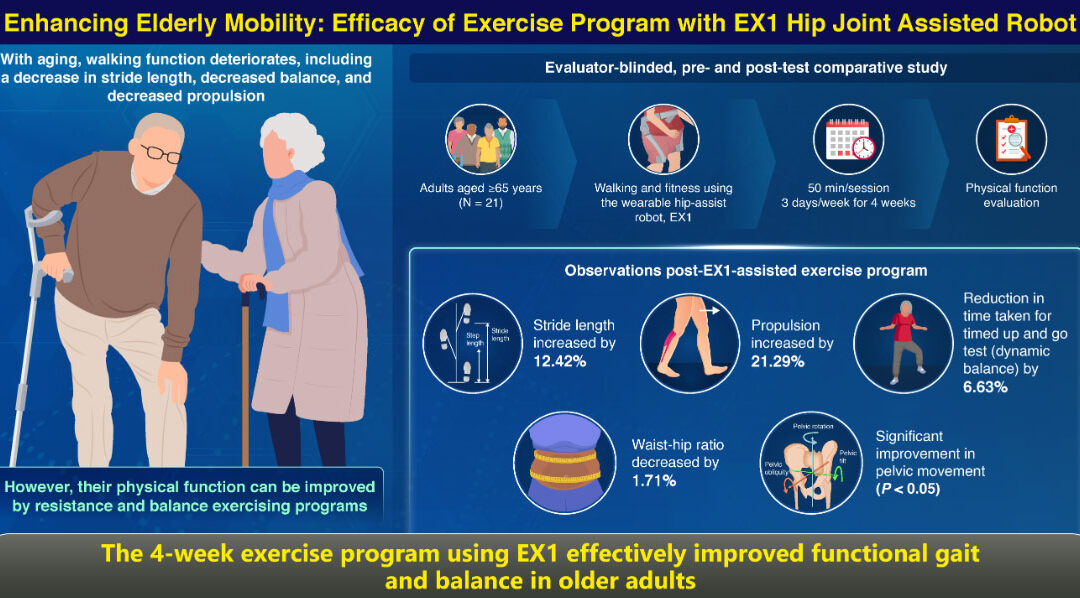
Led by Professor Wan-hee Lee from Sahmyook University College of Health Science, Korea, a collaborative team of researchers, Noble County, and Samsung Electronics, assessed the effectiveness of EX1 in executing a 4-week combined exercise program for older adults. Twenty-one adults age 65 years or above performed a supervised exercise program consisting of walking, and strength and balance exercises, wearing EX1 for 50 minutes per session, 3 times a week for 4 weeks. To compare pre- and post-exercise attributes, the spatiotemporal parameters and pelvic movement were analyzed by G-Walk. Additionally, functional outcomes were evaluated by the Timed Up and Go (TUG) test, muscle power by rehabilitative ultrasound imaging, and waist-hip ratio. Following the exercise regimen, significant improvements were noted in various spatiotemporal factors: stride length increased by 12.42%, whereas propulsion increased by 21.29%, suggesting improved walking ability. The TUG test revealed a 6.63% decrease in completion time, indicating improved dynamic balance and expanded movement range among participants. Additionally, there was a 1.71% reduction in the waist-hip ratio.
While the statistical significance of the increased walking speed wasn’t confirmed, a noticeable enhancement, especially during mid-walking, was attributed to the assistive mode of EX1. This mode notably improved stride length, affecting forward movement in straight walking. Moreover, pelvic movement in 3 planes significantly improved, aligning within normal ranges, fostering efficient walking by reducing energy consumption and bolstering stability through extended feet and a lower body center. The exercise program also positively impacted 1-leg standing endurance, potentially due to strengthened hip-centered muscles crucial for fall prevention among older adults. Analysis of muscle activity revealed heightened activation of core muscles during walking, likely influenced by EX1’s waist support, contributing to trunk stability maintenance.
These findings suggest that although the 4-week exercise period was relatively short for older adults and did not notably enhance muscle strength, EX1 still displayed positive effects on improving gait function and balance ability in this population.