






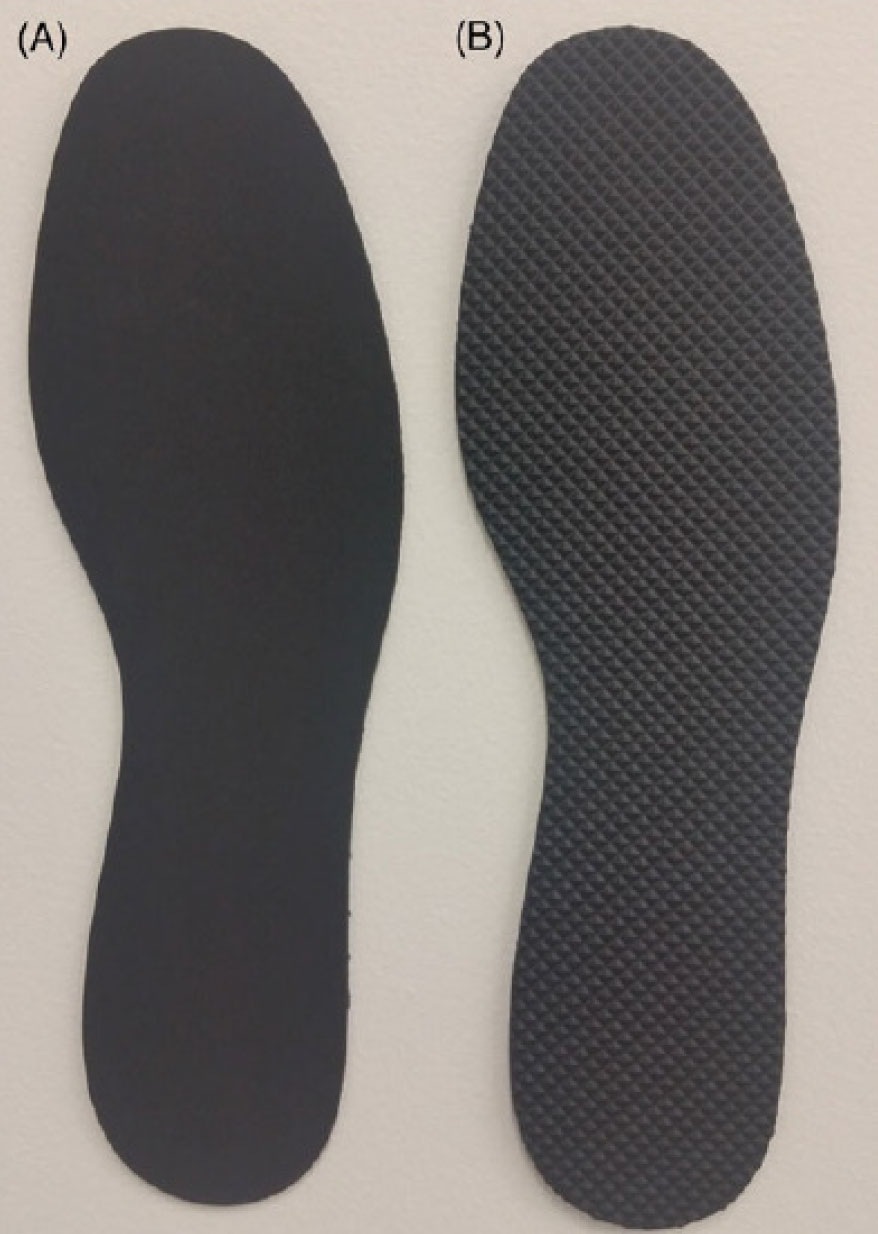
Figure. Smooth (A) and textured (B) shoe insoles.
Innovative shoe insoles, designed to enhance sensory information on the plantar surface of the feet, could help to improve walking in people with Multiple Sclerosis (MS). This study sought to compare the effects of wearing textured versus smooth insoles, on measures of gait, foot sensation, and patient-reported outcomes (PROs), in people with MS.
The authors report on a prospective, randomized controlled trial with concealed allocation, assessor blinding, and intention-to-treat analysis. Thirty ambulant men and women with MS (Disease Steps rating 1–4) were randomly allocated to wear textured or smooth insoles for 12 weeks. Self-reported insole wear and falls diaries were completed over the intervention period. Laboratory assessments of spatiotemporal gait patterns, foot sensation and proprioception, and PROs, were performed at Weeks 0 (Baseline 1), 4 (Baseline 2), and 16 (Post-Intervention). The primary outcome was the size of the mediolateral base of support (stride/step width) when walking over even and uneven surfaces. Independent t-tests were performed on change from baseline (average of baseline measures) to post-intervention.
The results showed there were no differences in stride width between groups, when walking over the even or uneven surfaces (P ≥ 0.20) at post-intervention. There were no between-group differences for any secondary outcomes including gait (all P values > 0.23), foot sensory function (all P values ≥ 0.08) and PROs (all P values ≥ 0.23).
In their conclusion, the authors wrote that in their small trial, prolonged wear of textured insoles did not appear to alter walking or foot sensation in people with MS who have limited foot sensory loss. They also called for further investigation to explore optimal insole design.
Source: Hatton AL, Williams K, Chatfield MD, et al. Effects of wearing textured versus smooth shoe insoles for 12 weeks on gait, foot sensation and patient-reported outcomes, in people with multiple sclerosis: a randomised controlled trial. Brain Impair. 2023;24(2):148-167. doi: 10.1017/BrImp.2022.33.