
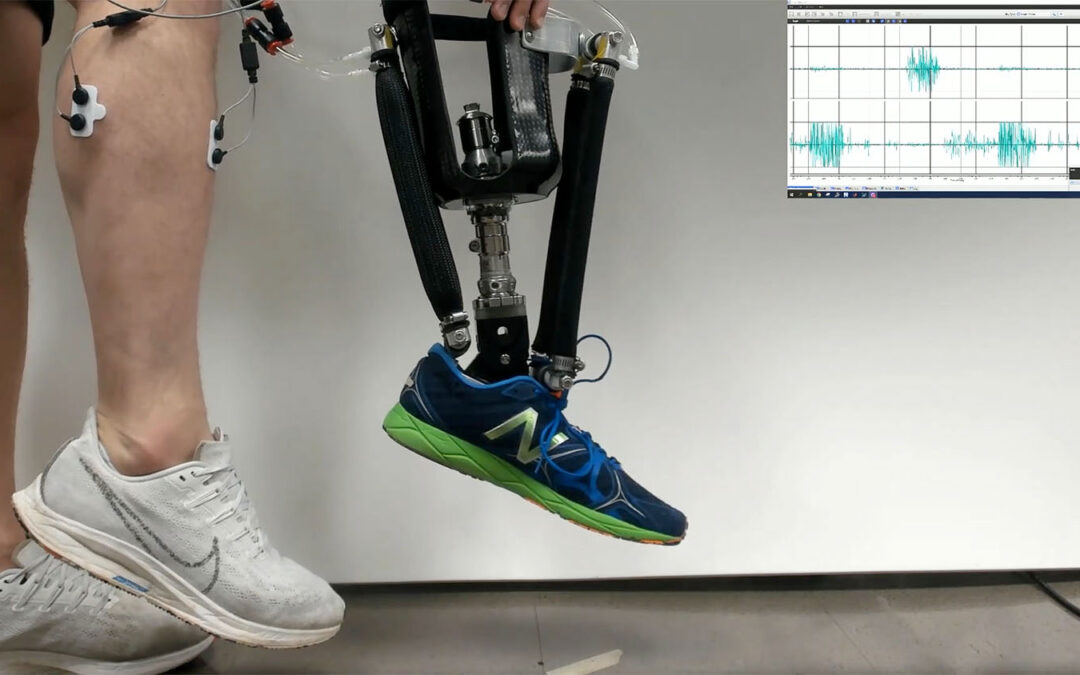








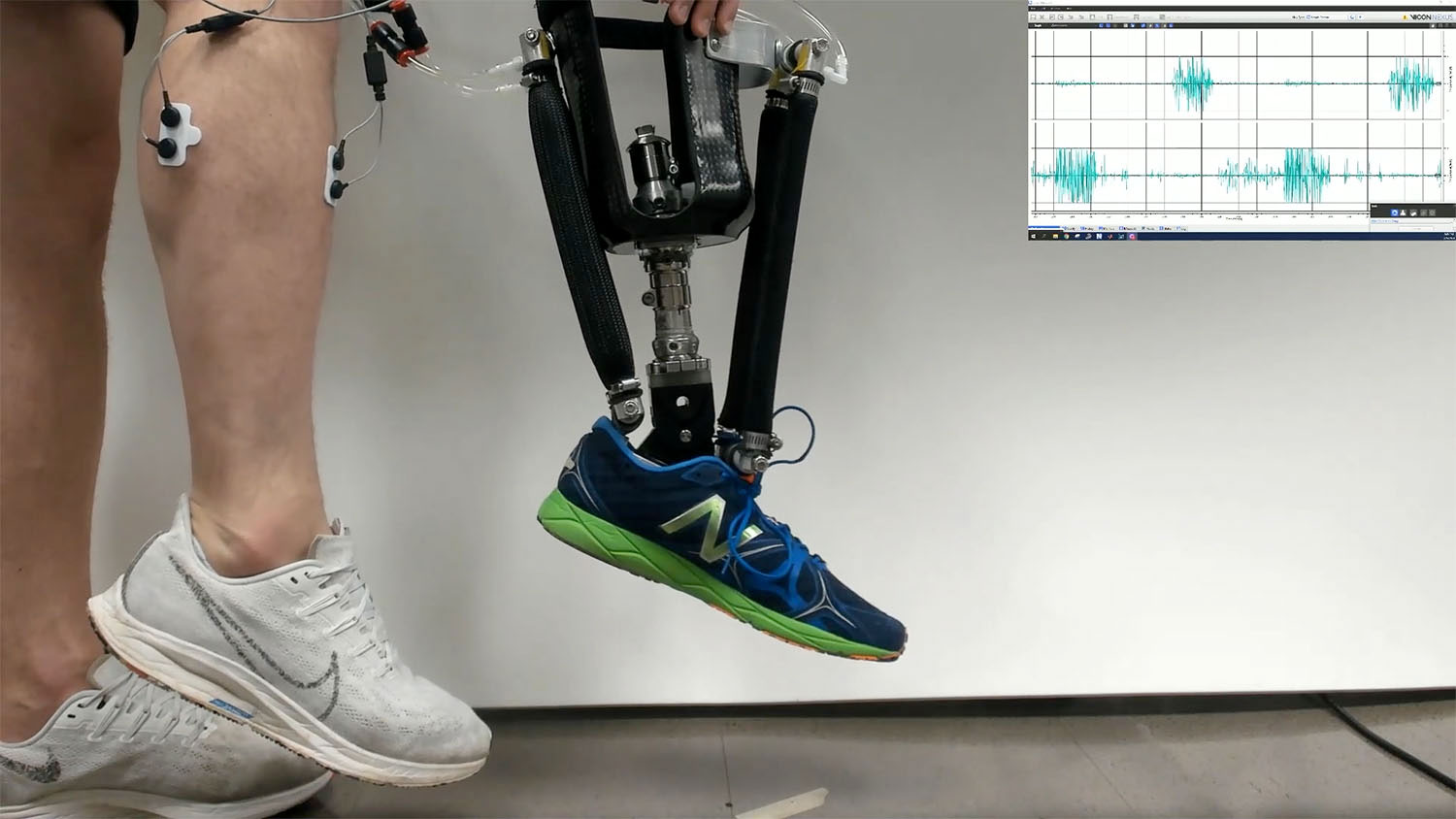
EMG sensors (on calf at left) capture electrical activity generated by muscles when they are flexed. This signal tells the prosthesis which artificial muscle to flex and how much to flex. For individuals with amputation, these sensors are placed in the prosthetic socket. The graph (right) shows the EMG signal, which is used to control the prosthesis. Image courtesy of Aaron Fleming.
Robotic prosthetic ankles that are controlled by nerve impulses allow individuals with lower limb amputations to move more “naturally,” improving their stability, according to researchers from North Carolina State University (NC State) and the University of North Carolina (UNC) at Chapel Hill. “This work focused on ‘postural control,’ which is surprisingly complicated,” said Helen Huang, PhD, the Jackson Family Distinguished Professor in the Joint Department of Biomedical Engineering at NC State and UNC.
This study builds on previous work, which demonstrated that neural control of a powered prosthetic ankle can restore a range of abilities, including standing on challenging surfaces and squatting. The researchers worked with 5 people who had unilateral transtibial amputations. Study participants were fitted with a prototype robotic prosthetic ankle that responds to EMG signals that are picked up by sensors on the leg. The researchers conducted general training for study participants using the prototype device, so that they were somewhat familiar with the technology.
Study participants were then tasked with responding to an expected perturbation under 2 conditions: using the prostheses they normally used, and using the robotic prosthetic prototype.
“We found that study participants were significantly more stable when using the robotic prototype,” said Aaron Fleming, a recent PhD graduate from NC State. “They were less likely to stumble or fall.”
In a separate portion of the study, researchers asked study participants to sway back and forth while using their normal prostheses and while using the prototype robotic prosthesis. Study participants were equipped with sensors designed to measure muscle activity across the entire lower body.
“Basically, muscle activation patterns when using the prototype prosthetic were very similar to the patterns we see in people who have full use of 2 intact lower limbs,” said Huang. “That tells us that the prototype we developed mimics the body’s behavior closely enough to allow people’s ‘normal’ neural patterns to return.”