







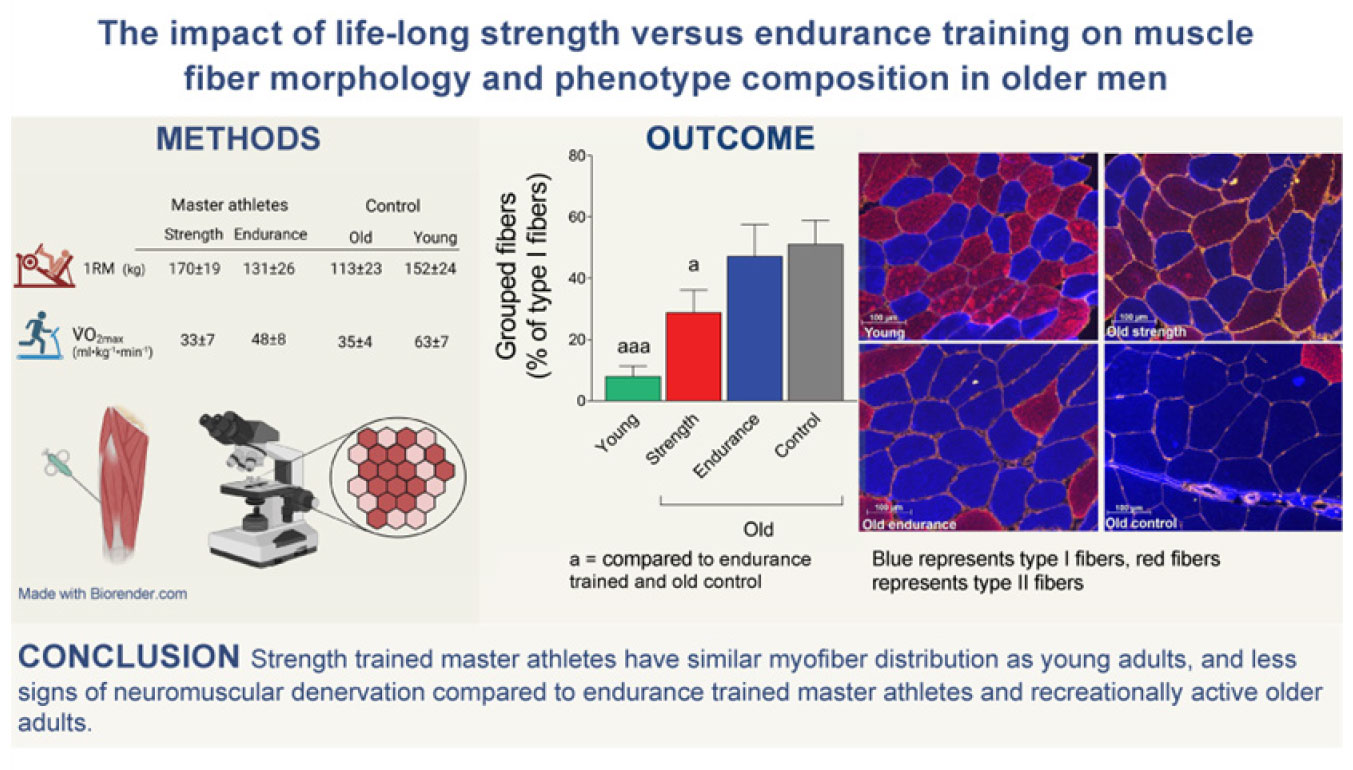
 Aging is typically associated with decreased muscle strength and rate of force development (RFD), partly explained by motor unit remodeling due to denervation, and subsequent loss of fast-twitch type II myofibers. Exercise is commonly advocated to counteract this detrimental loss. However, it is unclear how lifelong strength versus endurance training may differentially affect markers of denervation and reinnervation of skeletal myofibers and, in turn, affect the proportion and morphology of fast-twitch type II musculature. Thus, the study authors compared fiber type distribution, fiber type grouping, and the prevalence of atrophic myofibers (≤1,494 µm2) in strength-trained (OS) versus endurance-trained (OE) master athletes and compared the results to recreationally active older adults (all >70 yr, OC) and young habitually active references (<30 yr, YC). Immunofluorescent stainings were performed on biopsy samples from vastus lateralis, along with leg press maximal strength and RFD measurements. OS demonstrated similar type II fiber distribution (OS: 52.0 ± 16.4%; YC: 51.1 ± 14.4%), fiber type grouping, maximal strength (OS: 170.0 ± 18.9 kg, YC: 151.0 ± 24.4 kg), and RFD (OS: 3,993 ± 894 N·s−1, YC: 3,470 ± 1,394 N·s−1) as young, and absence of atrophic myofibers (OS: 0.2 ± 0.7%; YC: 0.1 ± 0.4%). In contrast, OE and OC exhibited more atrophic fibers (OE: 1.2 ± 1.0%; OC: 1.1 ± 1.4%), more grouped fibers, and smaller proportion of type II fibers (OE: 39.3 ± 11.9%; OC: 35.0 ± 12.4%) than OS and YC (all P < 0.05). In conclusion, strength-trained master athletes were characterized by similar muscle morphology as young, which was not the case for recreationally active or endurance-trained old. These results indicate that strength training may preserve type II fibers with advancing age in older men, likely as a result of chronic use of high contractile force generation.
Source: Tøien T, Nielsen JL, Berg OK, et al. The impact of life-long strength versus endurance training on muscle fiber morphology and phenotype composition in older men. J Appl Physiol (1985). 2023 Dec 1;135(6):1360-1371. doi: 10.1152/japplphysiol.00208.2023.