








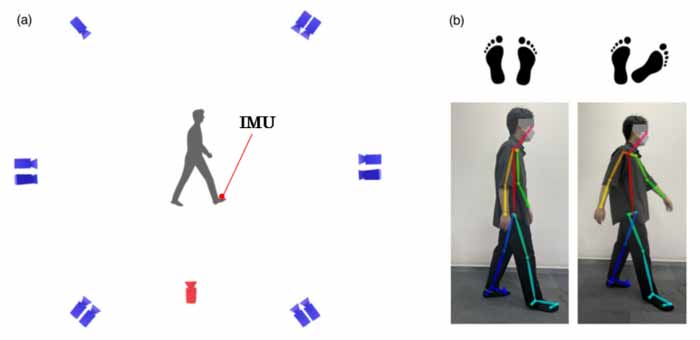
TUS researchers developed a method that enables accurate gait analysis by combining information from a small IMU attached to the shoe with estimated information on the bones and joints of the lower limbs, obtained by capturing the gait from a single RGB camera. Image courtesy of Yamamoto and TUS.
A team of researchers from the Faculty of Science and Technology, Tokyo University of Science (TUS), and from the Prefectural University of Hiroshima, Japan, have developed a simple and accurate sensor-fusion method for accurate gait analysis. They combined information from a small inertial measurement unit (IMU) sensor attached to the shoe with estimated information on the bones and joints of the lower limb, obtained by capturing the gait from a single RGB (red, green, blue) camera.
To test this innovation, the team used single RGB camera-based pose estimation by OpenPose (OP) and an IMU sensor on the foot to measure ankle joint kinematics under various gait conditions for 16 healthy adult men between 21 and 23 years of age who did not have any limitation of physical activity. The participants’ gait parameters and lower limb joint angles during 4 gait conditions with varying gait speed and foot progression angles were noted using only OP as well combined measurements from OP and the IMUs. The latter was the team’s novel proposed method. Results from these techniques were compared to gait analysis using 3DMC, the current gold standard.
The proposed combination method could measure gait parameters and lower limb joint angles in the sagittal plane. Moreover, the mean absolute errors of peak ankle joint angles calculated by the combination method were significantly less compared to OP alone in all the 4 gait conditions. This is a significant development in gait analysis, the team said.
“Our method has the potential to be used not in medicine and welfare, but also to predict the decline of gait function in healthcare, for training and skill evaluation in gyms and sports facilities, and accurate projection of human movements onto an avatar by integrating with virtual reality systems,” said TUS Assistant Professor and research team member Masataka Yamamoto, PhD.