






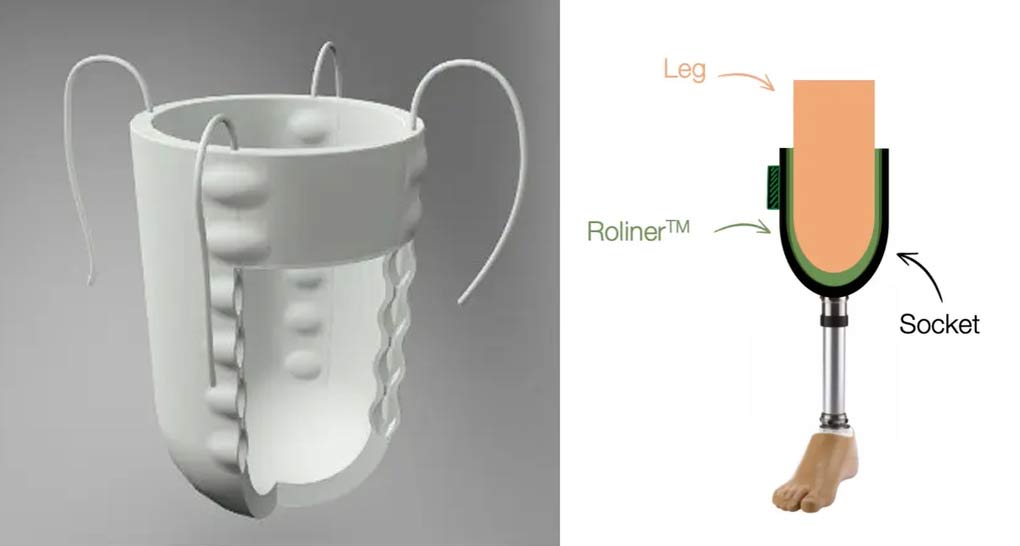
The solution enables individuals to manage their prosthetic limbs and give them more control over their condition; avoid chronic pressure ulcers; and remain more active and productive by enjoying pain-free daily lives. Image courtesy of Imperial College London.
A new dynamically adaptive material, ‘Roliner,’ that was developed by researchers at the Imperial College London, department of bioengineering, offers amputees the power to change the shape, volume, and stiffness of the liner that is used to attach a prosthetic limb’s socket to a residual leg. Amputees could make these tweaks using their smartphone in real-time, providing a more comfortable and personalized fit.
The material can incorporate artificial intelligence so each liner can ‘learn’ the personal preferences of the user. It can automatically adjust its properties according to how the human body changes in response to variables such as the time of day, weight loss or gain, and hormonal fluctuations. An amputee’s desired fit may also change due to the type of activity being undertaken. For example, they may prefer a looser fit while sitting and a tighter, more controlled fit when walking.
Roliner is made from silicone elastomers with channels that can be pressurized to change the material’s properties, meaning its volume and shape can change. Its data-driven approach standardizes the quality of prosthetic fittings. The researchers also believe that the technology could have applications beyond prosthetics, because it could be used in any situation where rigid materials must touch the human body. For example, Roliner could be used to increase the flexibility of exoskeletons used in rehabilitation, to modulate the pressure points of hospital beds, or to improve the personalized fit and safety potential of protective gear such as ski boots and even wearables used by astronauts in space