
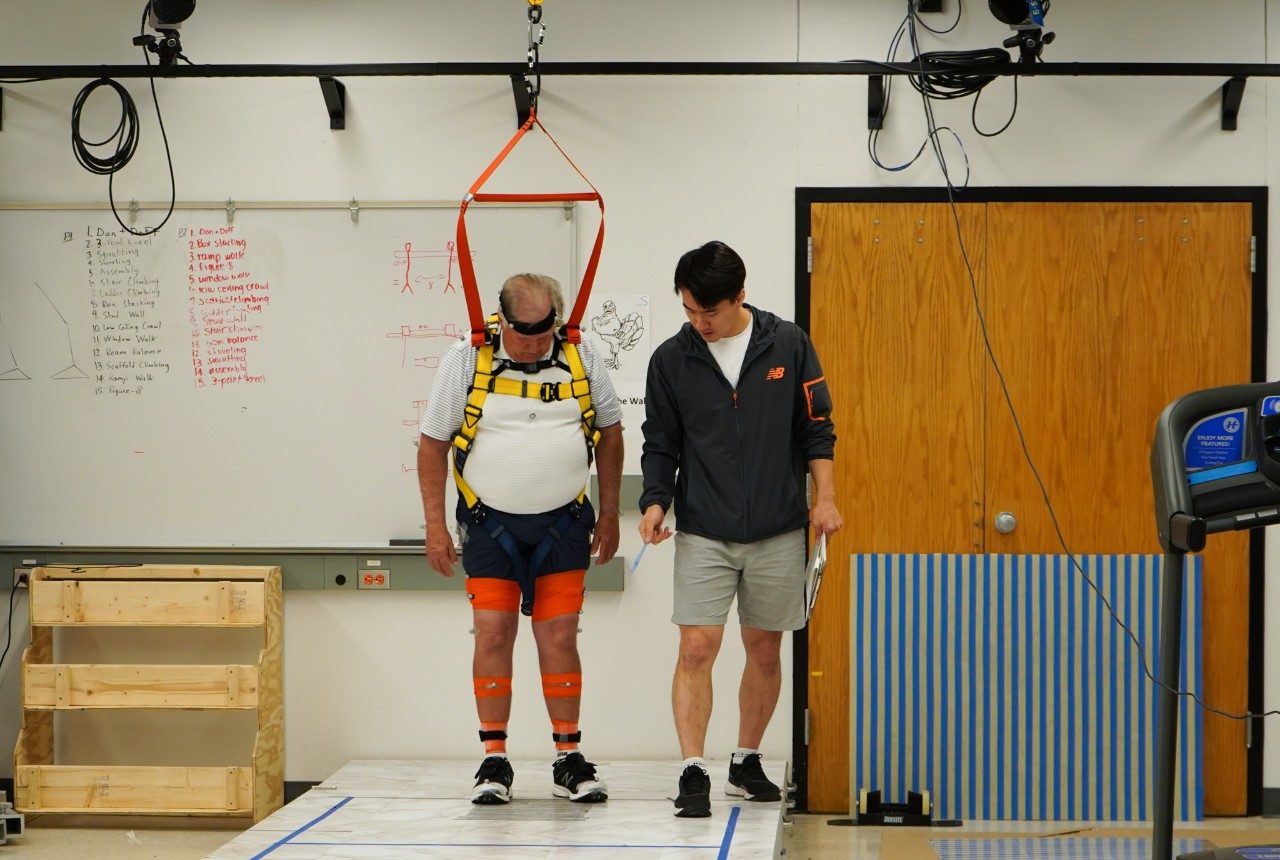








A study participant trips of a section of the walkway that raised shortly before his approach. Lee and other researchers work to make sure participants aren’t expecting the obstacle.
Professor Michael Madigan, PhD, and doctoral candidate Youngjae Lee with the Madigan Biomechanics Group in the Grado Department of Industrial and Systems Engineering at Virginia Polytechnic Institute and State University are working toward a solution to a common problem: trips and falls. They have developed an innovative balance training regimen that could potentially reduce injuries sustained from trip-induced falls in adults over 65.
Lee has also been testing wearable sensors outside the lab to determine if they can accurately track movements and record data for researchers. The goal is for the sensors to measure the effectiveness of balance training in the real world. Lee’s research focuses on reactive balance. His balance training helps participants regain their centers of gravity and strengthen their bodies so recovery after a fall is easier.
The balance training allows participants to safely and repeatedly practice these movements in a controlled manner. Over the course of 3 weeks, Lee and other graduate students meet with participants twice per week to go through progressive stepping exercises that mimic the movements necessary to regain footing during a fall. Once participants are comfortable stepping, the training extends to balancing the upper body and learning to balance the torso. At the end of their training program, participants harness up and test their balance recovery skills in the lab.
In addition to the balance training, participants wear the sensors that record body movements on their shoes and underneath their clothing outside the lab for 3 weeks after training. Lee checks the wearable sensors weekly to ensure they’re working properly and collecting data. Participants also use voice recorders to describe any incidents of trips and falls and subsequent response.
The wearable sensors are being used as an alternative to balance training on a treadmill, which makes the training much more cost effective and accessible. Training could then take place at senior community centers, rehabilitation offices, retirement communities, and other locations.