







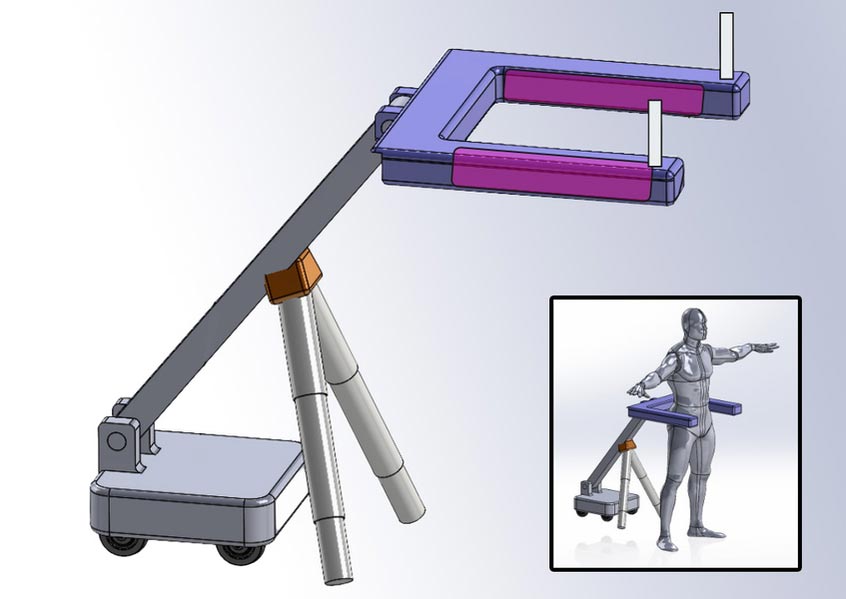
In designing E-BAR, the researchers aimed for a robot that provides physical support, prevents falls, and safely and unobtrusively moves with a person. They looked to do away with any harness, to give a user more independence and mobility. Image courtesy of the researchers.
To help address the eldercare challenge, a team of engineers from the Massachusetts Institute of Technology is looking to robotics. They have built and tested the Elderly Bodily Assistance Robot, or E-BAR, a mobile robot designed to physically support the elderly and prevent them from falling as they move around their homes. E-BAR acts as a set of robotic handlebars that follows a person from behind. A user can walk independently or lean on the robot’s arms for support. The robot can support the person’s full weight, lifting them from sitting to standing and vice versa along a natural trajectory. And the arms of the robot can catch them by rapidly inflating side airbags if they begin to fall.
With their design, the researchers hope to prevent falls, which today are the leading cause of injury in adults who are 65 and older.
In its current version, the robot is operated via remote control. In future iterations, the team plans to automate much of the bot’s functionality, enabling it to autonomously follow and physically assist a user. The researchers are also working on streamlining the device to make it slimmer and more maneuverable in small spaces.