







 By Janice T. Radak, Editor
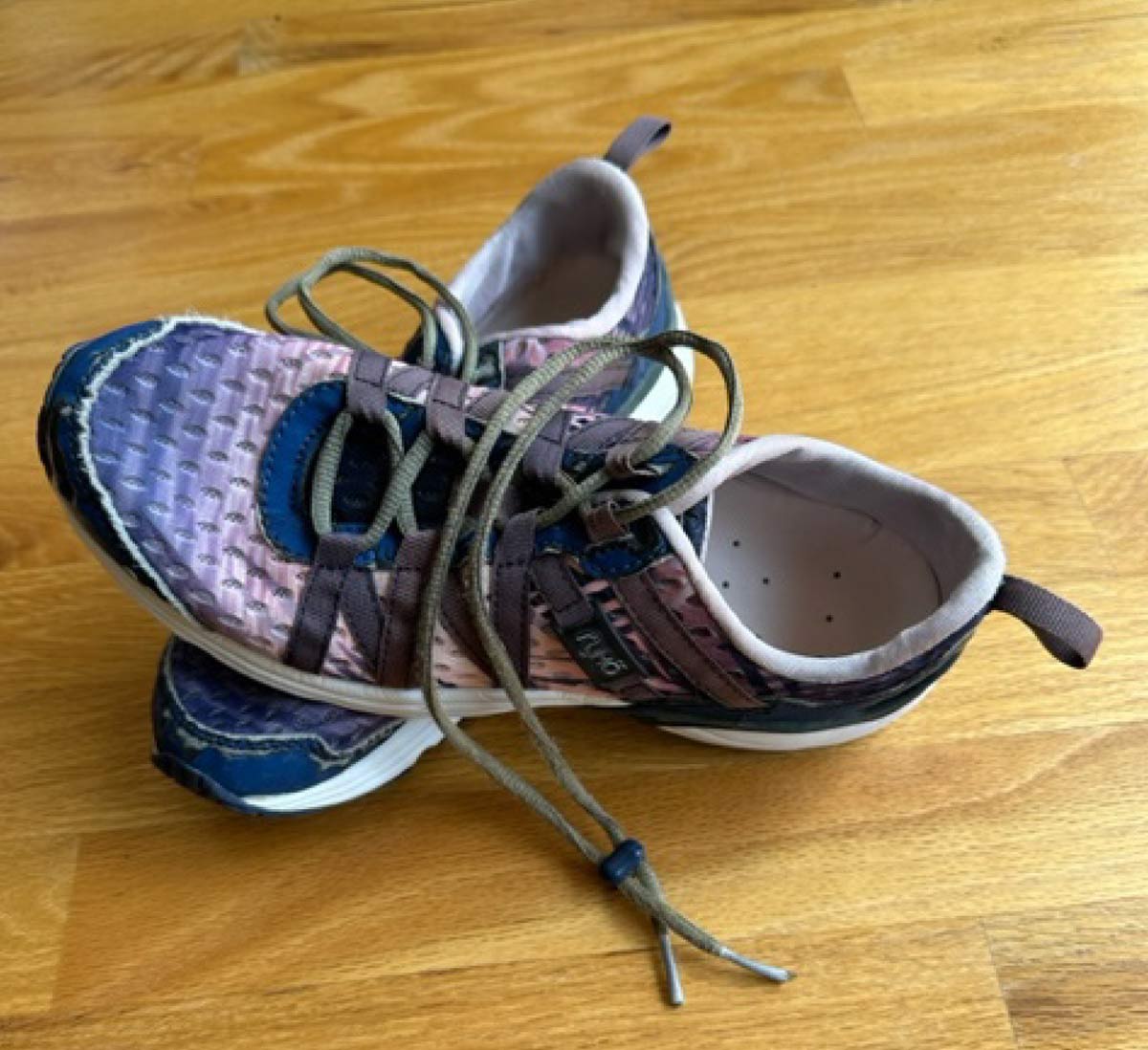
As I stuffed the old water aerobic shoes into the recycle bag, I felt terrible pangs of sadness, like losing a friend who had endured a long journey with me. I’d been through a lot in those shoes.
I lost 40 pounds in those shoes.
I healed an injured back in those shoes.
I got off high blood pressure medicine in those shoes.
I was able to tolerate a 4th day at Disneyland in 90-degree heat in those shoes (granted I swapped out their insoles for a sturdier orthotic insole, but still…).
I made myriad new friends in those shoes who continue to support my water aerobic habit.
Those shoes supported my arches, kept the plantar surfaces of my feet from being rubbed raw by the pool floor, and with the help of an elastic plantar fascia sleeve, kept my left posterior tibial tendon from being shredded by the sesamoid on my left foot.
Those weren’t just shoes, they were a mandatory part of my workout. They weren’t just workout clothes…they were personal equipment. Personal protective equipment. PPE!
And that made me think about a Guest Perspective we ran 18 months back— “What If We Adopted PPE as a Mindset for Ankle Protection?” by the Australian inventor and designer, Craig J. Hubbard.1 In that article, he argued that the taping methods used today for ankle injury prevention are basically the same as those that were in play when we landed a man on the moon—50 years ago! Yet we know far more today about the long-term cumulative costs of ankle injury and the subsequent post-traumatic ankle osteoarthritis (PTAOA).
As noted by the Ankle Consortium in their 2016 Consensus Statement,2 while a single lateral ankle sprain (LAS) is often considered an innocuous injury that will heal on its own, “Unfortunately, the majority of patients with a history of LAS will sustain at least one additional sprain, with many developing physical and subjective functional limitations, with ongoing ‘giving-way’ in the affected ankle, resulting in the defined condition of chronic ankle instability.”
The statement goes on to say: “Compounding the high percentage of the population that reports a history of LAS, is evidence of early onset PTAOA, along with decreases in physical activity levels and health-related quality of life. This illustrates that PTAOA is a degenerative health issue that is not exclusive to middle-aged and elderly populations. Furthermore, the financial impact of LAS is high, with billions spent annually on initial treatment and follow-up care. The negative consequence of LAS and chronic ankle instability are concerning, and improved efforts to address these conditions must be initiated.”
But Hubbard pointed out that “ankle safety in sports is not given the same media, research, or administrative attention, nor is it subjected to the same risk assessments, standards, and testing as traditional sports PPE, such as helmets, pads, mouth guards, or even the gloves staff use to prevent blood infections.”
He went on to argue that the long-term effects of LAS have not garnered as much attention to date as concussion, yet LAS occurs far more often. As a result, he said, the absence of consistent safety standards and public awareness of the real costs of LAS allows the continued use of ankle tape as PPE for athletics across the spectrum.
But things may be shifting. In a January 2023 systematic review and meta-analysis (the most recent available at this writing), Wang et al3 concluded that proprioceptive training is recommended for preventing LAS, especially for people with a history of lateral ankle sprain. Bracing, they argued, seems to have an ambiguous preventive effect and requires further investigation.
As we encourage more physical activity across the age spectrum, given the prevalence of ankle sprains, we should rightfully expect more ankle sprains. But will tape be an appropriate preventive for all populations? What about the waste factor—what to do with all that used tape? What about those with sensitive or fragile skin? What to do about adhesive-on-adhesive residue—will that provide enough support? What about the dreaded MARSI—medical adhesive-related skin injury? What about folks with arthritis whose flexibility prevents the reach needed to properly apply the tape? Are there alternatives in development?
What Hubbard was really arguing for is a mindset shift. Moving away from the notion of ankle sprain as a 1-off injury that just needs a band-aid. Just as we wouldn’t ask someone with a partial foot amputation to simply stuff a sock in an old shoe, should we really ask athletes—or anyone who is being physically active regularly—to use a 50-year-old solution that current evidence doesn’t truly support?
“What’s in a name? That which we call a rose/ By any other name would smell as sweet.”

As I recall from high school English, Juliet’s line is meant to convey the idea that what’s important is what a thing is…not what it is called.
Since parting with these shoes, I have a clearer idea of what their successors actually are…and what they actually do for me. They are indeed personal protective equipment for me and my specific challenges.
But one has to wonder,what is the most effective PPE for the long-term complications of LAS?
With apologies to Shakespeare…
Janice T. Radak is Editor of Lower Extremity Review.
- Hubbard CJ. What If We Adopted PPE as a Mindset for Ankle Protection? Lower Extremity Review. 2020;8:15-16.
- Gribble PA, Bleakley CM, Caulfield BM, et al. 2016 consensus statement of the International Ankle Consortium: prevalence, impact and long-term consequences of lateral ankle sprains. Br J Sports Med. 2016;50:1493-1495.
- Wang F, Guan Y, Bamber Z, et al. Preventive interventions for lateral ankle sprains: A systematic review and meta-analysis. Clin Rehabil. 2023 May;37(5):585-602. doi: 10.1177/02692155221137640. Epub 2023 Jan 11. PMID: 36630892.