Every avalanche begins with the movement of a single snowflake, and my hope is to move a snowflake. Thomas Fey
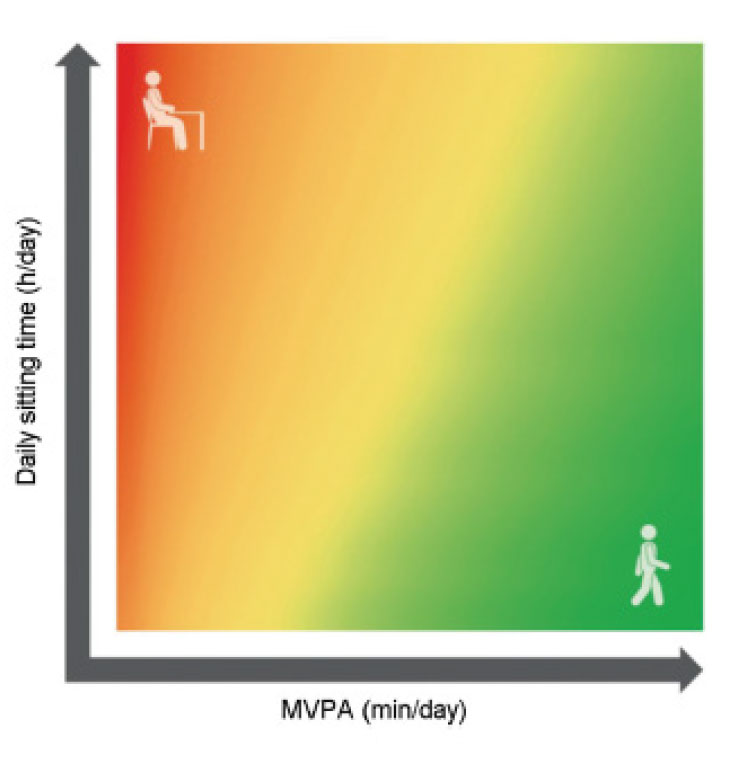
Figure. Relationship among moderate-to-vigorous physical activity (MVPA), sitting time, and risk of all-cause mortality. The red zone illustrates greater mortality risk with higher amounts of sitting time combined with low levels of MVPA (top left corner). The green zone illustrates how higher amounts of MVPA can mitigate the risk of even moderate-to-high levels of sitting time (top right area). Reprinted with permission from reference 1. All rights reserved.
By Janice T. Radak, Editor
Happy 13th birthday Lower Extremity Review! Like any growing teenager, we’ve been through some changes, but there are plenty more still to come!
Just before the pandemic started, we began to identify and understand what LER’s users wanted to learn more about so we could better focus our coverage. Mobility and all that keeps us moving topped that list. And key to mobility, you guessed it, is the lower extremity! Our findings led to the development of the 4 pillars of editorial coverage which were introduced in June 2020:
- Biomechanics matter
- Injury prevention is possible
- Diabetic foot ulcers can be prevented
- Collaborative care leads to better outcomes.
While these 4 pillars identify critical areas, when you look at the literature overall, a far bigger picture emerges in 2022: bodies that are physically active have better health and quality of life outcomes.
And so, as we enter our 13th year, we are adding a new pillar of coverage: Movement is essential. We use movement to mean physical activity (PA), where PA is defined as any voluntary bodily movement produced by skeletal muscles that requires energy expenditure. Indeed, the evidence is pretty clear that movement does a body good. In its 2018 report,1 the Physical Activity Guidelines Advisory Committee (PAGAC) found robust evidence to show that:
- There is a dose-response relationship between sedentary behavior (SB) and all-cause and cardiovascular disease (CVD) mortality risk, as well as a direct relationship with CVD, type 2 diabetes (T2D), and certain cancers. However, the risk associated with SB can be attenuated with greater amounts of moderate-to-vigorous physical activity (MVPA).
- PA lowers weight and fat gain and is associated with better bone health, even in children as young as 3 years.
- In older adults, multicomponent PA reduces risk of fall-related injuries; aerobic and multicomponent PA and balance activities improve physical function in the general population, as well as in those with frailty or other chronic conditions.
- Regular PA helps reduce the incidence of hypertension.
- Both the risk of T2D and the risk of its progression can be reduced with MVPA, aerobic, and dynamic resistance exercise—independent of weight status.
- PA prevents weight gain and helps maintain healthy body weight in both adults and children and is strongest for those who spend >150 min/week in moderate-intensity activity.
- PA improves cognitive function across the lifespan, quality of life, symptoms of anxiety and depression, and sleep.
This issue is dedicated to all of the benefits provided by movement in all its forms—physical activity, exercise, resistance, whatever you want to call it. We pulled together articles that examine ways to reduce sedentary behavior and the myriad benefits that accrue when patients are encouraged to move—from improved glucose metabolism to the prevention of loss of muscle mass.
We also include the Physical Activity Guidelines for Americans as well as a discussion of resistance and high intensity interval training in older adults. The data is clear: Movement is safe for most people. Starting small and gaining confidence is key to getting patients engaged enough to do more.
And we also address what physical activity can do for two common and critically important conditions: plantar fasciitis and diabetic peripheral neuropathy—yes, exercise can be a logical part of a therapeutic regimen for both of these conditions. And we also introduce you to an innovation that could transform how you think about walker assist devices.
Just as we do for the other 4 pillars, we will be covering ‘Movement is essential’ in every issue. As the Baby Boomers age and more need guidance on how to stay or start becoming physically active, the message of this pillar will only grow in importance.
We welcome your thoughts on the topic…please feel free to email me at ja****@*********ne.com.
Here’s to making movement essential everyday.
Reference
- DiPietro L, Buchner DM, Marquez DX, Pate RR, Pescatello LS, Whitt-Glover MC. New scientific basis for the 2018 U.S. Physical Activity Guidelines. J Sport Health Sci. 2019;8:197-200.