







 By Simon Bartold
In Part I, we looked at some of the great paradigms of injury prevention that have underpinned the running shoe industry for more than 40 years: overpronation/motion control and cushioning. Did these paradigms stand up to scientific scrutiny? The evidence would appear to be no. So, where else should we be looking? In Part II we will examine the nature and effect of vibration on human systems during running and pose a possible alternative explanation for running-related injury and performance.
Let’s have a look at what else—besides overpronation/motion control and cushioning—might be involved, because in relation to the link between injury and load… the answer has got to lay elsewhere.
So if it’s not motion control, or cushioning, then what might
it be?
- We need to understand that midsole geometry is the key.
- Technical foams are here to stay.
- Having a shoe that’s very lightweight is important.
- We’ve moved away from rigid footwear as a control strategy to increase flexibility.
- We’ve moved away from this concept of footwear segmentation.
Figure A shows the Salomon Predict on the bottom that I was very involved in, and then Brooks did the Aurora. You can see these are heavily decoupled shoes. Look at the Predict’s whole back segment. This is a 2-piece upper where the whole back segment is extremely flexible. In fact, it was not built in a running shoe factory. It was built in the factory that builds the Victoria’s Secrets bras. Yes, it was built in a bra factory because obviously they’re experts at form-fitting. So, the Predict is extremely flexible, extremely decoupled, and the same with the Aurora. This is possibly the way of the future.
What Should the Model Shoe Look Like?

Figure A: Now we’re looking at shoes like this: Salomon Predict on the bottom and Brooks Aurora on top.
Geometry, not additional support components, are the most important things. We’ve got to focus not on whether a runner is pronating or supinating, in other words, frontal plane. We’ve got to try to figure out how the runner moves forward, in other words, forward transition. How do you get from contact to propulsion most efficiently, economically, and effectively? That’s got to be the focus. We’ve got to change our focus away from pronation and supination.
So cushioning is not so much about injury prevention due to impacts, but rather it’s more about comfort. And we know that comfort equals performance and most likely affects fatigue. And when we talk about fatigue, we’re going to change gears here a bit because fatigue in injury may well be the smoking gun and the thing that we really do need to have a look at. It’s something that’s under-researched and not very well understood.
Vibration is like a great black hole in footwear research, although it probably is responsible for around 20% of all input load–think about things like pressure, impact force accelerations, things like that. Vibration accounts for about 20% of all impact load.
Put simply, the human body is a vibrating system: While you’re sitting there listening to me, I’m talking to you, creating a shockwave that’s going into your ear, and it’s creating a vibration amongst the little bones in your ear that are allowing your brain to interpret it as a sound signal. Meanwhile, you’re vibrating. You’re reacting with the chair. Believe it or not, that’s what’s happening.
So the impact force generates an input signal which is a shockwave, and the response to this shockwave when you run is a muscle adaptation, the so-called muscle tuning, and it varies completely from athlete to athlete.
When you’ve got the frequency of input of the vibration, in other words the frequency of the interaction between the shoe and your body, if that equals the frequency of vibration of the tissue, then we have something called resonance, and resonance is a bit of an issue because when that happens, we try to focus on attenuating or dampening the input vibration.
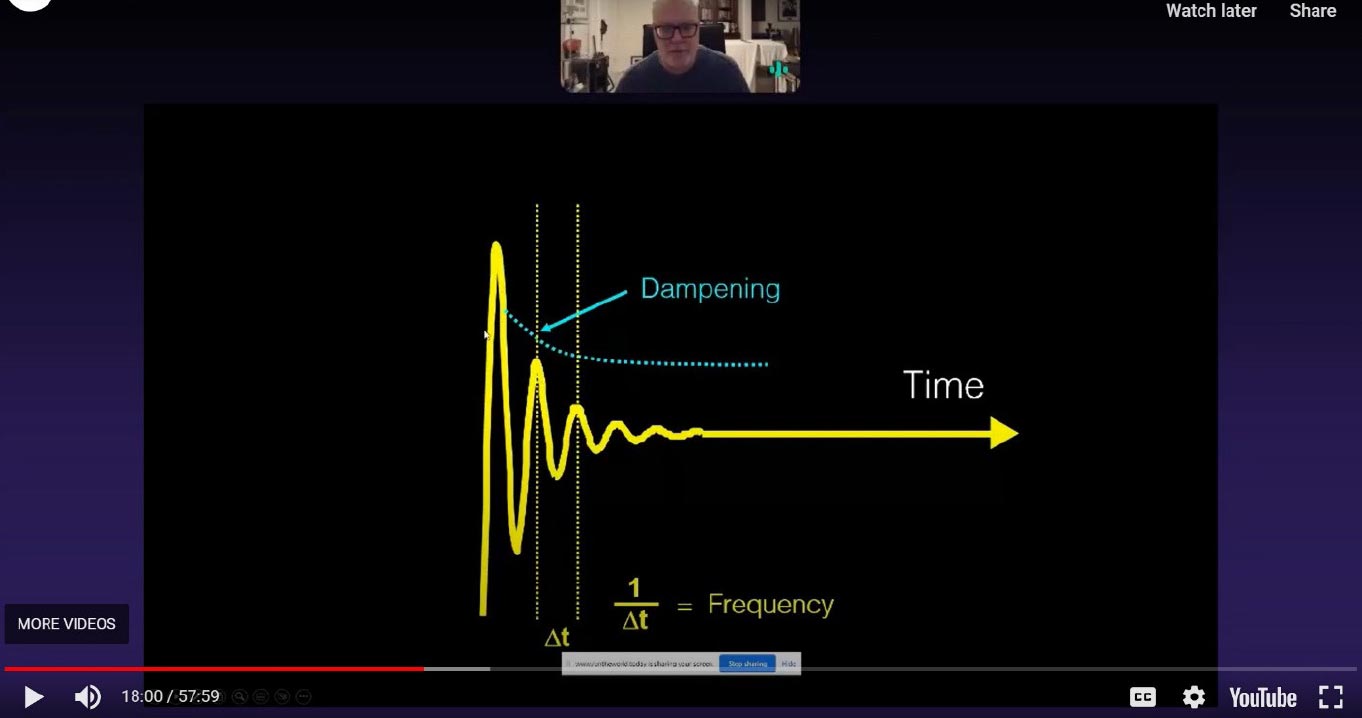
Figure B
Vibration exists in both the amplitude domain and also a frequency domain. We don’t want to affect them both: We want to try to reduce the amplitude and widen the frequency if we possibly can (Figure B).
There are a couple of things we can look at:
- Kurtosis is basically shock, and this looks at the amplitude of the vibration which we measure with an axial tibial accelerometer (Figure C top)
- Perhaps more important, again using accelerometer, is to look at the frequency of the vibration which is measured by using something called the Power Spectral Density (Figure C bottom)
Using these, we can convert the accelerometer data into the frequency of the vibration. Frequency is simply the number of vibration waves that pass a fixed place in a second and is measured in Hertz. In other words, if you’ve got a frequency of 300 Hz, it means that you’ve got 300 vibrations going by in 1 second.
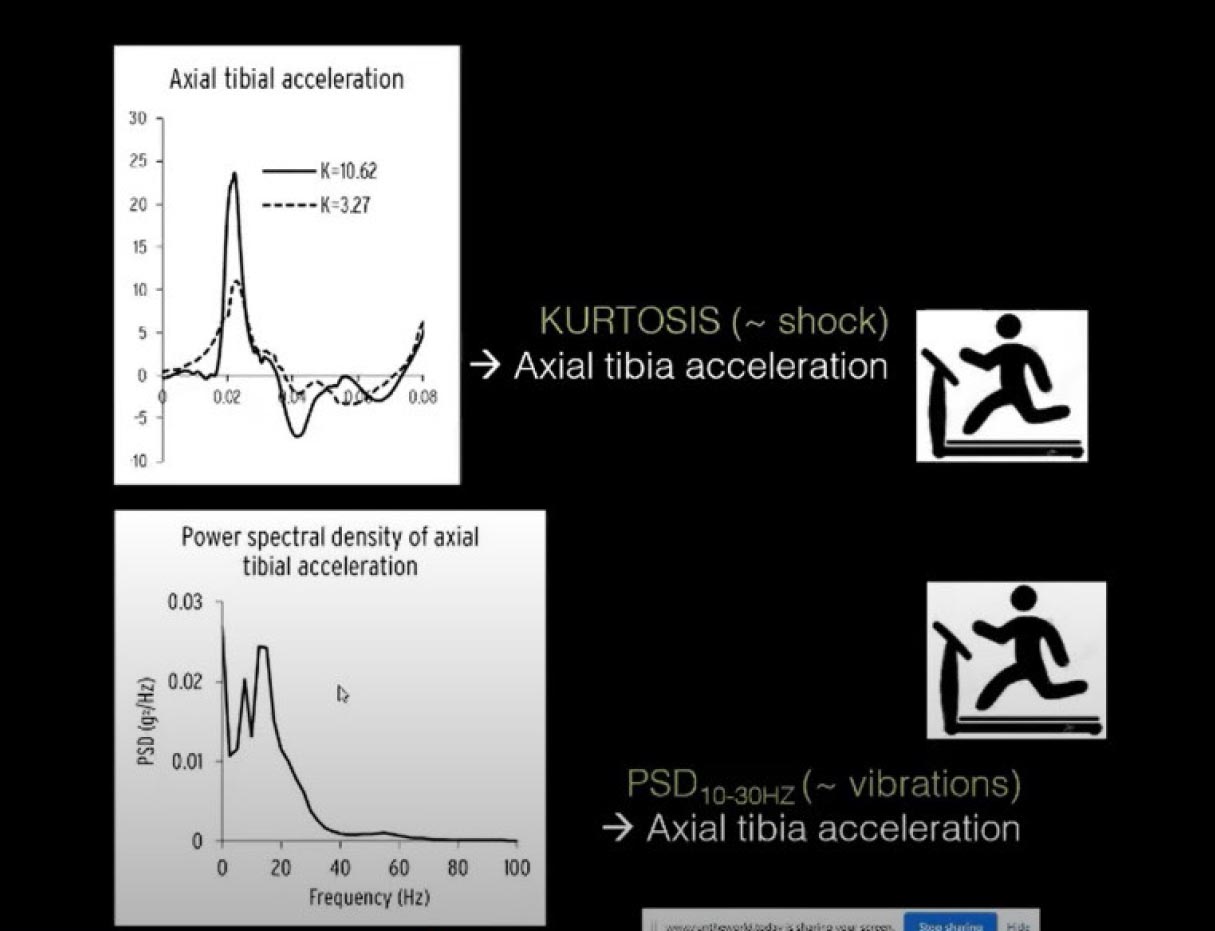
Figure C
There are 2 main ways that we can influence or dampen or attenuate vibration. The first is by muscle contraction (more on that later). The second main way we can do it is with footwear. But if we’re going to use footwear to reduce vibration, we’ve got a conundrum. Take the Achilles tendon for example. This tissue vibrates–probably between 10 and 30 Hertz. Now we’ve got this shoe called the Asics Gel- Kayano® 29. This shoe costs almost $300 in Australia and it’s a very good shoe. But what if, and I’m not saying it does, but what if this shoe just happened to vibrate at 10 to 30 Hertz?
If that were the case, then [the Achilles tendon and the shoe] would match and we would have resonance. We’ve all experienced vibration resonance: When you’ve got a baseball bat, or here in Australia a cricket bat, and you hit the ball off the sweet spot, and you get that nasty sensation coming through the bat into your hands. That is resonance. That’s when the input vibration of the ball matches the input vibration of the baseball bat, and you get resonance.
This resonance can happen with footwear. If the shoe matches the vibration frequency of the tissue, you get resonance, and when you get resonance, you’re far more likely to get injury, which is what we want to avoid if we possibly can. So, we have to try to shift either the frequency of the shoe or the frequency of the tissue in 1 direction or another.
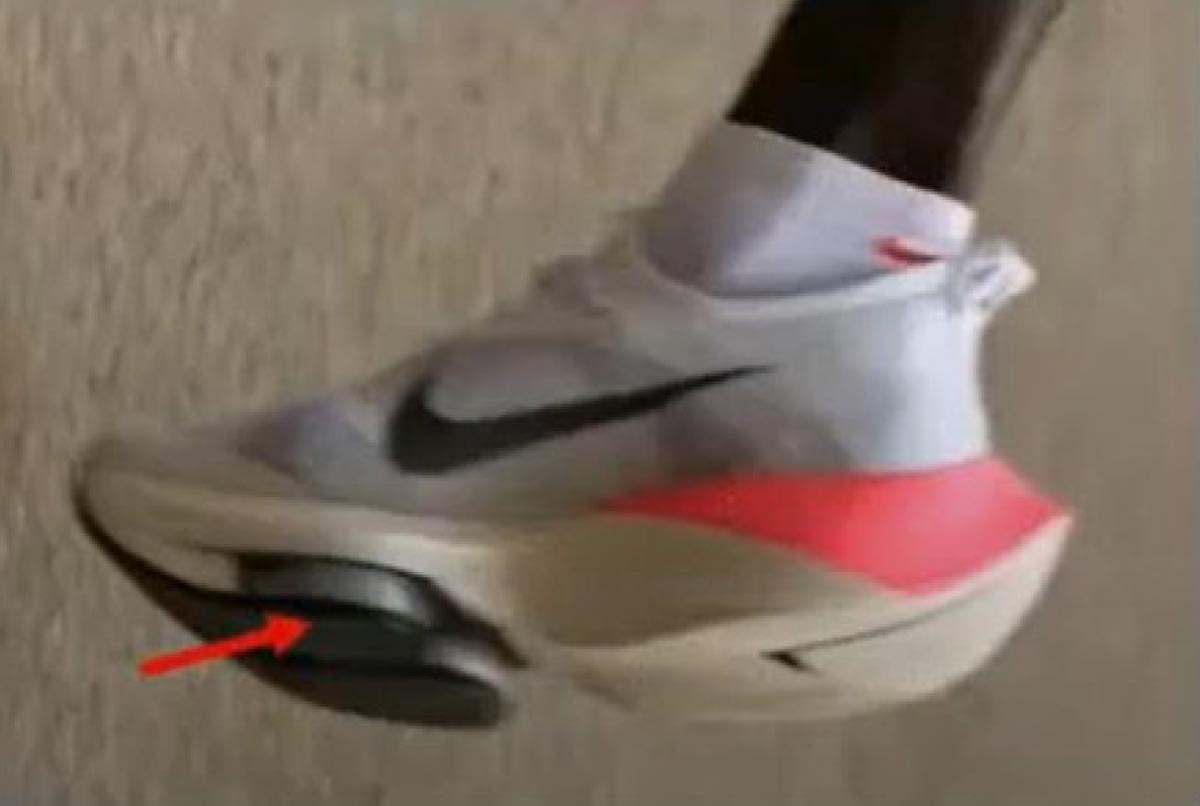
Figure D
Now the inter-relationship between muscle preactivation, fatigue, stiffness, effective mass, and tibial acceleration are complicated. It may well be that when Nike introduced the Vaporfly Next%® into the Ineos 1:59 challenge with the great Eliud Kipchoge in Vienna a couple of years ago, where he was the first man to go under 2 hours for the marathon distance of 26.1 miles, it may well be that somehow Nike either willingly or unknowingly cracked this nut of vibration and the link to fatigue. [The Vaporfly, Figure D] has this very unusual setup of these ZoomX foam pads in the forefoot, a massive rocker, huge amounts of foam, and the foam is very, very high energy-return and energy-storage foam. So something a bit strange is definitely going on with this shoe.

If you don’t believe me, watch the video of Kipchoge crossing the Ineos 1:59 finish line and ask yourself:
This guy has just gone 1:59:40 over the distance of 26.1 miles for the unofficial prize, does he look fatigued to you? Because he doesn’t look fatigued to me. He looks like he could turn around and run 26 miles back in the other direction; he looks as fresh as a daisy as he finishes the finish line. [This video can be viewed in the program on lerEXPO.com] Now I’ve seen other athletes like Ryan Hall. When he became the fastest American marathoner, he looked like he was going to die when he went over the finish line. Marathoners typically look absolutely exhausted, but Kipchoge doesn’t. Granted, this was a very staged event, of course, and every nuance of the event was determined. However, I do think the footwear is certainly playing a role in this and there’s something quite extraordinary going on there.

Figure E
Understanding Vibrations
We need to understand there are good vibrations and there are bad vibrations. When we look at good vibrations, these are physical forces: they result in maintenance or gain of bone mass. We’ve got Wolff’s law which shows these forces drive the healthy adaptation of bone structure. If we look at the great Rafael Nadal (Figure E), and I ask you, which is his dominant limb? It’s very easy for you to look at a picture like this and say, well obviously it’s his left arm because you can see the adaptation that’s occurred. It’s obvious his bone mass is completely different between the 2 forearms. If we were able to look inside, we could see osteopenic versus normal bone. There’s bone adaptation occurring here as a direct result of load. And this is the reason we have 2 groups who are very vulnerable to bone loss. First is swimmers, particularly distance swimmers, who spend so much time in the water, which is a pretty much gravity-free environment. They have to be doing weight-bearing activities that stress bone to maintain their bone mass. Second is astronauts. They have treadmills up in space so they can engage in activities that will stress bone and allow them to maintain their bone mass.
And then there are bad vibrations. When you watch the video of this fellow operating vibrating machinery, you can see his arms wobbling as the vibrations go throughout his system. You can see he’s smiling. By smiling, he’s contracting the muscles of his face and you can see there is nothing happening–no wobbling on his face. But when he stops smiling and relaxes his face muscles, you can start to see the vibrations–the wobbling–coming all through his face all the way to the top of his head.
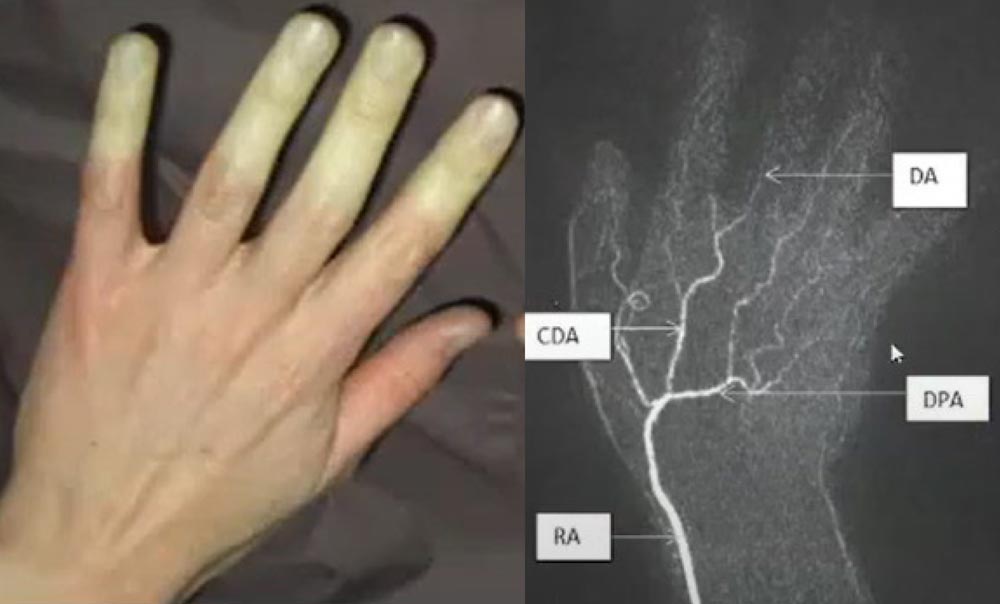
Figure F
People who habitually operate vibrating machinery do get some fairly significant issues, in particular a very fairly well documented condition called hand-arm vibration syndrome (Figure F, top). It’s like a fairly severe form of Raynaud’s phenomenon, with some nerve and muscle damage. In this magnetic resonance angiography (Figure F, bottom), we see a complete occlusion of the ulnar artery which is what’s causing the fingers to go white, because the blood’s not getting down there, so we know for certain that as a result of vibration, we get nerve and muscle damage.
We’ve also got bone injury and have recorded specifically stress fracture as a result of vibration. Unfortunately, at the moment we’ve only recorded that in rabbits, but it would seem fairly likely that we can draw a fairly strong dashed line to injury from vibration in humans, and this is why we think vibration is so incredibly important.
At Salomon, when I was there from 2014 until 2020, we spent a lot of time looking at the average transmissibility of shock or vibration through 24 tissues from the toes right up through the cervical vertebrae. Figure G shows different color codes for different tissues. If it’s in the negative, it means you’ve got no transmissibility of vibration at all. If it’s in the positive, you’ve got the vibrations being transmitted to the tissue now.
If we look at this group of positive bars where we’re getting fairly obvious large transmissibility of vibration through the system, it equates to the part of the human body in the red-tint box. You should ask yourself, isn’t this the area where we see most injury occurring in runners? The answer is yes, most runners get injured in the tissues below the knee, with a very high focus for injuries around the metatarsals, the bones of the foot, the heel, going all the way up to the knee. This graph, then, beautifully demonstrates why we think vibration might be very important.
Adding to this, one of our biomechanists was also able to track the vibration frequency of all these tissues at work as well, and that’s why we know that the Achilles tendon vibrates at about 10 to 30 Hertz.
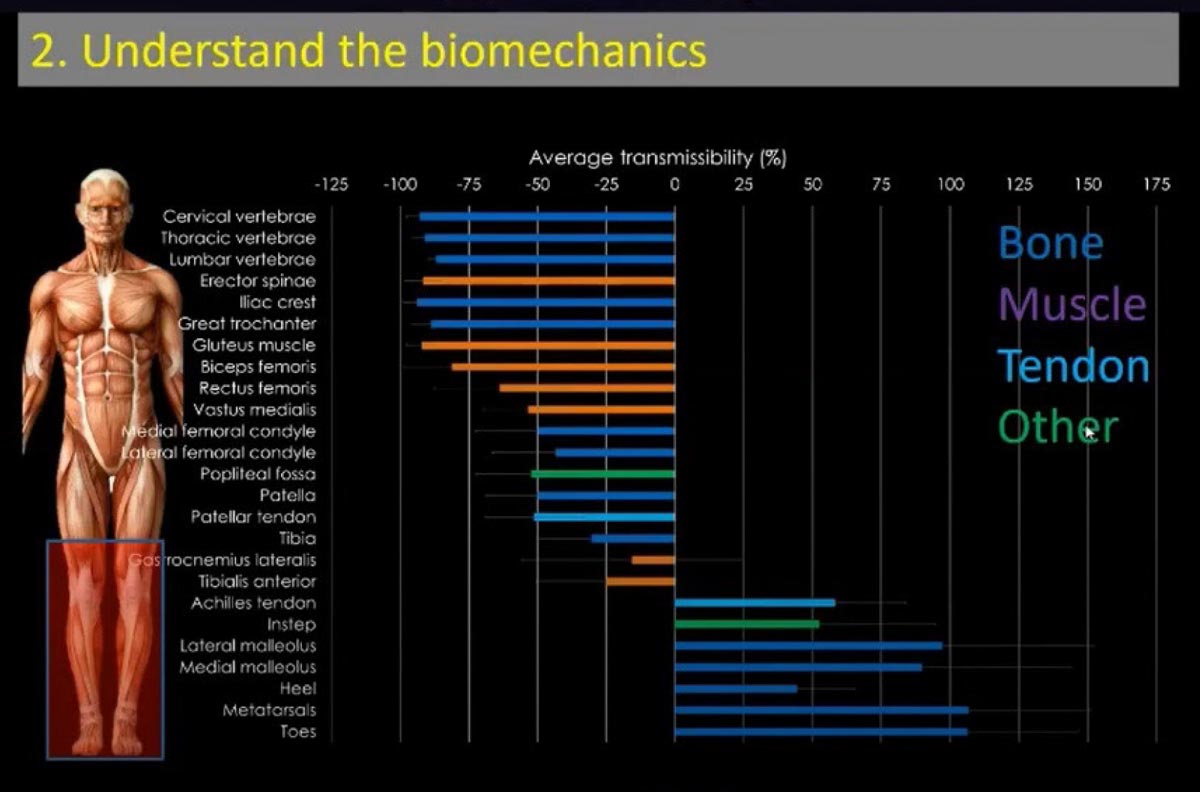
Figure G
In Summary
Obviously we need to change things up and look at how we might be able to change footwear, heavily decoupling here to try to look at independent support platforms. In the Salomon Predict, we could demonstrate a reduction in vibration in the shoe and also say quite confidently that a very, very flexible, highly decoupled shoe was at least as stable or more stable than shoes that were marketed as stability shoes.
In summary, I think we need to be focusing a lot more on input vibration, looking at both the frequency and the amplitude, because we think these may be the most important biomechanical variables. Having spent 40 years looking at loading rates and the first impact peak of runners and trying to reduce that without success, it’s time to shift our focus somewhere else and we really need to be looking at that in relation to running performance, running footwear, and running-related injury.
Simon Bartold, an internationally renowned podiatrist, is a performance footwear consultant, researcher, educator, mentor, and innovator who currently works with Xblades footwear. His award-winning website, BartoldClinical.com, offers online clinical education in sports medicine of the lower extremity and footwear design.
*lerEXPO hosted the recent “Pedorthic Runners Forum: A Science-Based Approach to Pedorthic Care of Runners and High-Performance Athletes.” During the 5-hour CEU program, Simon Bartold, the noted sports podiatrist from Australia, gave a presentation titled, Load Resolution in Runners: What Really Matters… This edited transcript presents the second half of his talk, which focused on vibration as a potential mechanism of injury prevention, despite being one of the least investigated in the scientific literature. Part I focused on overpronation/motion control and cushioning as mechanisms of failed injury prevention. Find that article in our September issue starting on page 33. To hear the entire lecture plus other speakers from the event, check out lerEXPO.com/past-events/.