Foot orthoses made with advanced design and manufacturing technologies aren’t just technically impressive—they’re also clinically relevant, according to the results of two studies presented in June by…
By Jordana Bieze Foster

Lower Extremity Review
Foot orthoses made with advanced design and manufacturing technologies aren’t just technically impressive—they’re also clinically relevant, according to the results of two studies presented in June by…
By Jordana Bieze Foster
In late May lower extremity clinicians, orthotic lab owners and managers, and technology experts gathered at the Georgia Institute of Technology in Atlanta for a discussion of digital technology in orthotic application, design, and manufacture. By Emily...
One of the most-talked-about images from the 2013 Orthotics Technology Forum (OTF) depicted 11 custom foot orthoses made by 11 experienced orthotists and podiatrists for a single patient. All 11 practitioners had been given the same information about the patient’s condition, yet all 11 orthoses were distinctly different.
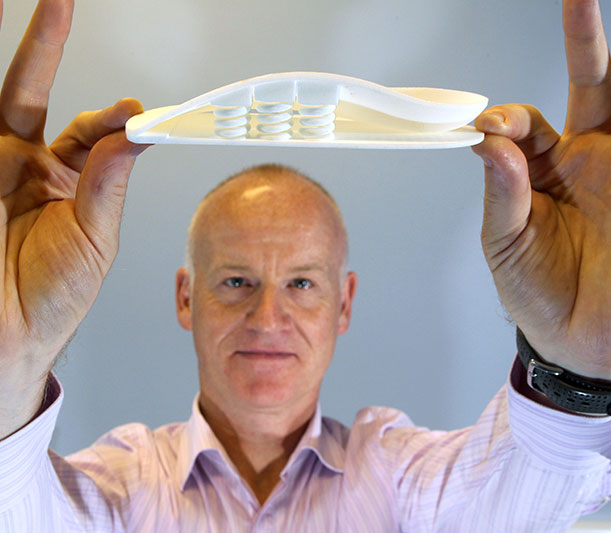
The Orthotics Technology Forum presentation given by Ben Boyer, CPed, was as much about what the speaker was wearing as what he was saying. Boyer, who is the lab manager at Kintec in Vancouver, Canada, wore a product he thinks may represent part of the future of orthotic design and manufacture—orthoses he’d printed with a hobbyist-level desktop 3D printer.

The need to replace entrenched processes and thinking with fluid, fast-moving orthotic design and manufacture that minimizes errors and maximizes resources was highlighted by several speakers at the Orthotics Technology Forum, including Jarret Eschenburg, CPed, director of operations at Coral Springs, FL-based SureFit, a subsidiary of Hanger.
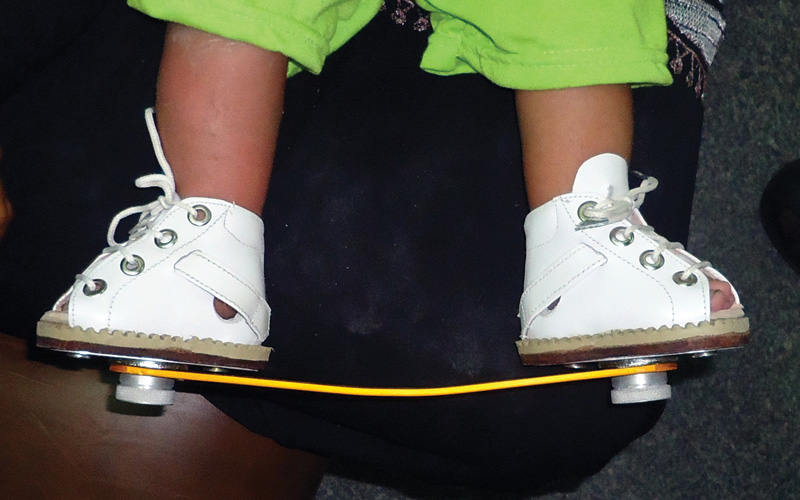
The Ponseti method of clubfoot management has achieved worldwide acceptance, but practitioners and researchers are still working to identify the best ways to optimize clinical outcomes while remaining sensitive to issues of cost effectiveness and cultural...
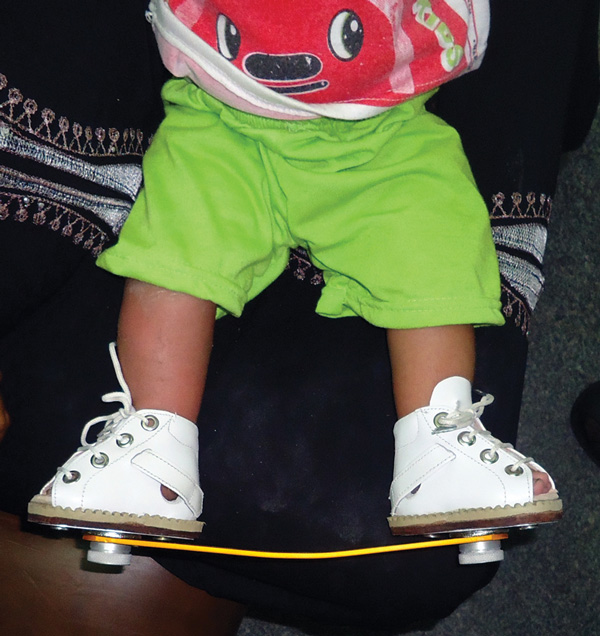
Treatment of children with clubfoot has evolved considerably in the five years that have elapsed since the inaugural International Clubfoot Symposium, and the benefits of this evolution are particularly evident in resource-poor nations—home to about 80% of the 200,000 children born each year with clubfoot. But practitioners who treat patients in these areas still face financial, cultural, and logistical challenges.
By Emily Delzell
Clubfoot correction ideally should be performed during infancy, before children learn to walk, but experts agree that the Ponseti treatment method can also be effective in older children. Speakers at the International Clubfoot Symposium in October presented successful outcomes for Ponseti treatment of neglected clubfoot in patients aged up to 21 years.
By Jordana Bieze Foster
Tibialis anterior tendon transfer (TATT) is known to be associated with limited ankle dorsiflexion, but practitioners should be aware that plantar flexion also can be negatively affected, according to research presented in October at the International Clubfoot Symposium.
By Jordana Bieze Foster

Foot orthotic laboratories have long been the principal players in the computer aided design and computer aided manufacturing (CAD-CAM) of foot orthoses. But practitioners are gradually starting to play a bigger role in the process—a development that dramatically enhances the potential for clinical creativity but also introduces an extra element of uncertainty.
Computer aided manufacturing is anything but a one-size-fits-all proposition. Customers have a range of variables to choose from, and making the right decision in most cases depends on knowing what type of orthotic material the machine will be asked to handle.
The use of technology to improve orthotic design is not limited to CAD-CAM applications, as demonstrated by University of Salford researchers in two presentations at the Orthotics Technology Forum.

The fledgling field of additive manufacturing is still somewhat fragmented, as evidenced by the fact that the same technology can be described as rapid prototyping or 3D printing. But additive manufacturing’s profile is definitely on the rise, and its advocates are optimistic that lower extremity clinical applications are right around the corner.
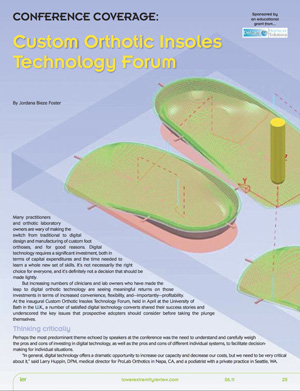
Increasing numbers of clinicians and lab owners who have made the leap to digital orthotic technology are seeing meaningful returns on those investments in terms of increased convenience, flexibility, and—importantly—profitability. At the inaugural Custom Orthotic Insoles Technology Forum, held in April at the University of Bath in the U.K., a number of satisfied digital technology converts shared their success stories and underscored the key issues that prospective adopters should consider before taking the plunge themselves.

Perhaps the most predominant theme echoed by speakers at the conference was the need to understand and carefully weigh the pros and cons of investing in digital technology, as well as the pros and cons of different individual systems, to facilitate decision-making for individual situations.
Join
Stay in the loop with the latest news and updates! Subscribe now to receive exclusive content, special offers, and important announcements straight to your inbox. Don’t miss out – join our community today for all the latest updates delivered directly to you.