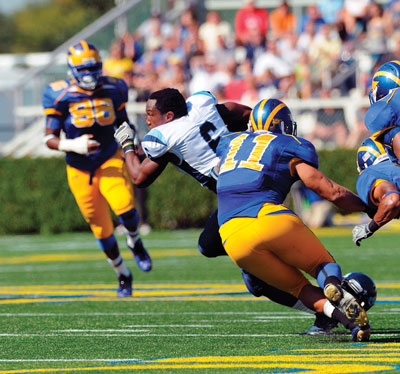
Knee and ankle sprains in National Football League (NFL) players occurred more frequently on artificial turf than on grass between 2000 and 2009, according to a study commissioned by the NFL Injury and Safety Panel e-published in September by The American Journal of Sports Medicine.
Lower Extremity Review
Lost in transition: Minimalist shoes don’t always alter gait
Barefoot-simulating and minimalist shoes are capturing the imagination of runners who hope to avoid injury and increase performance by adopting a forefoot or midfoot strike pattern, but recent research suggests runners don’t necessarily convert their gait simply by switching shoes.
Lower extremity work contributes to golf swing velocity, performance
Lower extremity work during a golf swing is positively correlated with both club head velocity and golfer skill level, according to research from the Ohio State University in Columbus, OH.
Soccer study explores factors that may link limb dominance to ACL injury risk
Kinematic and kinetic differences between dominant and nondominant limbs during cutting in soccer players could help explain previous findings regarding limb dominance and anterior cruciate ligament (ACL) injury risk, according to research from Ball State University in Muncie, IN.
Concussion conundrum: Chronic postural deficits elude detection
Sophisticated laboratory experiments have documented postural control deficits in athletes with a history of concussion, but research presented in June at the annual meeting of the National Athletic Trainers Association (NATA) suggests clinicians may find it difficult to identify similar deficits in concussed athletes once their other symptoms have resolved.
Hip adduction on landing stands out as predictor of future ACL injury risk
Hip adduction on landing is a significant predictor of anterior cruciate ligament (ACL) injury risk, according to a large prospective study from the University of North Carolina at Chapel Hill, presented in June at the NATA meeting.
In patients with patellofemoral pain, hip weakness may be result, not cause
A pain-inducing protocol significantly reduces hip extension strength in patients with patellofemoral pain (PFP), suggesting that hip weakness associated with the condition may be a result and not a cause, according to research from the University of Wisconsin-Milwaukee presented in June at the NATA meeting.
Going to extremes: Battling dangers of high intensity exercise
The exploding popularity of so-called extreme conditioning programs is now infiltrating the armed forces, prompting military sports medicine experts to take a closer look at the potential risks and benefits of high intensity exercise.
Hip strength deficits characterize both patellofemoral pain and osteoarthritis
Patellofemoral osteoarthritis (PFOA) is associated with deficits in hip abduction strength, a similarity to patellofemoral pain syndrome (PFPS) that appears to support the theory that the two conditions lie on the same continuum, according to research from the University of Calgary presented in late May at the ACSM meeting.
Ankle instability patients exhibit landing kinematics suggestive of ACL injury risk
Sagittal plane landing kinematics in patients with chronic ankle instability (CAI) mimic those associated with risk of anterior cruciate ligament (ACL) injury, suggesting that similar neuromuscular control deficits may be involved in both processes, according to research from the University of Toledo (OH) presented in late May at the ACSM meeting.
Direction change: Backward running may reduce PF pain
Backward running involves lower patellofemoral joint compression forces than forward running and is a viable strategy for rehabilitation of patellofemoral pain syndrome in runners, allowing them to continue exercise without increasing these forces, according to UK research e-published in April in the Journal of Biomechanics.
Physical examination outperforms MRI for diagnosing Achilles tendon rupture
A retrospective analysis e-published in April in Clinical Orthopaedics and Related Research found physical examination is superior to magnetic resonance imaging (MRI) for diagnosis of acute Achilles tendon ruptures. Investigators at Thomas Jefferson University Hospital in Philadelphia compared 66 patients…
Rigid footwear affects jump landing mechanics in female soccer players
Interactions between gender and footwear type affect landing mechanics in soccer players, according to research e-published in April in the Scandinavian Journal of Medicine & Science in Sports. Investigators at Duke University in Durham, NC, conducted motion analysis on 28…
Loading lessons: Select exercises carefully for ACL rehab
Exercises prescribed for rehabilitation after anterior cruciate ligament (ACL) reconstruction should be designed to protect the healing graft from excessive strain in addition to rebuilding muscle strength and activation, according to evidence-based recommendations from a multicenter team of experts.
By Jordana Bieze Foster
Barefoot running offers no metabolic advantage over lightweight footwear
The metabolic cost of running increases with heavier footwear, but barefoot running is no more metabolically efficient than running in a lightweight shoe, according to research from the University of Colorado at Boulder. In 12 men experienced in barefoot running,...
Join
Subscribe For Updates
Stay in the loop with the latest news and updates! Subscribe now to receive exclusive content, special offers, and important announcements straight to your inbox. Don’t miss out – join our community today for all the latest updates delivered directly to you.