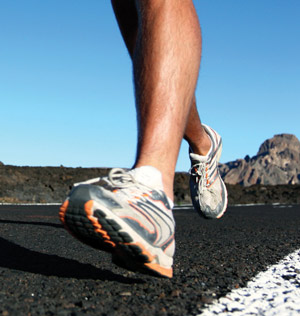

Shortening step length and switching foot strike pattern both effectively decrease patellofemoral joint loading during running, according to research from East Carolina University in Greenville, NC, presented in February at the annual Combined Sections Meeting of the American Physical Therapy Association.
Lower Extremity Review
Platelet-rich progress: Data support PRP use for heel pain
Two studies published early this year found platelet-rich plasma (PRP) injection improved pain and function in patients with chronic severe plantar fasciitis who hadn’t responded to conservative treatments.
Neuromuscular training in young girls boosts skills, may reduce future risks
Researchers reported in February that integrative neuromuscular training (INT) enhances motor skills in girls, improving fitness and offering potential protection from development of risk factors for anterior cruciate ligament tears and other musculoskeletal injuries.
Soccer players have strength deficits upon returning from hamstring injury
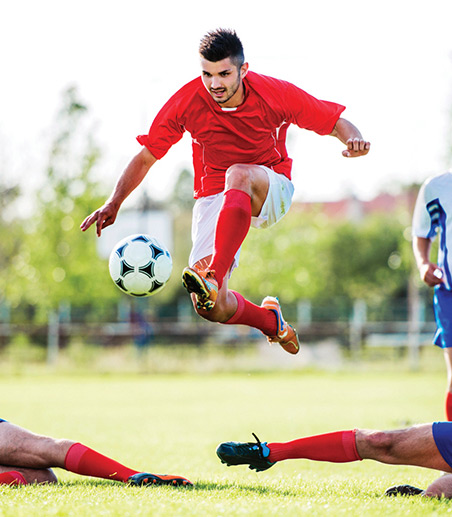
Researchers from Qatar reported in February that soccer players who sustain a hamstring injury are likely to have isokinetic strength deficits when they return to play, but the effect of those deficits on reinjury rates is unknown.
Switch trials: Shoe use, striking affect risk in runners
Switching between different pairs of shoes may help prevent running-related injuries, but switching from a rearfoot strike pattern to a nonrearfoot strike pattern may not, according to two separate studies from Luxembourg and Iowa State University.
Delayed patellar tendon development in teens may lead to overuse injuries
Knee extensor muscle development appears to outpace patellar tendon development in elite male adolescent volleyball players, which may increase their risk of patellar tendinopathy and other overuse injuries, according to research from Berlin, Germany.
In college football, most turf toe cases occur in games, on artificial surfaces
A Stanford University study suggests that turf toe injury rates in collegiate football players are lower than expected, possibly as a result of improvements in synthetic turf technology.
Prepare for landing: Bladed cleats may put fifth met at risk
Bladed soccer cleats were associated with increased forefoot loading during a jump-landing task, which may lead to a higher risk of fifth metatarsal stress fractures, according to a study published in the September-October issue of the Journal of Athletic Training.
Leg mechanics, training conditions may predict Achilles pain in runners
Investigators at the University of Tuebingen in Germany have identified alterations in lower leg mechanics and higher impacts caused by “fast” training conditions (e.g., interval training sessions, competitions) as potential risk factors for Achilles tendon pain in runners.
Anterolateral knee ligament ‘discovery’ makes headlines, but is not really new
The media buzz over the apparent discovery of a new knee ligament announced in early November faded quickly as experts pointed out that the finding was not exactly new.
The NFL’s ACL issue: Experts debate contributing factors
A flurry of anterior cruciate ligament (ACL) injuries in National Football League (NFL) players early in the preseason has medical experts theorizing about the contributing factors and what can be done to protect players in the future.
Balance training also improves jump height in youth basketball players
Twelve weeks of balance training using unstable surfaces improves jump performance as well as balance in youth basketball players, according to an Italian study published the August issue of Sport Sciences for Health.
Increased running cadence simulates some advantages of going barefoot
The acute effects of increased running cadence are similar to those of barefoot running, according to two studies that looked at the two techniques in a single group of runners.
Stress management: Landing mechanics predict fracture risk
Landing biomechanics have long been a focus of anterior cruciate ligament (ACL) injury research, but they may also be predictive of lower extremity stress fracture, according to a study presented in July at the American Orthopaedic Society for Sports Medicine (AOSSM) meeting in Chicago.
Two studies explore contributions of core muscles to ACL injury risk
Two recent studies underscore the association between core muscle function and risk factors for anterior cruciate ligament injury.
Join
Subscribe For Updates
Stay in the loop with the latest news and updates! Subscribe now to receive exclusive content, special offers, and important announcements straight to your inbox. Don’t miss out – join our community today for all the latest updates delivered directly to you.