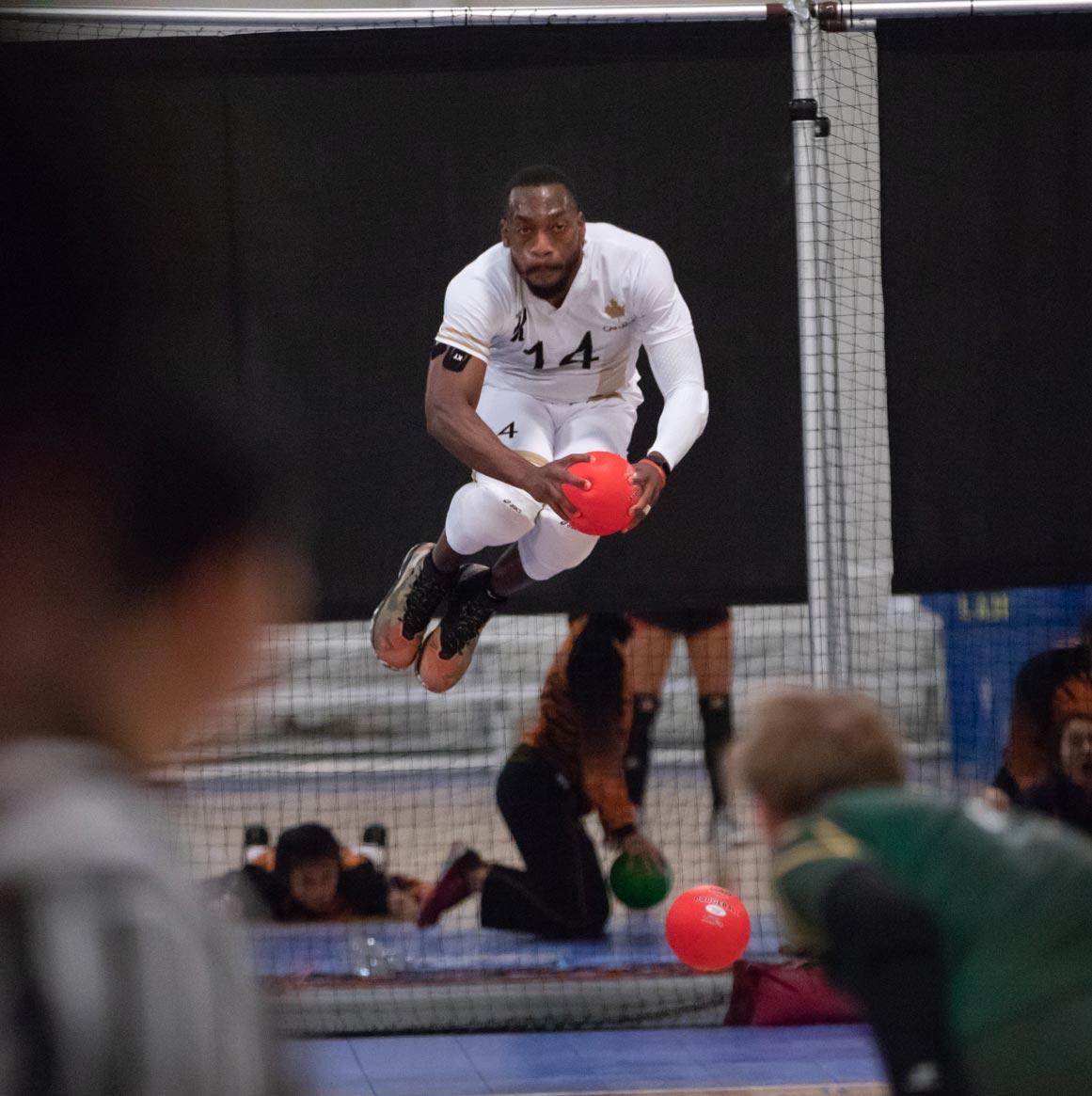
Photos courtesy of American Photographic and USA Dodgeball.
By Brenda Kramer, BS
Dodgeball is a unique sport – it challenges a player’s every energy intermittently. Can you throw from a backwards turn mid-air and hit the opposing player in such a way that he or she can’t catch the ball – all while dodging incoming balls from the opposing team – and then run to the back of the court and stop?
In dodgeball, especially at the elite or semi-pro level, there’s a lot of stop and go, great intensity then stop. Complex physical moves – jump, twist, dodge, throw, land, run, stop – sometimes done simultaneously, other times played out like a slow waltz as you move around the court. It’s an intermittent sport, sort of like tennis, perhaps more like volleyball…bottom line, it requires a lot of physicality from each player as well as endurance to last through a match. That’s what makes it so much fun to play, yet complex to train for.
As a trainer, my goal is to marry personal fitness with the sport’s required skills to help dodgeball players improve their performance. Despite the many stops and starts, dodgeball is a game of movement, of quick reflexes, because even when standing still, dodging incoming balls is still a must. And with all that, multi-directional movement comes the risk of injury, so it is crucial to train players through similar movement patterns utilizing the parts of the body that are frequently taxed while playing.
For me, prevention is about being prepared, making sure all the tissues are prepared for dodgeball movements. Like every other sport, warm-up is key. Stretches that involve all the major muscle groups are pretty standard. My favorites include dynamic movements such as walking knee hugs, traveling lateral lunges, and the World’s Greatest stretch, which is essentially a combination of stretching the hip flexors, quadriceps, and gastrocnemius and soleus, while incorporating thoracic spine and shoulder mobility as well. These warm-up movements are my favorite because they incorporate full body mobility, they increase blood flow to large muscle groups (such as the quadriceps and hamstrings), and they allow players to feel more flexible prior to picking up a ball.
Dodgeball involves a lot of quick reflexes, players have to react to multiple balls being thrown simultaneously, so body control is an important component of preparation. To support stability and control in multi-directional movement, I have players focus on balance and single leg movements. Examples of lower body exercises that I frequently use with my dodgeball clients include plyometric movements such as power skips, skater hops, and lateral bounds. In regards to increasing single-leg strength, I like to incorporate single-leg box squats, single-leg or b-stance Romanian Deadlifts (RDLs), or single-leg step-ups onto a box.
 But preparation isn’t just before the game, it should be happening frequently during training before tournaments, focusing on lower body strengthening, plyometrics, and power exercises to build a strong foundation. Additionally, it is important to also incorporate some forms of both anaerobic and aerobic training into a dodgeball player’s programming. That can include sprint training, focusing on acceleration and lasting about 5-10 seconds, or longer distance runnings to build an aerobic base. Dodgeball is a quick moving, intermittent game, but the matches can be long and the players with endurance are the ones who can still run and throw with full power even after 40 minutes of active play.
The foot movements in dodgeball can be quick, so strong ankles and feet are important. Like most other sports, a proper warm up with stretching before the game starts is the key to keeping ankles and feet safe. I encourage my clients to improve ankle strength and flexibility by doing targeted exercises throughout the workout week in addition to rolling out the feet or even working out barefoot at times. Examples of exercises I use with my clients include banded stretches to increase ankle dorsiflexion (which is crucial for movements such as jumping and squatting), calf raises and isometric holds in a split squat position, and big toe doorway stretches.
Prevention also includes proper equipment for the skills required. For those with weak ankles or chronic ankle instability, ankle braces should be considered, but the main focus should be to strengthen lower limb muscles and ligaments during training in order to avoid bracing while playing. Additionally, proper footwear is required while playing. Some players prefer shoes with high ankle support such as standard basketball shoes, while others prefer lower cut shoes such as volleyball and indoor soccer shoes. It all depends on comfort level as well as lower limb stability.
Brenda Kramer is a certified personal trainer with a Bachelor’s degree in kinesiology from Whittier College. She is a member of Team USA Dodgeball (2019, 2022). Find her on Instagram @brendakramer.