








 By Mikel D. Daniels, DPM, MBA, President and Chief Medical Officer, WeTreatFeet Podiatry
When patients enter a podiatry office, their impressions begin forming immediately. Before any history is taken or exam performed, they are already processing what they see. Eyes are drawn to the physical space, the efficiency of the front desk, the demeanor of the staff. They enter the treatment room and notice the equipment in the room while waiting for the physician. These early signals shape expectations in ways that are both subtle and powerful. In many cases, they influence how patients interpret everything that follows.
Psychology describes this as the halo effect, a bias where 1 positive trait shapes how people see everything else about a person, product, or organization. This was originally coined by American psychologist Edward L. Thorndike, in a 1920 paper titled, “A Constant Error in Psychological Ratings”. In his paper, he studied how military officers rated their subordinates. Today, we can use this to view our own practices. If patients see a modern, well-equipped environment, that single visible attribute often leads them to assume the physician is more skilled, more current, and more trustworthy across the board. While patients may not understand what each device does, people think they can recognize something as “up-to-date” when they see it. It is this perception that spills over into their beliefs about diagnosis, treatment, and outcomes.
In podiatry, this matters because so much of what we do depends on patient confidence and engagement. Patients come to us in pain, with impaired mobility, or fear of complications such as ulceration, infection, or amputation. When the environment and the tools signal that their problem is being taken seriously, and being evaluated with contemporary methods, they are more likely to trust our recommendations. The result is that the patient will follow treatment plans, return for follow-up, and speak positively about the practice to others. The halo effect of podiatry, when aligned with sound clinical judgment and clear communication, becomes more than just perception. It becomes a practical lever that influences adherence, outcomes, and the overall reputation of the practice.
Technology as a Signal of Quality
Patients rarely have the technical background to evaluate clinical decision-making. Instead, they rely on observational cues to form judgments about the care they are receiving. Modern equipment serves as one of the most immediate and tangible of these cues. Equipment such as a high-resolution imaging system, or a diagnostic ultrasound often communicates a commitment to staying current.
This perception aligns with broader findings in healthcare research. Studies on patient satisfaction consistently show that environmental and visual factors influence perceived quality of care. This is true even when clinical outcomes are equivalent. In this context, technology functions as a proxy for expertise. Patients may not fully understand how a device works, but they associate it with quality. This leads to the perception of a higher level of care.
In practice, this effect is easy to observe. Patients frequently comment on new equipment, often with statements such as, “This looks advanced,” or “You must be very up to date.” These remarks are not simply casual observations or kind words, they reflect a shift in confidence. That confidence can influence how patients engage the rest of the visit.
Influence on Patient Behavior
The halo effect extends beyond perception into behavior. If technology shapes how patients perceive care, it also shapes how they behave in response to that care. Patients who view a practice as modern and capable are more likely to trust diagnoses, and in the end, adhere to treatment plans. This has direct implications for conditions that rely heavily on patient participation.
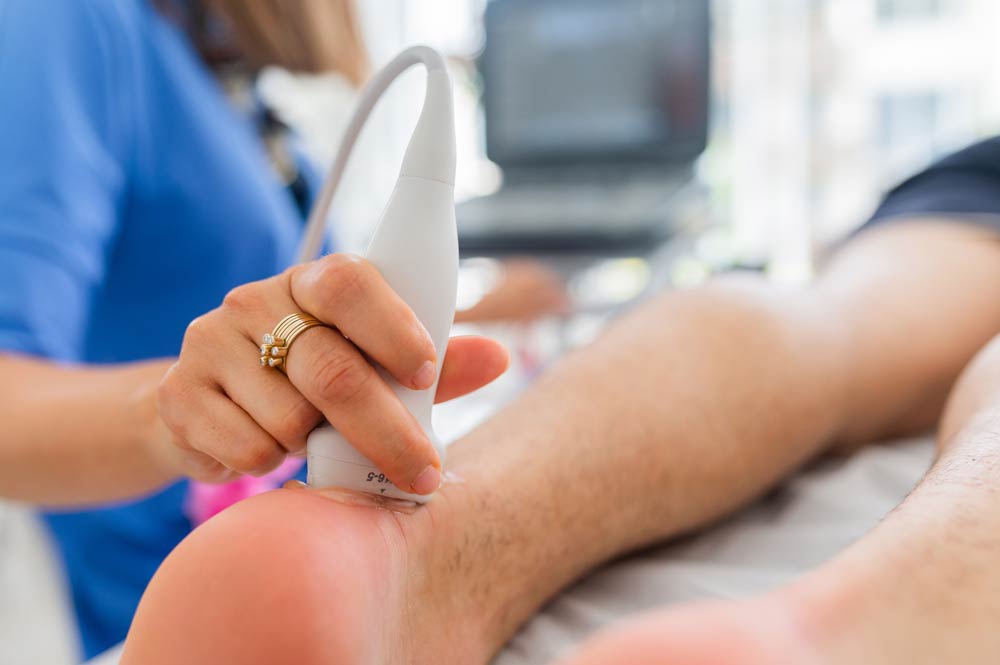
As an example, consider a patient presenting with plantar heel pain. From a clinical standpoint, the diagnosis can often be established through history and physical examination. However, when diagnostic imaging such as ultrasound is incorporated, the interaction changes. The condition becomes visual and concrete rather than abstract. Patients can see the area of inflammation or tissue change. This serves to reinforce the explanation and treatment plan provided by the clinician.
This visualization often improves understanding, but something else is happening. While no one is paying attention, it secretly strengthens commitment. A patient who sees evidence of pathology is more likely to follow through with stretching protocols, orthotic use, activity modification, and even attend follow-up appointments. In this way, the technology indirectly supports better outcomes by improving adherence.
A similar dynamic is present in diabetic foot care and wound management. Patients facing the possibility of infection, hospitalization, or amputation often experience significant anxiety. The presence of advanced diagnostic tools (such as vascular assessment devices, digital imaging, or specialized wound therapies) can provide immediate reassurance. Without requiring detailed explanation, the environment communicates capability.
That reassurance has practical value. It allows patients to focus on the treatment plan rather than the potential for catastrophic events. It also fosters a sense of partnership. This is critical in managing complex, confusing, or longitudinal conditions.
Impact on Referral Patterns
The halo effect is not limited to patient perception. Referring providers are influenced by many of the same signals (although often in a more indirect way). Primary care physicians, endocrinologists, and other specialists develop impressions based on communication, outcomes, and reputation within the medical community. It has its own “halo effect”
Technology contributes to that reputation by creating a distinct identity. A practice that invests in advanced tools or complex protocols becomes known for those specific capabilities. Over time, this association acts as a cognitive shortcut. When a referring provider encounters a challenging case, such as a patent with a condition involving limb preservation or advanced wound care, they are more likely to recall the practice perceived as having the necessary resources.
This pattern is supported by referral behavior research. This suggests that physicians often rely on familiarity and perceived expertise when directing patients. Technology, when integrated into a broader pattern of consistent outcomes and communication, reinforces both.
Internal Effects on Team Culture
Within the practice, the presence of modern technology can influence team dynamics and morale. Staff members are highly attuned to whether a practice is investing in growth and improvement. The introduction of new tools often generates a sense of momentum and pride.
This internal response can also lead to operational benefits. Staff who feel they are part of a forward-moving organization tend to be more engaged in their roles. Their communication with patients becomes more positive, they adapt more readily to workflow changes, and they contribute to a more cohesive patient experience. In many cases, they also become informal ambassadors for the practice, sharing their experiences within their personal and professional networks
Because patients often see the medical assistant first, staff confidence in the available technology can provide early reassurance that the practice has the tools to help them. A visible commitment to advancement can reinforce a culture of continuous improvement–but only if implementation is thoughtful. Technology introduced without adequate training or integration is far more likely to create frustration instead of enthusiasm.
Risks of Misalignment
The halo effect can be beneficial, but it is not inherently positive. Its impact depends on alignment between perception and reality. When technology is underutilized, poorly integrated, or inconsistently applied, it can undermine trust rather than build it–especially in practices with multiple providers where patients may see different clinicians over time.
Patients also notice when equipment appears unused or when its role in their care is unclear. An expensive device that sits idle in the exam room may be interpreted as unnecessary or wasteful. In some cases, it can raise questions about decision-making within the practice.
All of this highlights the importance of intentional adoption. Technology should be selected for its clinical value and integrated into workflows in a consistent and visible way. Every team member should understand not only how to use a device, but also how to explain its purpose in straightforward terms.
Communication as a Multiplier
The effectiveness of technology is closely tied to communication. Most patients do not need detailed technical explanations, but they do need clarity. A simple statement from the provider explaining how a tool improves diagnosis, reduces uncertainty, or enhances treatment, will significantly increase its perceived value.
For instance, showing a patient an ultrasound image while explaining the source of their pain transforms the interaction. It shifts the conversation from abstract description to shared understanding. Multiple studies have shown that problems are easier to understand when visualized. This not only improves comprehension but also reinforces trust.
At the same time, it is important to maintain balance. Technology should support, not replace, the clinician-patient relationship. Patients seek expertise and reassurance from a person, not a device. The most effective practices use technology to enhance human interaction, not overshadow it.
Relevance in Lower Extremity Care
In lower extremity medicine, the interplay between perception, technology, and outcomes is particularly pronounced. Many conditions we treat directly affect a patient’s mobility. Patients are acutely aware of how their condition limits walking, working, and independence. While discussing these functional limitations is crucial, overemphasizing what the patient already knows can backfire. If the encounter feels like confirmation of the obvious, patients may conclude that the interaction offered little value.
This creates a setting in which both technical capability and patient confidence are essential. Advanced tools reinforce the seriousness with which conditions are evaluated and treated. Clear communication provides direction and reassurance. Together, they create a more structured and supportive care experience.
In high-risk populations, such as patients with diabetes or peripheral vascular disease, this combination becomes even more critical. It is well known that intervention, adherence to treatment, and timely follow-up can significantly influence outcomes. This is where the halo effect of technology, when aligned with strong clinical practice, can support each of these factors.
Technology as Opportunity and Responsibility
The integration of new technology into podiatric practice offers clear advantages. It can enhance diagnostic accuracy, expand treatment options, improve patient engagement, improve treatment efficiency, and strengthen referral relationships. At the same time, it can become a situation of be careful what you wish for, and this might introduce higher (or even unrealistic) expectations.
Patients who perceive a practice as advanced expect a corresponding level of care. Referring providers expect consistent outcomes. Staff expect systems that support efficiency and growth. Meeting these expectations requires more than acquiring equipment. It requires thoughtful implementation, ongoing training, and a commitment to communication.
When evaluating new technology, it is useful to consider both its functional and symbolic roles. Functionally, the question is whether it improves diagnosis, treatment, or workflow. Symbolically, the question is what it communicates about the practice. The most effective investments address both.
Cost and Financial Considerations
Sales representatives present a steady stream of “next greatest” solutions, from equipment and supplies to medications. In an environment of declining reimbursement, products that add revenue can be attractive. Some equipment directly generates revenue, while other tools primarily support diagnosis or treatment without adding to the top line.
While cost sensitivity is essential, return on investment should include more than direct reimbursement. The halo effect of technology can influence new patient volume, referral patterns, and practice differentiation. When calculating ROI, it is worth asking: Will this equipment be a differentiator? Can it help increase new patient numbers? Does it improve efficiency so the practice can provide additional services? The value of these answers should factor into the calculus.
Does Podiatry Really Change Based on the Halo Effect?
The halo effect of technology is a real and influential component of modern podiatric practice. It shapes how patients perceive care, how they engage with treatment, and how practices are viewed within the broader medical community. When aligned with strong clinical judgment and clear communication, it can enhance both experience and outcomes. For podiatrists, the practical question is not, “Should I buy more technology?” but, “Which technology will meaningfully improve care and how will we visibly integrate it into every visit?”
However, the effect is not automatic. It depends on thoughtful selection, consistent use, and integration into a patient-centered approach. Technology alone does not define quality, but it can reinforce it when used well.
In the end, the value of any tool lies in how it supports better care. The goal is not simply to appear advanced, but to deliver care that justifies that perception. The result must be consistent, clear, and effective. When that alignment is achieved, the halo effect becomes more than an impression. It becomes part of a practice’s identity.
Dr. Mikel Daniels is a board-certified podiatrist and healthcare executive with more than 2 decades of experience in foot and ankle surgery, wound care, and medical economics. As President and Chief Medical Officer of WeTreatFeet Podiatry, he has grown the practice from 1 office into a regional network of surgical centers, and retail health services across Maryland, Pennsylvania, and Washington, D.C.
Dr. Daniels earned his Doctor of Podiatric Medicine from Temple University and an MBA in Healthcare Administration, combining clinical expertise with business strategy to deliver efficient, patient-centered care. His work focuses on complex reconstructive procedures, diabetic limb salvage, sports injuries, and minimally invasive techniques designed to accelerate recovery.
A Fellow of the American College of Foot and Ankle Surgeons and the American Professional Wound Care Association, Dr. Daniels also consults for biomedical technology firms and serves as a principal investigator in clinical research. His insights have appeared in Forbes, Parade Magazine, and CNN, and through his writing and mentorship, he continues to advance innovation