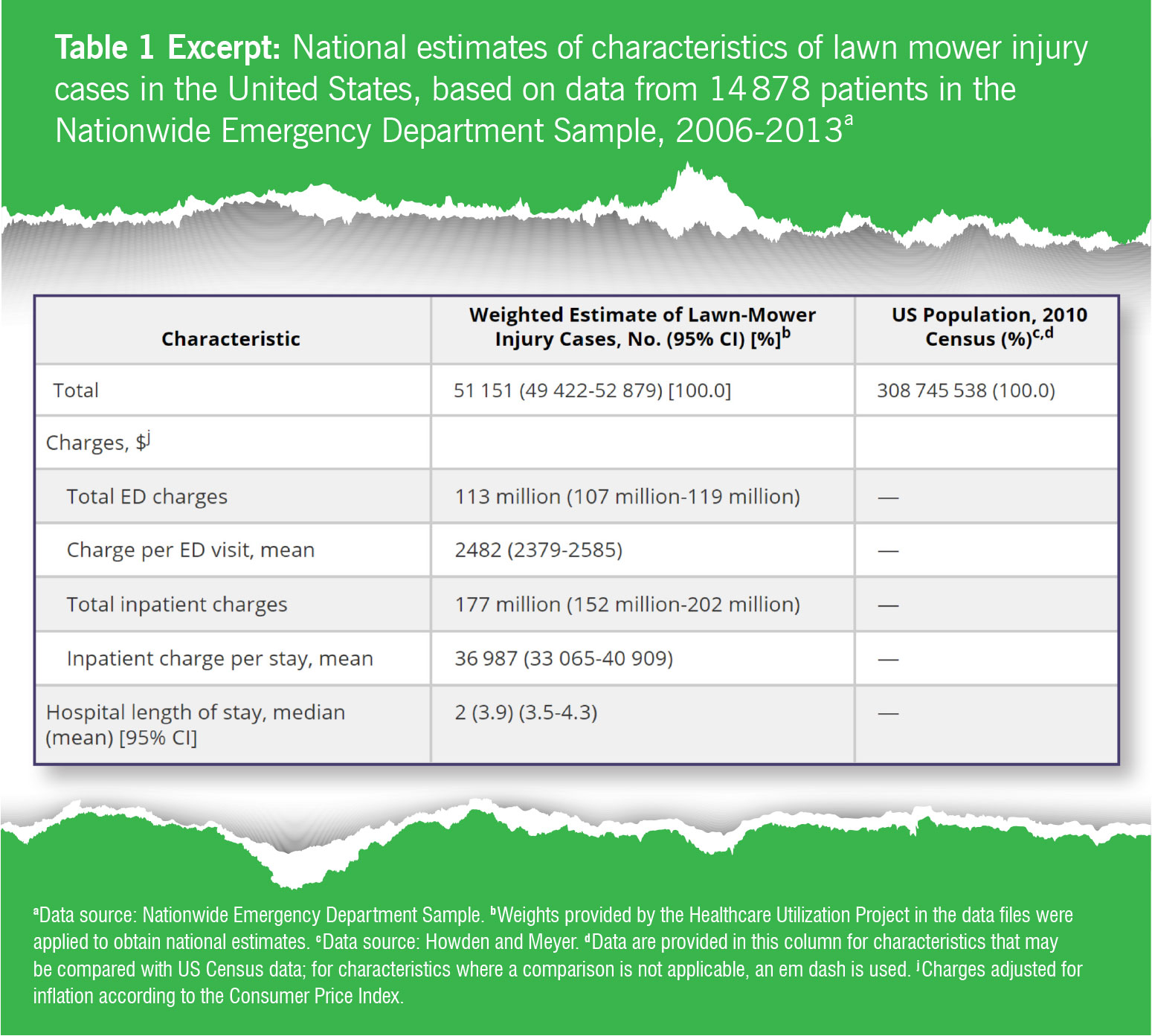








 A 2018 study from Johns Hopkins Surgery looking at 8 years of data found an average of 6,400 lawn mower injuries per year with an average cost of $37,000 per patient
In an unusually comprehensive analysis of nationwide data, researchers from Johns Hopkins Medicine concluded that the rate of lawn mower injuries persists at close to 6,400 a year, most of them requiring surgery and hospitalization, and costing an average of $37,000 per patient. The study, tracking 8 years of data between 2006 and 2013, was published in Public Health Reports.
“Despite consumer education programs and warning labels, lawn mower injuries in the United States remain a serious public health concern,” said Deborah Schwengel, MD, assistant professor of anesthesiology and critical care medicine at the Johns Hopkins University School of Medicine and the study’s senior author. She is also associated with Johns Hopkins Children’s Center.
Overall, the Hopkins analysis showed that the most frequent injuries were to men (43,567 of 51,151, or 85.2%), and that children up to age 4 were 6 times more likely to have a foot/toe or lower extremity injury and 1.7 times more likely to have an amputation than those age 15 and above. Conversely, older teens and adults age 15 and above were 8.3 times more likely to have an injury to the hand or upper extremity. This, the researchers said, suggests that young children are more likely to get injured by running into the yard while a family member operates the lawn mower or by getting their foot trapped in the machine while sitting in the operating member’s lap, and that the majority of teens and adults sustain injuries from sticking their hands into the mower to clear debris.
The data were not able to inform the researchers about the type of mower that caused an individual injury; what mower designs were most likely associated with injuries; or whether those injured were bystanders or doing the mowing.
Previous studies, says Schwengel, have generally collected data only on certain types of injuries associated with consumer products without addressing issues of cost or national scope.
To better understand the extent of the problem, Schwengel and her team drew on information gathered for the United States Nationwide Emergency Department Sample (NEDS), the largest emergency department database in the U.S. Overall, they focused on medical record reports of lawn mower-related emergency department visits and hospitalizations from Jan. 1, 2006, to Dec. 31, 2013. NEDS captures 25 million to 30 million emergency department visits, or 20% of all emergency department visits in the US, each year.
The researchers also collected age, geography, gender and other information about those injured, along with the day of week and month when each visit occurred.
For the analysis, the research team identified 14,878 lawn mower injuries over the 8-year period, which, when adapted to reflect national ER visit data, represented an estimated 51,151 injuries, and consisted of about 6,394 cases per year on average.
For the entire study population, most of the injuries were lacerations (23,907 of 51,151, or 46.7%), fractures (11,433 or 22.4%) and amputations (11,013 or 21.5%). The most common injury locations were wrist or hand (33,477, or 65.4%) and foot or toe (10,122 or 19.8%).
Of the 51,151 cases, 43,567 (85.2%) were in men; 19,162 (37.5%) happened in the South; 33,886 (66.3%) occurred on a weekday; and the majority, 36,686 (81.7%), occurred between April and September.
By looking at standardized injury codes, or E-codes, the researchers were able to look at national averages of treatment costs for the codes and determine that emergency room charges totaled an average of $2,482 per patient, and average inpatient charges totaled $36,987 per patient.
Schwengel and her colleagues caution that the study was limited to E-codes that are used by hospitals primarily for administrative purposes, and that the collection and reporting of these codes varies from state to state. However, they say the findings are comparable in outcome to previous studies, and that the NEDS data sample allowed for more in-depth analyses of charges, procedures performed and patient demographics for these types of injuries.
“Understanding what types of injuries occur in certain groups should help engineers design safer lawn mowers and policymakers create more appropriate prevention policies,” said Schwengel. One example of a better lawn mower design that could prevent injury, the researchers said, would be one with stopping features that automatically activate when human flesh is detected near blades.
Source: Hottinger DG, Nasr I, Canner JK, Kattail D, Koka R, Schwengel D. Incidence, distribution, and cost of lawn-mower Injuries in the United States, 2006-2013. Public Health Reports. 2018;133(5):570-577. doi:10.1177/0033354918785909. News report available at https://www.hopkinsmedicine.org/news/newsroom/news-releases/2018/09/lawn mower-injuries-a-persistent-source-of-serious-injury-and-high-costs-new-study-affirms.