







 By Ryan Crews, PHD
1. The Movement Boogeyman
For many living with diabetic foot disease, the sidewalk has become a source of fear. There is a persistent medical boogeyman suggesting that every step is a gamble, a potential trigger for a devastating ulcer. This fear often leads to a life of inactivity, fueled by the belief that staying off your feet is the only way to stay safe.
However, clinical research reveals a startling irony: inactivity is actually one of the greatest risks to your health. By embracing the Goldilocks principle and cutting-edge wearable technology, we can transform movement from a threat into a powerful tool for biological maintenance.
2. The Goldilocks Principle: Finding the Just Right Level of Stress
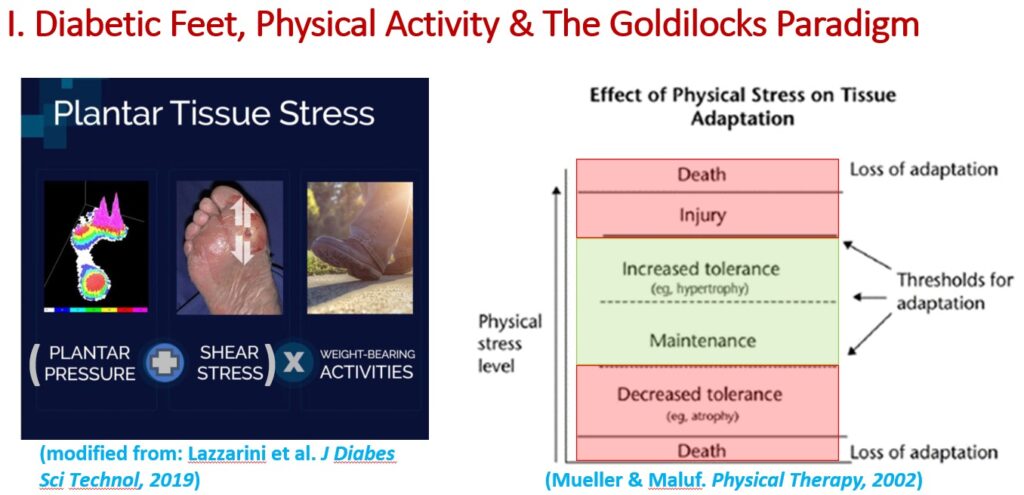
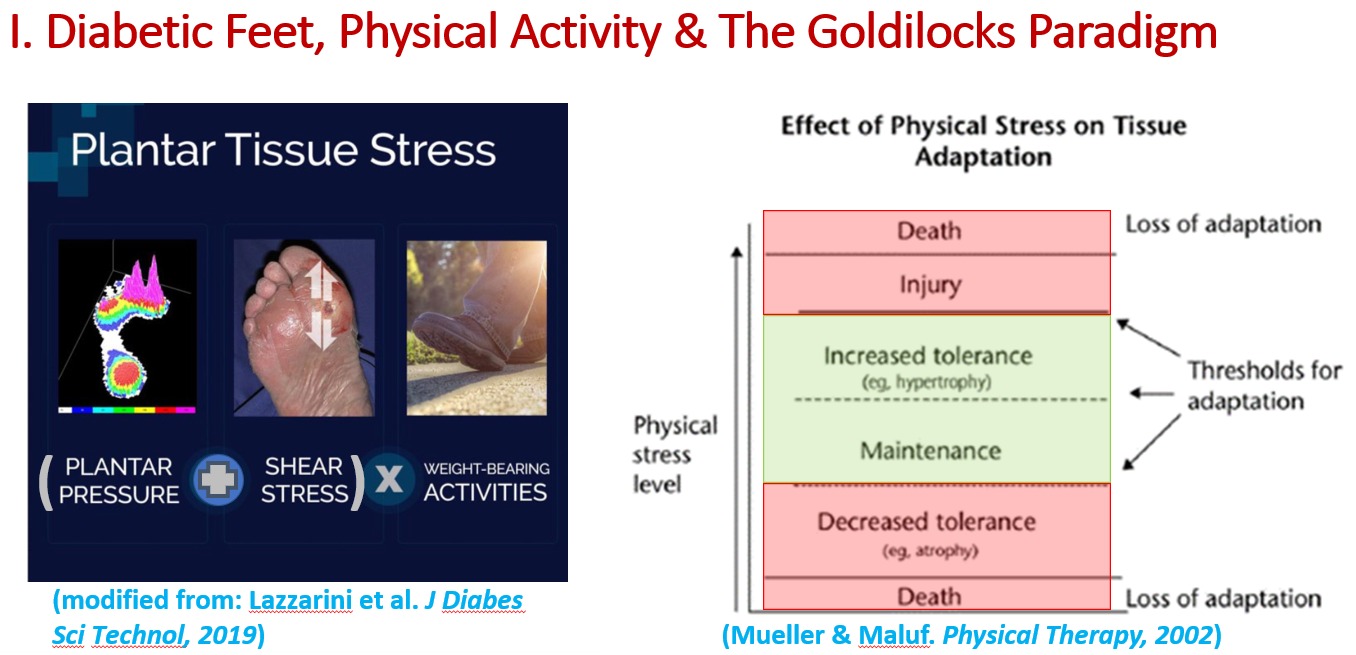
To protect feet at risk of diabetic foot ulceration, one must first understand Plantar Tissue Stress. This isn’t just a single force; it is the interaction of 3 critical variables: Plantar Pressure (the vertical weight on your foot), Shear Stress (the horizontal tugging on the skin), and Cycles (how many times that stress is repeated, like your daily step count).
Your foot tissue responds to these stresses in one of 3 ways:
- The Atrophy Zone: When there is too little stress, your tissues weaken. In persons with diabetes this increases the likelihood for plantar foot ulcers when they engage in moderate weightbearing activity following prolonged periods of minimal activity.
- The Damage Zone: This occurs when you apply too much stress too quickly, leading to tissue breakdown.
- The Safe Zone: This is the “Just Right” level where tissue is maintained or even strengthened through increased tolerance.
Building tolerance through gradual, consistent stress is the ultimate goal. While it feels counter-intuitive to walk more to protect yourself, a foot that is never exercised becomes an easy target for injury.
 3. The Saturday Spike: Why Variability is More Dangerous Than Volume
A common myth suggests that the most active patients are at the highest risk for ulcers. However, landmark studies by Maluf and Mueller, as well as Armstrong and colleagues, found the opposite: people who develop ulcers often have lower average daily activity levels. In fact, one study showed that patients who developed ulcers actually experienced 40% less stress on their feet on average than those who remained healthy.
The real culprit likely isn’t the volume of steps but the variability in stress. This is the “Inactive Path to Ulceration,” perfectly illustrated by a character we’ll call Thanksgiving Joe. Joe spends his week at a sedentary desk job, where his feet adapt to near-zero stress.
When family visits for the holiday, Joe suddenly spends Saturday walking miles through the city. This “Saturday Spike” is a massive, sudden deviation from his normal routine. Because his feet weren’t conditioned for that load, the tissue fails under the surprise demand.
4. The Gift of Pain and Its Digital Replacements
In a healthy body, pain is a protective signal that tells us when a shoe is too tight or a step is too heavy. The legendary Dr. Paul Brand famously called this the gift of pain. When peripheral neuropathy numbs the feet, this internal warning system is silenced, leaving the body insensate and vulnerable. When we lose the gift of pain in the feet, we don’t have an internal warning system when something’s off in the feet.
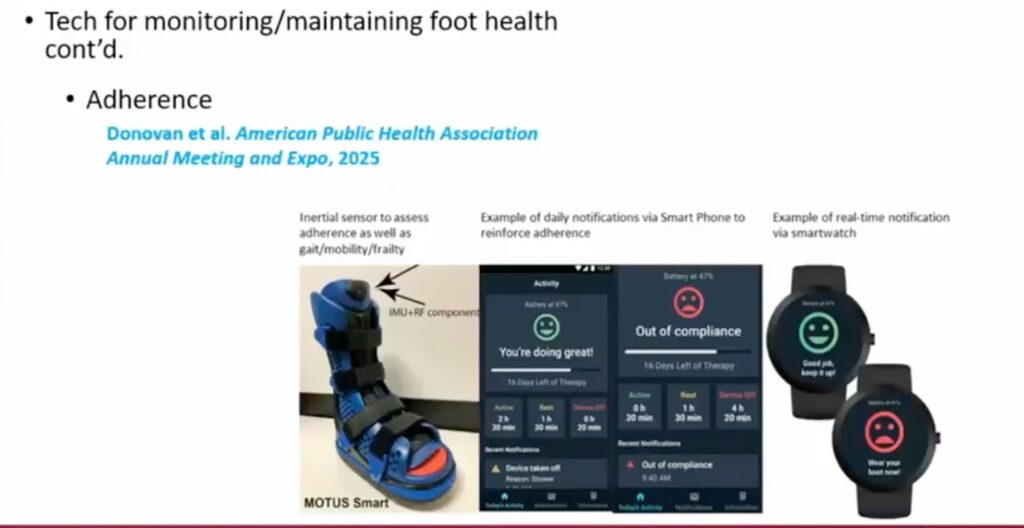
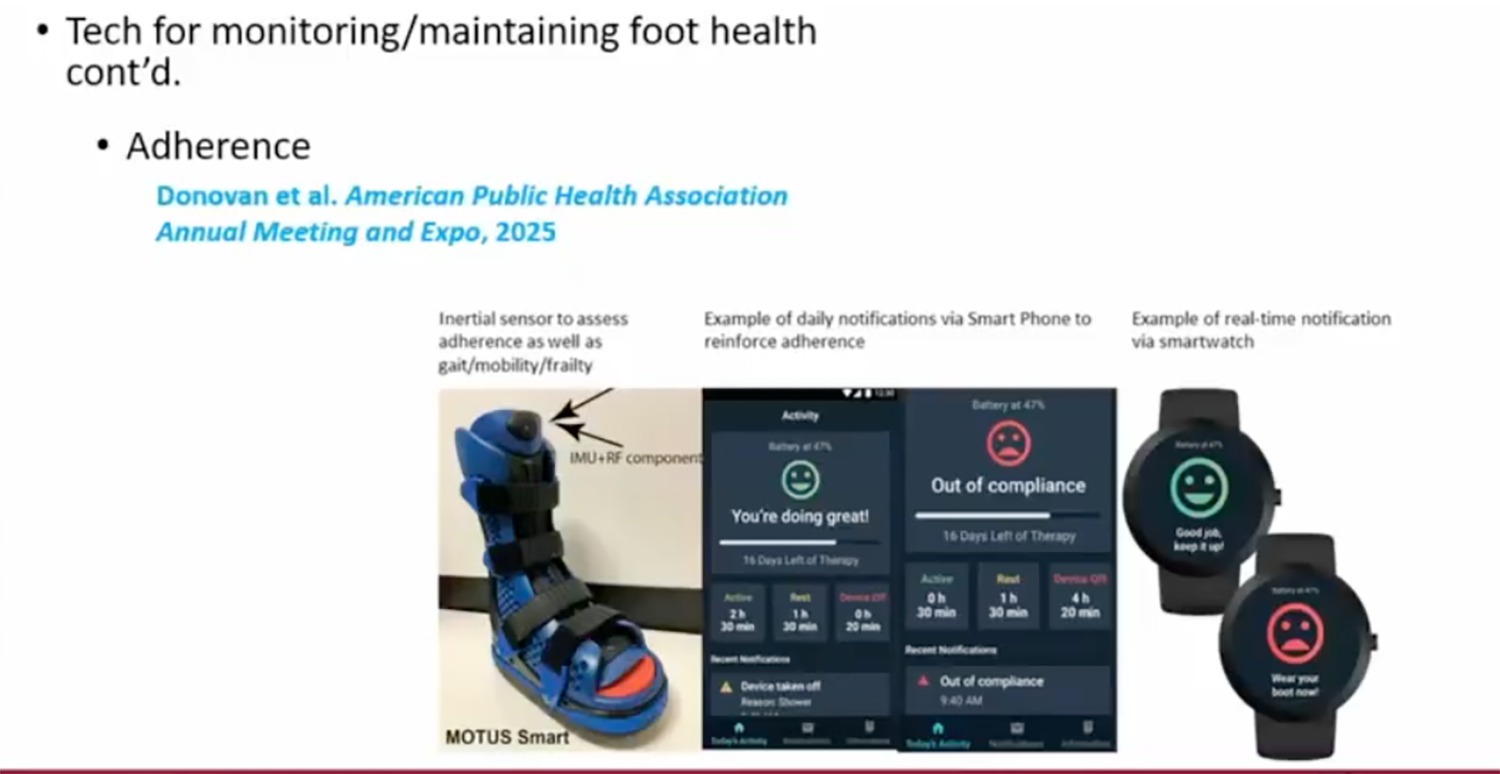
Modern technology in now being implemented in a biofeedback paradigm, bridging the communication gap that damaged nerves cannot cross.
- Smart Socks & Mats: These devices monitor skin temperature to identify localized inflammation suggestive of an impending ulcer. If one foot is significantly warmer than the other, the tech communicates the presence of a “hot spot” before a wound ever opens.
- Pressure-Sensing Insoles: These tools allow for real-time plantar pressure optimization. For high-risk patients, the goal is to keep pressure below the 200 kilopascals (kPa) threshold, a target used to validate custom footwear and prevent tissue breakdown.
 5. Practical Roadmap: The 1,000-Step Rule and AI Navigation
Safely increasing activity requires a roadmap, not guesswork. The International Working Group on the Diabetic Foot (IWGDF) suggests a clear, gradual goal: aim for a 1,000 steps per day increase over one’s current average. Crucially, this is a target to reach over time–not in a single day–to avoid creating a dangerous “Saturday Spike.”
Individuals can leverage the tools already in their pocket to help navigate this journey with confidence:
- AI as a Safety Scout: Tools like Google Gemini can assist individuals to find safe environments. For example, prompting the AI with: “Find walking trails near me that are ADA accessible, flat, and have fine gravel.” This helps individuals at risk for diabetic foot ulcers avoid uneven terrain that causes high shear stress and fall risks.
- Smartphone Tracking: Using a phone’s built-in health app can help individuals monitor their daily volume. If one averages 2,000 steps now, they can aim for 2,100 next week, allowing their plantar tissue the time it needs to adapt and toughen.
6. A New Horizon for Diabetic Foot Care
The era of avoidance-based care may be ending, replaced by a philosophy of managed engagement. We now recognize that keeping your feet in a state of total rest is not protection–it is a recipe for atrophy. By using data from technologies, devices such as smart mats that act as surrogates for non-functioning peripheral nerves and simple smartphone apps that can assist in managing activity profiles, individuals with diabetic foot disease can transform movement into a vital form of biological maintenance.
Ryan Crews serves as a clinical research scientist within the Center for Lower Extremity Ambulatory Research (CLEAR) and as an associate professor in the Department of Podiatric Medicine and Surgery. He joined the Dr. William M. Scholl College of Podiatric Medicine at Rosalind Franklin University of Medicine and Science in 2004. His teaching responsibilities are focused upon the themes of 1) clinical research and 2) biomechanics. Dr. Crews received his BS degree in exercise science from Truman State University in Missouri. While at Truman, he earned an internship within NASA’s Exercise Physiology Research Laboratory in Houston, Texas. While at NASA, he worked on research associated with assessing and improving the health of NASA’s astronaut corps. He then went on to pursue a MS degree in kinesiology from the University of Massachusetts at Amherst, where he focused on motor control and biomechanics studies. To support his thesis research, he was awarded the NASA Space Physiology Research Grant by the American College of Sports Medicine. While working at Scholl College he jointly pursued and obtained his PhD in Life Sciences from Manchester Metropolitan University. Since 2004 his primary research interests have centered on the intersection of biomechanics/physical activity with diabetic foot disease. Dr. Crews is a former member of the leadership team for the American Diabetes Association’s Foot Care Interest Group and is presently the Secretary for both the American Limb Preservation Society (ALPS) and the International Working Group on the Diabetic Foot’s Offloading Group.
This article is a summary of Dr. Crews’s presentation, “Integrating Technology to Help Patients Optimize Physical Activity Engagement and Avoid Pitfalls” from the Diabetes Technology and Prevention Summit November 15, 2025. To view the full presentation with questions and answers–and see the agenda for the program, visit https://diabetestech.lerexpo.com. Continuing education credits are available for this and many of the lerEXPO programs.
Related posts:

The Struggle to Stay Physically Active with Persistent Plantar Fasciopathy

Stopping Knee Hyperextension Starts with a Physical Therapy Examination and Then CPO Collaboration
Self-Powered Implantable Device Stimulates Fast Bone Healing
Current Ankle Osteoarthritis Treatment Practices of UK Podiatrists & Physiotherapists

Fillauer Motion Control President Retires, VP Named