








 By Mathias B. Forrester, BS
Background: Between two and three million work-related injuries occur in the United States (US) each year. A portion of these injuries involve the lower extremity. The US Department of Labor Occupational Safety and Health Administration (OSHA) collects information on work-related injuries and provides the information in several data sources. The objective of this study was to describe severe work-related lower extremity injuries included in one of these data sources.
Methods: The OSHA Severe Injury Reports database includes severe work-related injuries involving an amputation, in-patient hospitalization, or loss of an eye. Severe Injury Reports involving lower extremity injuries during 2015-2022 were identified, and the distribution of cases by various factors was examined.
Results: A total of 17,170 severe work-related lower extremity injuries were identified, representing 21.6% of the 79,351 total Severe Injury Reports. The number of severe work-related lower extremity injuries increased each year during 2015-2019 for an overall increase of 24% between 2015 and 2019. The number of lower extremity injuries declined 19% during 2020 and then increased slightly during 2021 and 2022. The most frequently injured body parts were the leg (not otherwise specified) (29.2%), ankle (15.3%), lower leg (14.3%), and foot (13.6%). The specific injuries were fractures (64.4%); nonspecified soreness, pain, or hurt (9.7%); cuts or lacerations (4.7%); amputations (4.6%); crushing injuries (2.7%); and other specified injuries (13.8%).
 Conclusion: Severe work-related lower extremity injuries occurred in over one-fifth of the total Severe Injury Reports. The most frequently injured lower extremity body parts were the ankle, lower leg, and foot. Fractures were reported in almost two-thirds of the severe work-related lower extremity injuries.
Between two and three million work-related injuries occur in the United States (US) each year. According to the US Department of Labor Bureau of Labor Statistics (BLS), private industry employers reported over 2.3 million nonfatal occupational injuries in the US in 2022. These injuries occurred in a wide variety of industries and resulted from a variety of events.1 A portion of these injuries involve the lower extremity.
The US Department of Labor Occupational Safety and Health Administration (OSHA) collects information on work-related injuries and provides the information in several data sources. The objective of this study was to describe severe work-related lower extremity injuries in one of these data sources that includes information on the injured body part.
Methods
 Since January 1, 2015, OSHA requires employers under the agency’s authority to report all severe work-related injuries. Severe Injury Reports are to be submitted if the injuries involved an amputation, in-patient hospitalization, or loss of an eye. Submission of Severe Injury Reports is not consistent among all states. In some states, private employers are under the authority of OSHA and must submit Severe Injury Reports to OSHA. In the remaining states, OSHA-approved state plans have authority over private employers, so only federal employers in these states submit Severe Injury Reports to OSHA.2,3
Data from the OSHA Severe Injury Reports database can be downloaded at https://www.osha.gov/severeinjury in a Microsoft Excel CSV file. Individual record (report) level data are provided in this database, so researchers can perform their own analyses. The provided data include the date when the event that resulted in the injury occurred; the name, address, and other location information of the business where the injury occurred; type of industry of the business; a narrative of the incident; the type of event leading to and source of the injury; nature (type) of injury; and affected body part. Injuries are coded using the Occupational Injury and Illness Classification System. Definitions for some of the data fields’ codes in the Severe Injury Reports are available in the Occupational Injury and Illness Classification Manual that can be downloaded at https://www.bls.gov/iif/definitions/oiics-manual-1992-1.pdf. One of the data fields in the Severe Injury Reports database is the North American Industry Classification System (NAICS) code (data field name Primary NAICS), which classifies the industry of a business. There are hundreds of NAICS codes grouped into 20 industry sectors. Definitions for NAICS codes and industry sectors can be found at https://www.census.gov/naics/.
The data are publicly available and de-identified. Therefore, institutional review board (IRB) approval was not required for this study. Severe Injury Reports have been used for previous peer review articles.3-6
Cases were Severe Injury Reports during 2015-2022 where the reported body part (Part of Body numeric field or Part of Body Title text field) was the lower extremity (leg) or any specified part of the lower extremity. The distribution of the injuries was determined by various factors. The analysis of the type of industry was based on the industry sector. Patient demographics (age, sex, race/ethnicity) are not included in the database, so these variables could not be examined.
Results
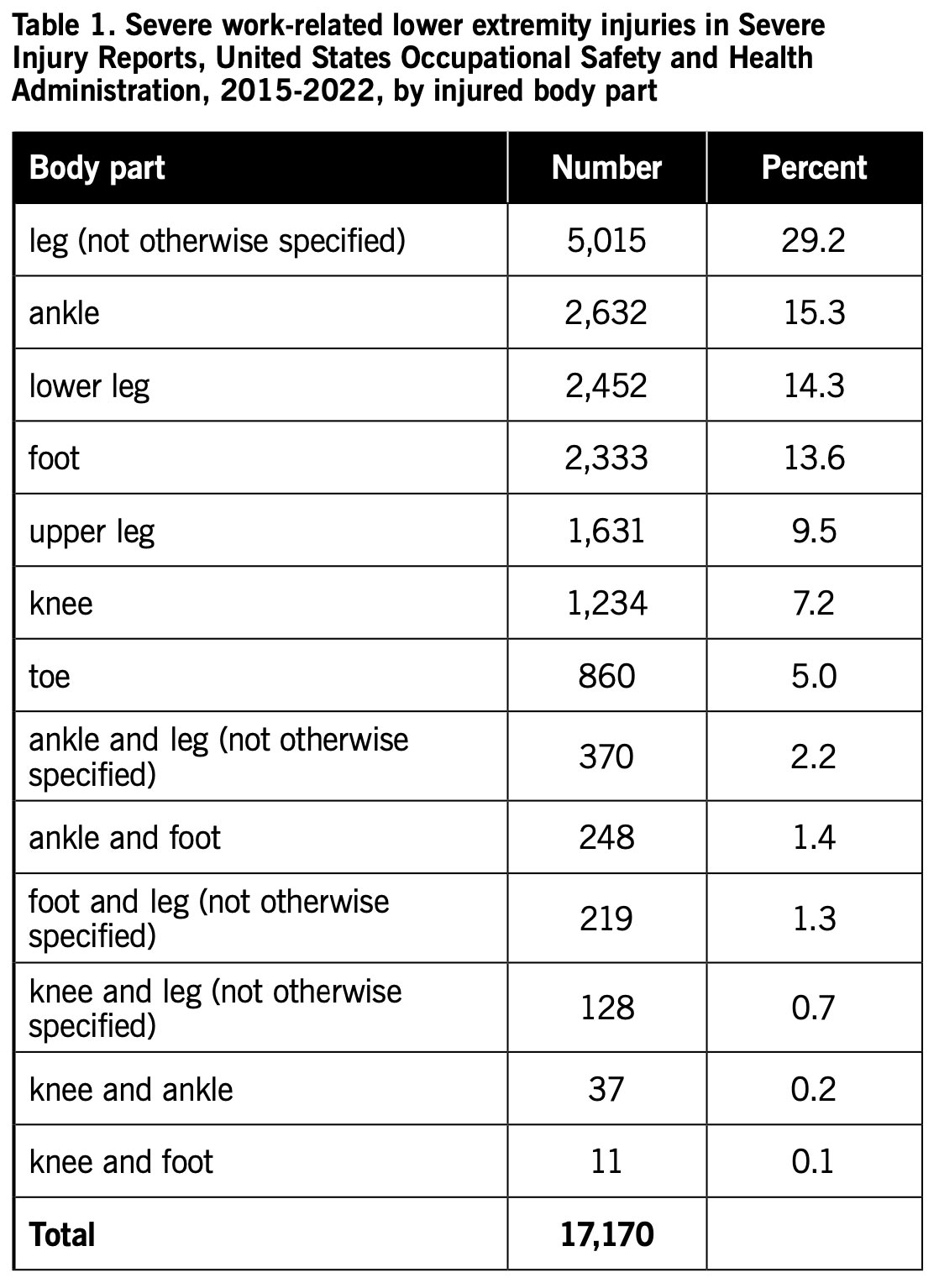
A total of 17,170 severe work-related lower extremity injuries were identified for 2015-2022, representing 21.6% of the 79,351 total Severe Injury Reports. Table 1 shows the distribution of these injuries by the affected body part. In almost 30% of the cases, the specific part of the lower extremity was not coded. Of those cases where the specific part of the lower extremity was coded, the most frequently injured body parts were the ankle, lower leg, and foot. The injuries were 11,066 (64.4%) fractures; 1,665 (9.7%) nonspecified soreness, pain, or hurt; 807 (4.7%) cuts or lacerations; 791 (4.6%) amputations; 472 (2.7%) crushing injuries; and 2,369 (13.8%) other specified injuries.
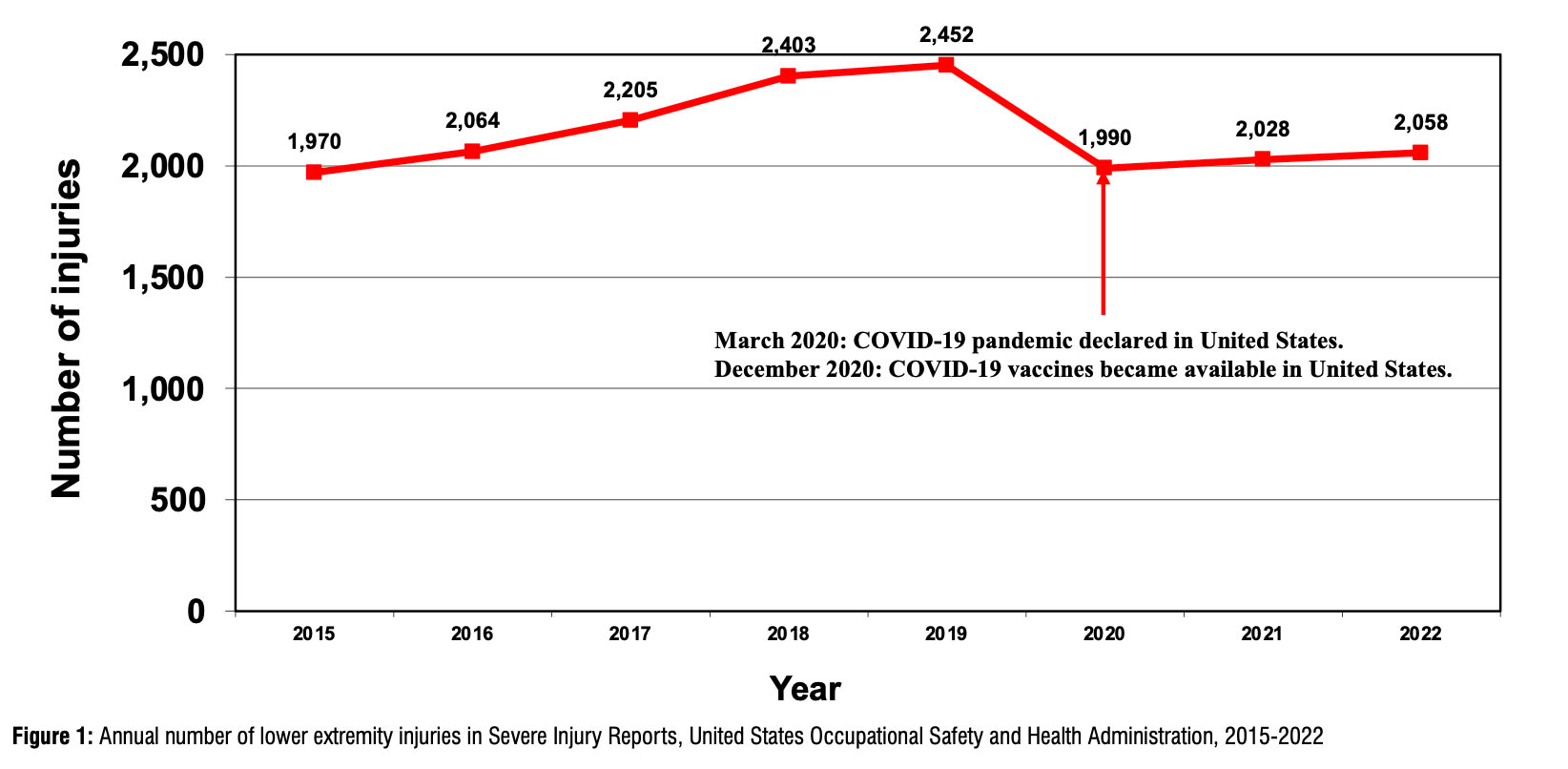
Figure 1 provides the annual number of cases. The number of severe work-related lower extremity injuries increased each year during 2015-2019 for an overall increase of 24% between 2015 and 2019. The number of lower extremity injuries declined 19% during 2020 and then increased slightly during 2021 and 2022.
 Of the 273 different coded events leading to injury, the most common were fall on same level due to slipping (n=1,513, 8.8%); other fall to lower level, unspecified (n=1,449, 8.4%); other fall to lower level less than 6 feet (n=935, 5.4%); part of occupant’s body caught between vehicle and other object in nonroadway transport incident (n=837, 4.9%); struck by object falling from vehicle or machinery-other than vehicle part (n=725, 4.2%); struck by falling object or equipment, not elsewhere classified (n=688, 4.0%); and pedestrian struck by vehicle in nonroadway area, unspecified (n=687, 4.0%). Of the 694 different coded sources of the severe work-related lower extremity injury, the most common sources were forklift, order picker, platform truck-powered (n=1,845, 10.7%); floor, not elsewhere classified (n=1,284, 7.5%); floors, walkways, ground surfaces, unspecified (n=790, 4.6%); and pallet jack-powered (n=749, 4.4%).
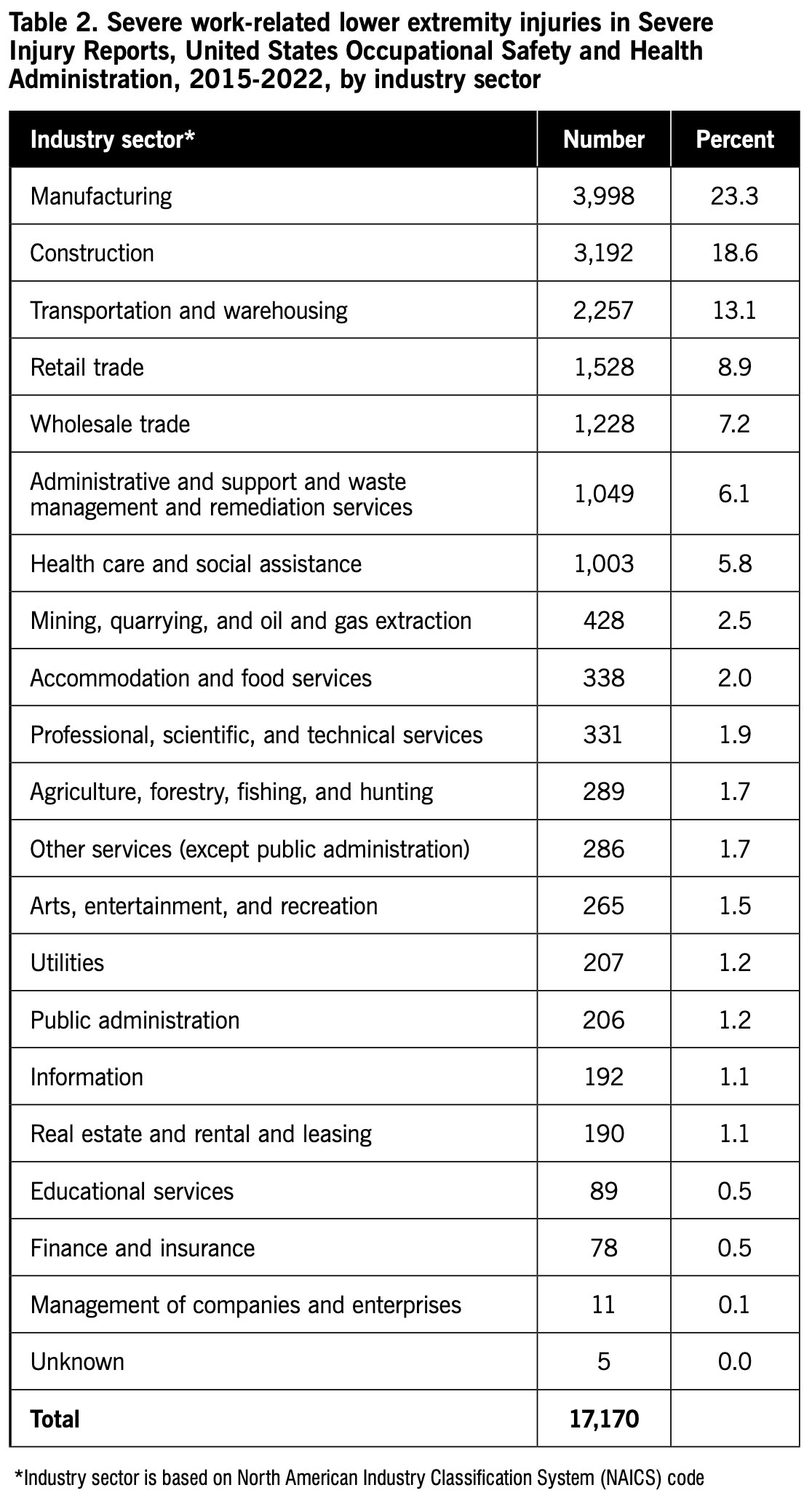
Table 2 shows the distribution of severe work-related lower extremity injuries by industry sector. The industry sectors with the highest number of severe work-related lower extremity injuries were manufacturing, construction, and transportation and warehousing. The states with the highest number of severe work-related lower extremity injuries included in Severe Injury Reports were Texas (n=2,782, 16.2%), Florida (n=1,963, 11.4%), Pennsylvania (n=1,412, 8.2%), Ohio (n=1,293, 7.5%), Georgia (n=1,019, 5.9%), Illinois (n=967, 5.6%), and New York (n=904, 5.3%).
Discussion
This study examined over 17,000 severe work-related lower extremity injuries included in OSHA Severe Injury Reports during a recent 8-year period. Such information is important because lower extremities injuries were involved in over 20% of all Severe Injury Reports.
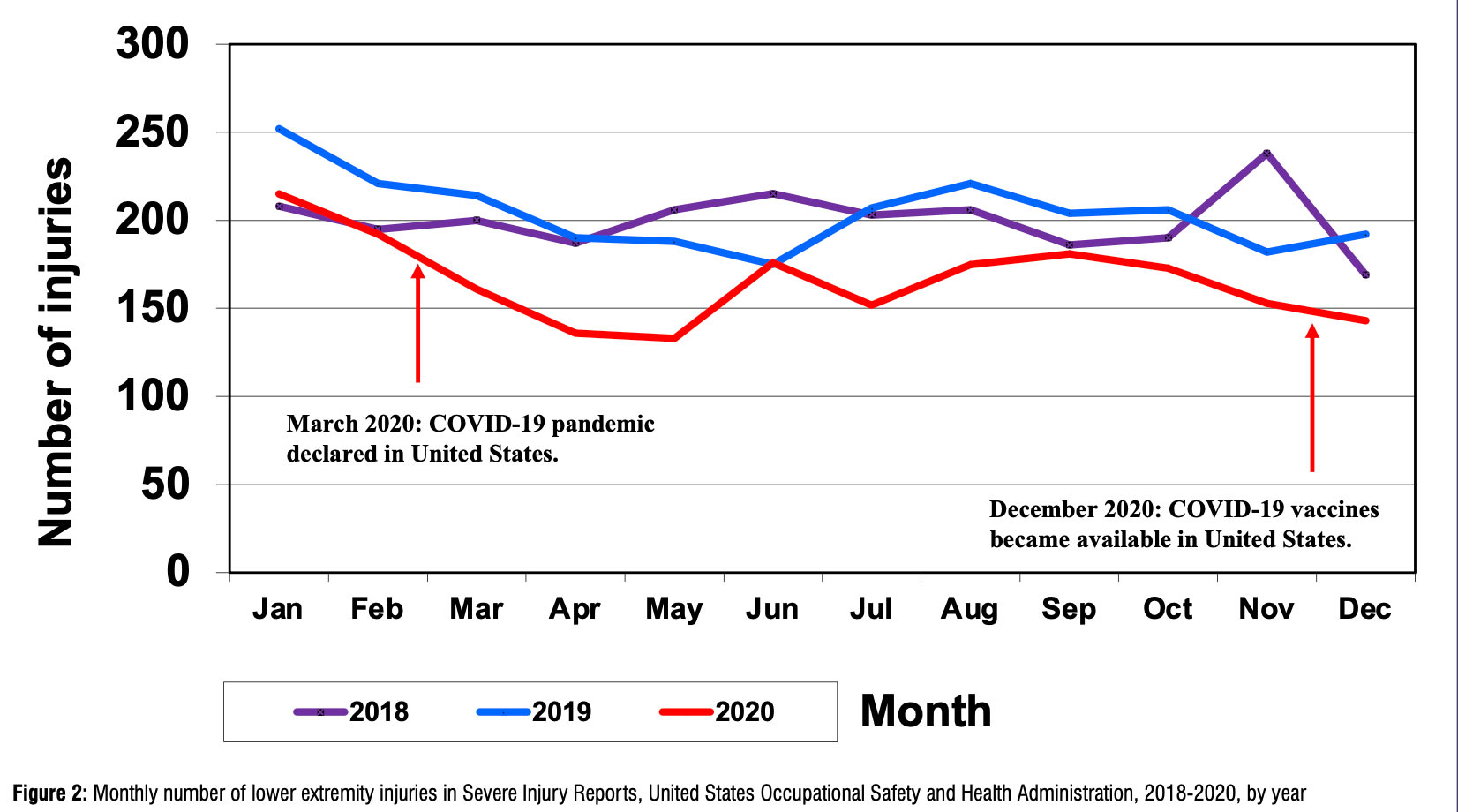
The number of severe work-related lower extremity injuries increased each year during 2015-2019 with a 24% increase over the 5-year period. However, the number of severe work-related lower extremity injuries decreased 19% between 2019 and 2020. One possible explanation for this decline is the COVID-19 pandemic and national emergency that was declared in the US in March 2020. In March 2020, states began to enact stay-at-home orders and close or restrict schools, businesses, and other facilities. In subsequent months, stay-at-home orders and closures and restrictions were lifted or modified, although this varied from state to state.7,8 As businesses and other facilities closed, fewer people were working outside the home. Consequently, fewer work-related injuries might be expected to have occurred. Figure 2 shows that the number of severe work-related lower extremity injuries in January and February 2020 was similar to the same months in 2018 and 2019. However, the number of severe work-related lower extremity injuries declined in March-May 2020, becoming much lower than the same months in 2018 and 2019. Although the number of severe work-related lower extremity injuries was higher in June-December 2020 than the preceding months, the number in July-December 2020 was still lower than the same months in 2018 and 2019. As businesses and other facilities reopened and the COVID-19 pandemic waned, the number of injuries might be expected to have increased. The number of severe work-related lower extremity injuries did increase, but only 2% in 2021 and 1% in 2022. A similar pattern was observed in BLS data where total nonfatal occupational injuries reported by private industry employers declined 21% from 2,686,800 in 2019 to 2,110,100 in 2020 and then increased 6% in 2021 (n=2,242,700) and 4% in 2022 (n=2,343,600).1
In almost 30% of the cases, the specific part of the lower extremity that was injured was not coded. Of the remaining cases, the most frequently injured body parts were the ankle, lower leg, and foot. Fractures accounted for 64.4% of the injuries. No other type of injury occurred nearly as often. The next most frequently reported injuries were nonspecified soreness, pain, or hurt (9.7%); cuts or lacerations (4.7%); and amputations (4.6%). Soreness, pain, hurt, cuts, and lacerations might be expected to occur more frequently than fractures. However, these latter injuries might be less likely to require hospitalization than fractures. OSHA requires Severe Injury Reports to be submitted if the injuries involved an amputation, in-patient hospitalization, or loss of an eye.2 This might bias the types of injuries included in the Severe Injury Reports database.

While 273 different types of coded events led to severe work-related lower extremity injuries, the following 7 events led to 39.8% of the injuries: fall on same level due to slipping; other fall to lower level, unspecified; other fall to lower level less than 6 feet; part of occupant’s body caught between vehicle and other object in nonroadway transport incident; struck by object falling from vehicle or machinery-other than vehicle part; struck by falling object or equipment, not elsewhere classified; and pedestrian struck by vehicle in nonroadway area, unspecified. In addition, while there were 694 different coded sources of the severe work-related lower extremity injury, the following 4 sources were involved in 27.2% of the injuries: forklift, order picker, platform truck-powered; floor, not elsewhere classified; floors, walkways, ground surfaces, unspecified; and pallet jack-powered. Three industry sectors – manufacturing, construction, and transportation and warehousing – accounted for 55.0% of the severe work-related lower extremity injuries.
 There are limitations to the study and the database used. All injuries are not included in Severe Injury Reports. OSHA only requires Severe Injury Reports to be submitted for those injuries involving an amputation, in-patient hospitalization, or loss of an eye.2 Only a limited number of variables are provided in the database, and the database does not include patient demographics. Submission of Severe Injury Reports is not consistent among all states, so comparisons between states cannot easily be made.
In conclusion, severe work-related lower extremity injuries occurred in 21.6% of the total Severe Injury Reports. The most frequently injured body parts were the ankle, lower leg, and foot. Fractures were reported in almost two-thirds of the lower extremity injuries. The injuries involved a wide variety of events, sources, and industries. The information in this study may be useful in reducing the number of lower extremity injuries in the workplace.
Mathias B. Forrester, BS, is an independent researcher in Austin, Texas. Now retired, he previously performed public health research for various university and government programs for 38 years.
- News release USDL-23-2359: Employer-reported workplace injuries and illnesses – 2021-2022. United States Department of Labor Bureau of Labor Statistics. November 8, 2023. Available at https://www.bls.gov/news.release/pdf/osh.pdf. Accessed December 7, 2023.
- United States Department of Labor Occupational Safety and Health Administration. Sever Injury Reports. Available at https://www.osha.gov/severeinjury. Accessed December 2, 2023.
- Tustin CE, Tustin AW. Reports to OSHA of severe occupational injuries due to animals, 2015-2021. Am J Ind Med 2023;66(11):1009-1013.
- Gomes H, Parasram V, Collins J, Socias-Morales C. Time series, seasonality and trend evaluation of 7 years (2015-2021) of OSHA severe injury data. J Safety Res 2023;86:30-38.
- Morrissey MC, Kerr ZY, Brewer GJ, Tishukaj F, Casa DJ, Stearns RL. Analysis of exertion-related injuries and fatalities in laborers in the United States. Int J Environ Res Public Health 2023;20(3):2683.
- Shi DS, Weaver VM, Hodgson MJ, Tustin AW. Hospitalised heat-related acute kidney injury in indoor and outdoor workers in the USA. Occup Environ Med 2022;79(3):184-191.
- Muccari R, Chow D, Murphy J. Coronavirus timeline: Tracking the critical moments of Covid-19. NBC News. January 1, 2021. Available at https://www.nbcnews.com/health/health-news/coronavirus-timeline-tracking-critical-moments-covid-19-n1154341. Accessed December 8, 2023.
- Trump DJ. Declaring a national emergency concerning the novel coronavirus disease (COVID-19) outbreak. Federal Register 2020;85(53):15337-15338.