







During recovery it’s important to listen to how your body feels. @PaulGoughPhysio
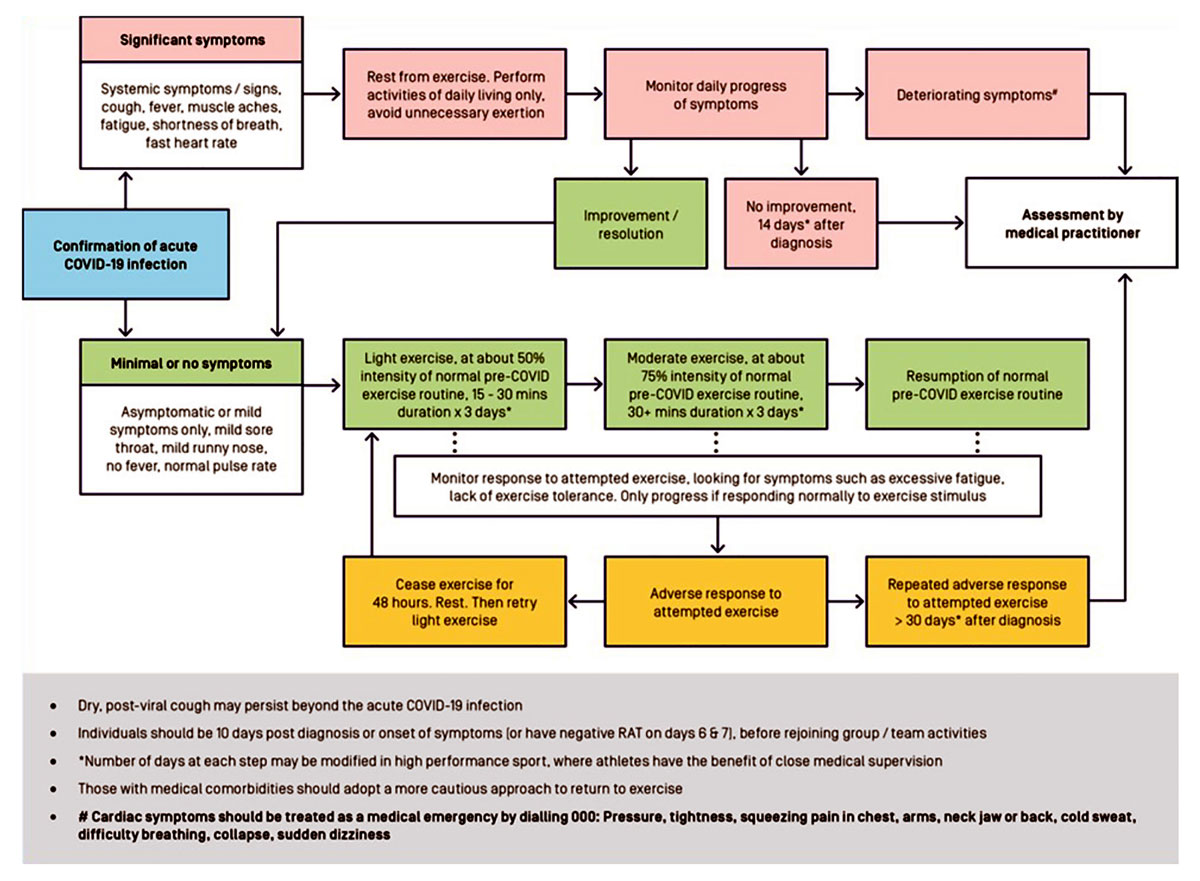
Figure. Graduated return to exercise after COVID-19 infection. Reprinted with permission from Elsevier Ltd. All rights reserved.
As the world moves into yet another phase of the COVID-19 pandemic, Australian sports experts in public health, cardiology, sports medicine, pediatrics, and sports training issued revised guidance for returning to sport after infection. They noted that the 2022 Omicron variant of SARs-CoV-2 (the virus that causes COVID-19) continues to evolve in clever ways, making evidence-based guidance difficult. However, previously published guidance, they noted, focused on the early experience with cardiac and respiratory complications, and required updating to reflect current reality, which includes readily available vaccines and improved therapies.
Noting Omicrom’s lesser virulence yet greater transmissibility than previous variants, the experts recommended the need for considering an individual’s unique experience with the virus, namely the duration and severity of the symptoms, as well as pre-existing medical concerns, prior fitness level, and the intensity of the chosen post-COVID exercise. Their point is to minimize any non-COVID related complications, such as those musculoskeletal injuries that often occur when individuals, who have been inactive, return too suddenly to a prior activity level.
While acknowledging the severity of cardiac symptoms (myocarditis in particular) early in the pandemic, the authors state that “even without vaccination, the risk of cardiac complications in young athletes following COVID-19 infection has been relatively low.”
As for a real-world return to exercise, they note that Australia and New Zealand have minimum 7-day isolation policies for anyone who tests positive. The important question they ask is this: “when is it safe for most individuals to return to exercise? The question needs to be framed in two parts: (1) safety for the individual (in terms of risks of developing complications) and (2) safety for other individuals that the recuperating individual comes in contact with on return (in terms of potential to infect others).”
They also see this moment in time as an opportunity to reset the culture of training: they hope that their guidance on the slow return can help displace that notion of pushing through when sick that often leads to viral fatigue syndrome.
While the figure provides their detailed recommendations on when to return to exercise, they conclude that most individuals can safely return 7-14 days after infection. They caution, however, that the timeline to return should be guided by the individual’s health and fitness history.
This article summarizes “Return to exercise post-COVID-19 infection: A pragmatic approach in mid-2022,” by David C. Hughes, John W. Orchard, Emily M. Partridge, Andre La Gerche, and Carolyn Broderick. The article was published June 7, 2022, in the Journal of Science and Medicine in Sport. 2022;25(7):544-547. doi: 10.1016/j.jsams.2022.06.001. Readers are encouraged to review the original, which is available online for free.