








Shockwave, PRP, and laser treatments are reshaping how clinicians manage chronic foot and ankle conditions
 By Keith Loria
For decades, the treatment pathway for chronic foot and ankle conditions followed a familiar progression: conservative care, escalating symptoms and ultimately, surgery for patients who failed to improve. Today, that pathway is evolving. A growing number of clinicians are incorporating regenerative therapies earlier in the process, offering patients additional options before surgical intervention becomes necessary.
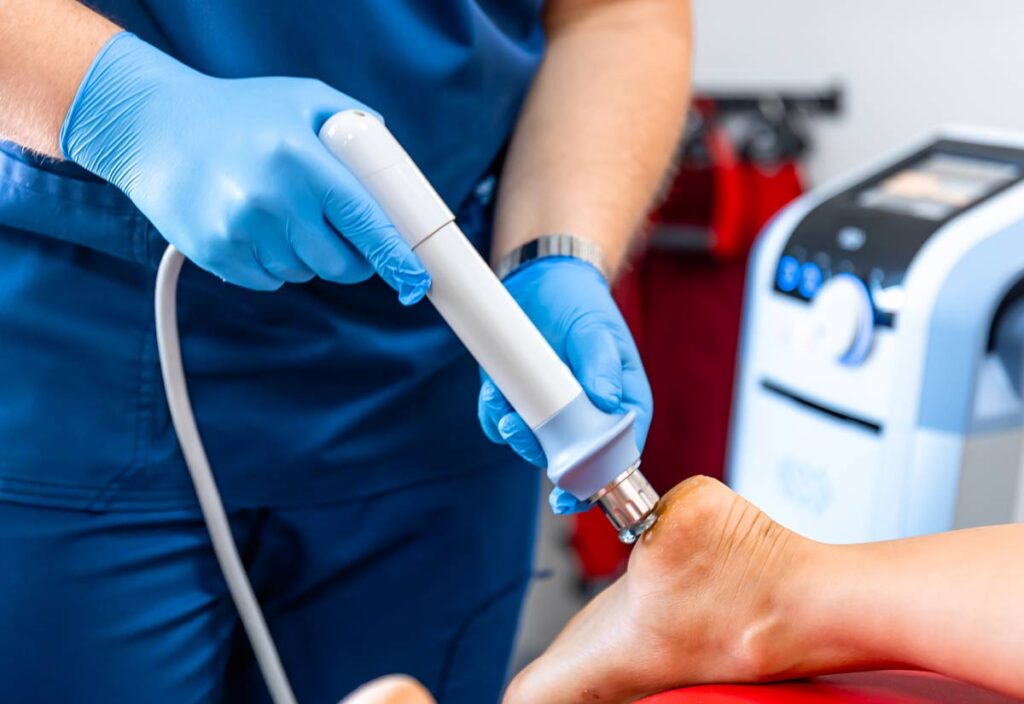
These therapies—ranging from shockwave and laser treatments to platelet-rich plasma (PRP) and other orthobiologics—focus on stimulating the body’s intrinsic healing mechanisms rather than simply masking symptoms. For patients with chronic soft tissue injuries, this shift is significant.
A major proponent of this movement is Emily Splichal, DPM, MS, CES, of the Center for Functional & Regenerative Medicine in Chandler, Arizona, whose practice focuses on chronic tissue injury.
“I see and will think of regenerative modalities for chronic plantar fasciosis, partial tears of the plantar fascia and ligament degeneration,” she said. “They give patients another option to improve their function and reduce their symptoms before surgery.”
Splichal notes that success does not always mean complete resolution of symptoms.
“If I can reduce a patient’s symptoms by 50%, I consider that a success,” she said, adding that many patients are able to return to meaningful activity with that level of improvement.
Stacking Therapies for Better Outcomes
As regenerative medicine becomes more widely adopted, clinicians are moving away from single-modality treatments toward more comprehensive, multi-step protocols.
Tek Fish, DPM, owner of Clover Podiatry in Vancouver, Washington, describes a growing emphasis on personalization.
“There are so many options,” he said. “At the end of the day, I’m asking one question: which of these therapies, or combination of therapies, is going to get this patient better the fastest?”
He noted that shockwave therapy has proven particularly effective for chronic inflammation, while laser therapy often excels in acute presentations. PRP and other biologics are used in more complex cases, including chronic wounds and post-surgical healing.
Importantly, he sees the future in combining these modalities.
“Stacking therapies is becoming more widely accepted, and the early data is showing better outcomes when you combine modalities,” Fish said.
Splichal believes that regenerative therapies should not be viewed in isolation.
“What you do around the regenerative modality creates the greatest success,” she says.
Her approach involves a carefully structured protocol that includes reducing load on the affected tissue, gradually reintroducing stress, and integrating functional rehabilitation. She notes that many failures attributed to regenerative treatments are actually the result of incomplete or poorly designed protocols.
Redefining Patient Outcomes
The rise of regenerative therapies is also changing how clinicians define success. Rather than focusing solely on pain reduction, many providers are shifting toward functional outcomes, looking at what patients are able to do in their daily lives.
Michelle Morse, DPM, podiatric foot & ankle surgery specialist in Boston, Massachusetts, noted this shift is important.
“Most people are able to return to their functional goals if we improve their pain by 80%,” she says. “Those goals vary widely, from walking long distances to returning to sports or recreational activities. Understanding these goals early in the treatment process is critical to patient satisfaction.”
Similarly, Ashley Katzenback, PT, DPT, owner of Cape Concierge Physical Therapy in Mashpee, Massachusetts, integrates regenerative therapies into broader rehabilitation programs.
“Shockwave therapy speeds up recovery timelines significantly,” she said. “But we have to find the root cause and address it with strengthening, gait training and manual therapy.”
Her approach highlights an important distinction: regenerative therapies may initiate healing, but long-term success depends on addressing underlying biomechanical issues.
A Structured Approach to Healing
For some clinicians, regenerative medicine is not just a treatment option, it is part of a comprehensive care model.
For instance, S. Don Kim, DPM, medical director of Kim Holistic Foot & Ankle Center in Long Beach, California, has developed a structured 3-month program designed to address chronic and complex conditions.
“My program is not built around a single injection,” he said. “It combines regenerative injections with lifestyle interventions, nutritional support and adjunctive therapies such as hyperbaric oxygen.”
This broader approach reflects a growing understanding that healing is influenced by multiple factors, including systemic health, biomechanics, and patient behavior.
Limitations and the Need for Standardization
Despite the promise of regenerative medicine, clinicians acknowledge that it is not a universal solution.
Patient selection remains critical. Splichal noted that these therapies are most effective in cases involving chronic degeneration or partial tears, rather than complete structural damage.
“You need a patient who is willing to follow the protocol,” she said, emphasizing the importance of compliance.
Kim stresses that regenerative therapies should not replace surgery when structural correction is clearly required.
Academic voices reinforce this balanced perspective. Samantha Landau, DPM, a professor at New York College of Podiatric Medicine at New York Medical College, points out that regenerative treatments are most effective in early-stage or degenerative conditions and should be viewed as an adjunct rather than a replacement for surgery.
“Overall, regenerative medicine is shifting how we approach foot and ankle pathology,” she said. “Instead of only managing symptoms, we are now able to support the body’s intrinsic healing capacity in a way that aligns well with both patient expectations and long-term functional outcomes.”
Looking to the Future
As regenerative therapies continue to gain traction, clinicians expect further refinement in protocols and broader adoption across the profession.
Splichal hopes that future research will lead to more standardized approaches, reducing variability and improving outcomes.
For now, regenerative medicine is reshaping lower extremity care by expanding the range of available treatments and offering patients new pathways to recovery—often without the need for surgery.
A graduate of the University of Miami, Keith Loria is a D.C.-based award-winning journalist who has been writing for major publications for more than 20 years on topics as diverse as healthcare, travel, sports and entertainment.