









By Jay Segel, DPM; Sally Crawford, MS
It’s a physics problem – We live dynamic lives, in turn, we suffer dynamic consequences!
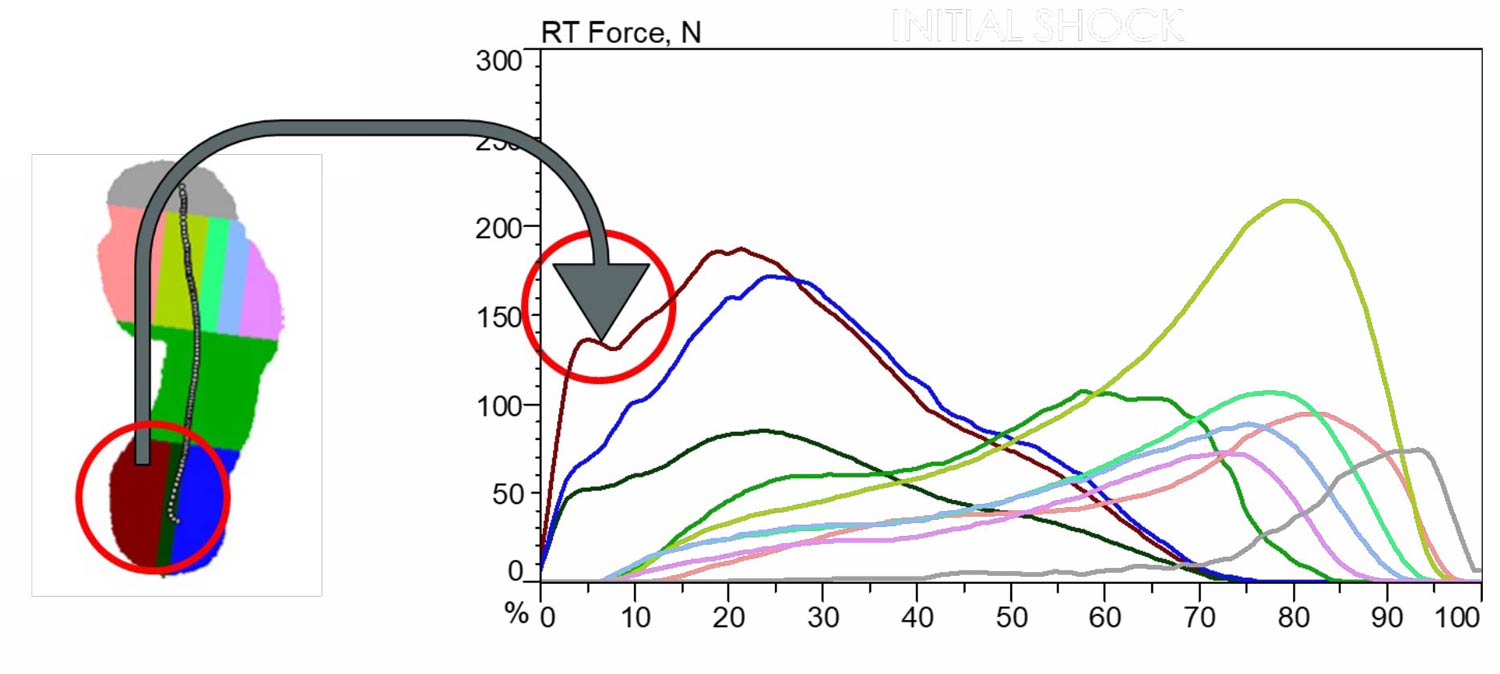
Figure 1: The center of pressure (COP) gait line is a visual expression of the path progression of loading (shown left in the figure). The COP is based on contact with the ground, which is represented in CAGA as the ground reactive forces (graphed on the right in the figure). Simply put, the line is an aggregate of points representing the COP, plotted on the X and Y coordinates repetitively at the sample rate, starting at the red circle. COP gait lines objectively demonstrate how that force impacts each point in movement and loading.
In the last installment, we focused on our problematic anatomy. We continue this discussion by looking at what happens when we add the interaction between 2 dissimilar bodies, the foot and the floor, and the introduction of force. The bad news is that our feet collide with the support surface with force, and that support surface returns the favor by hitting the foot in an equal and opposite manner called the ground reactive force. The good news is that we can apply the laws of physics, specifically, the formulae of collision dynamics, which allows us to understand, predict, and manage this repetitive set of actions. We can see some of this happening and we can observe the negative results on the body, but to measure these interactions, we need a reliable, reproducible device with a set of tools – that is the science and discipline of Computer Aided Gait Analysis (CAGA).
CAGA allows us to better understand the consequences of individual biomechanical and structural deformities, weaknesses, asymmetry, and abnormalities compromising balance during stance and human locomotion. But what it really can come down to is a better understanding and explanation of basic physics.
As a baseline, the vast majority of us do not have mechanical woes while resting or in bed; the challenges begin with weight-bearing and bipedal movement. As a living example, we like to use the bear as a model. We like to say that what it doesn’t understand didactically, it knows instinctually.
When we get out of bed and put our weight on our feet, we add significant challenges to our problematic anatomy by adding forces. When we, as a manner of speaking, hit the floor, the support surface hits us back. This is a phenomenon known as ground reactive forces and is one of Newton’s natural laws of physics. However, there is a second force added that is often not considered – gravity.
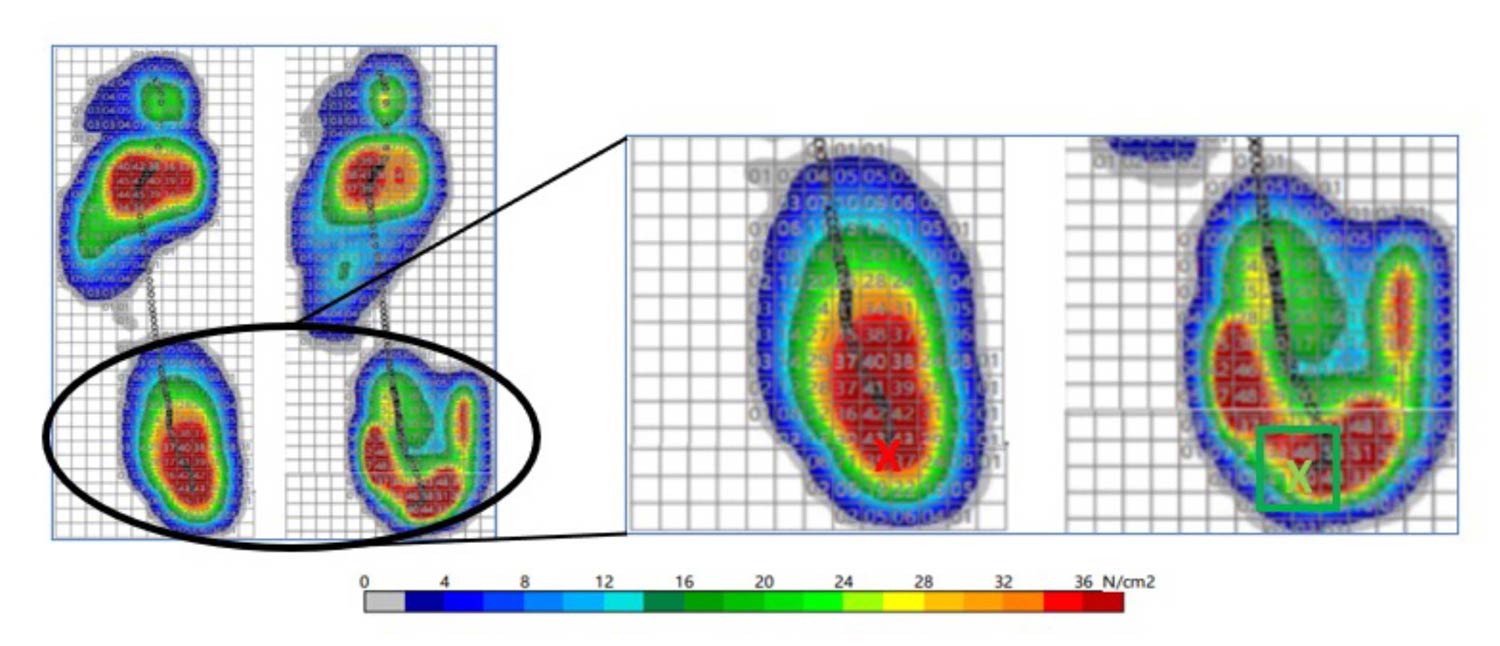
Figure 2: Three things happen to reduce pain and aid walking and deal with Newton’s dirty truths: 1) Locally, the impact point is shifted posterior, back, and away from a typical but not ideal area that coincides with plantar heel spurs and the vulnerable origin of the plantar fascia. 2) The increase in the landing foot/floor angle allows for a more efficient gait with greater power and momentum in each step. 3) An improvement in spatial and temporal gait elements and the progression of the foot through each step as observed in the “center of pressure” graph.
When we add locomotion to the equation, it’s useful to consider each step as a collision between a 3-dimensional foot of limited mass and a 2-dimensional support surface of relatively unlimited mass. This is, as we say, a battle the foot cannot win, and in fact, it loses this battle about 4 million times a year based on average human walking patterns. These deforming forces destroy joint integrity and neutrality.
Now, with some physics under our belt, we can layer on quantitative visuals to guide interpretations of this problem using the center of pressure (COP) data from CAGA. The COP is a fundamental concept in studying human movement and balance (Figure 1). When a person stands or walks, their body exerts a force on the ground, which is countered by an equal and opposite force known as the ground reaction force (GRF). The COP is the point where this total force (the GRF) is concentrated, playing a vital role in maintaining stability and preventing falls.
The COP is supposed to represent a forward progression of weight bearing from heel to toe. If initial contact is moved to the forefoot, we see a devastating alteration of pressure flow, known as retrograde COP. Again, all thanks to physics! Instead of this line moving normally from heel to toe, we see a period where our center of pressure is moving backward while our body momentum wants to trend forward. This potential for divergence of force is the very definition of shear stress that would have direct impact on the many joints of the foot and ankle with stark negative effects on the entire kinetic chain!
As gait is a cyclical and repetitive set of events, looking at the aggregate of the COP gait lines and pressure plots, in motion, is critical (Figure 3).
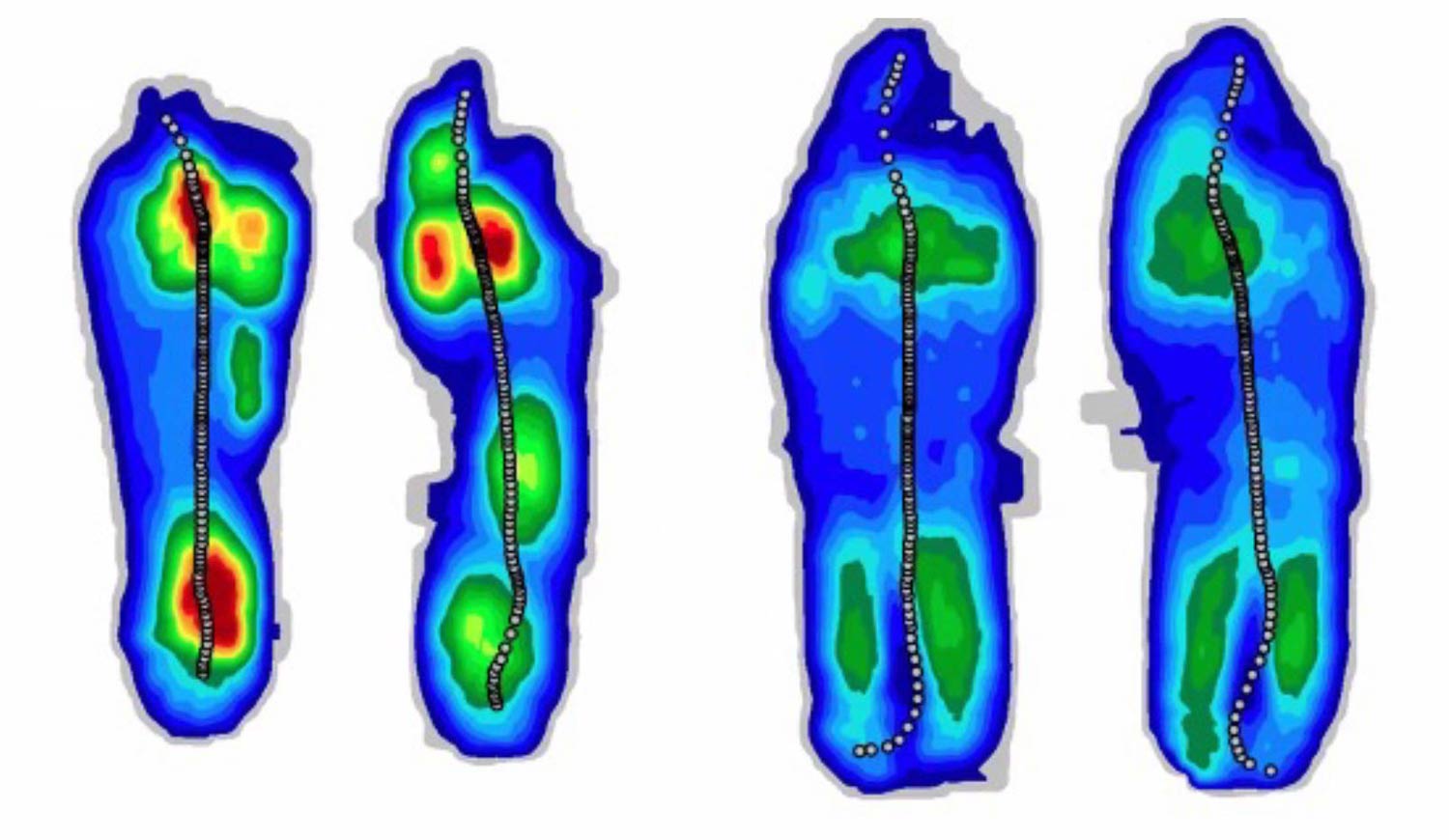
Figure 3: With the help of the ground reaction force, we can live dynamic lives but at the same time, it is the most destructive phenomenon humans face. Force is the root cause of impact, shock, tearing, and friction as represented in average pressure plots characterizing exact influences we have control over: shoe and footwear solutions.
As a sidebar, some of the language may seem familiar from prior months, and that is done deliberately. Over the years of practicing, teaching, and writing about biomechanics, these familiar phrases and analogies have helped to convey lofty concepts in easily digestible pieces in a consistent framework. Please look forward to next month’s CAGA 101 covering more on what we can’t see with our eyes without the help of these tools.
Jay Segel, DPM, is a Podiatrist, Biomechanist, Orthotic and Gait Analysis Specialist, in Martha’s Vineyard, MA.
Sally Crawford, MS, is a Biomedical Engineer, IT director, and data manager.
Part 1 of this 12-part series, CAGA 101: The 12 Dirty Truths Of Foot Mechanics, which appeared in the February issue, can be accessed at https://tinyurl.com/y78kj5s3.