








Dirty Truth #4: Shock Absorption is Energy Loss–Understanding Loading in Gait Analysis
 By Jay Segel, DPM; Sally Crawford, MS
Perhaps the most surprising and unintuitive of all the dirty truths is number four, “Shock absorption via cushion is energy loss.” At first blush, cushion seems like a no-brainer benefit. When we delve into this idea a bit deeper, applying our structure, the forces acting on the lower limbs, and applying the physics that we talked about in the last three dirty truths, the truth of number four becomes clear.
Picking up where we left off last month,1 the physics of collision dynamics that happen when our feet strike the ground include bony deformation, the receipt of impact force, and energy loss as our bone structure recovers after impact.
In the world of CAGA (computer-aided gait analysis), understanding the truths about loading is fundamental, but also easily bypassed in the thinking and patient education process. Every step we take is a complex interplay of forces, each requiring energy to propel us forward. Yet, with each stride, there is an inevitable loss of energy due to shock absorption at impact. To define and differentiate the terms shock and pressure, we would refer to shock as a high-pressure event happening in a very short amount of time. This principle—shock absorption is energy loss—highlights the importance of those collision effects in motion. As discussed in prior articles,2-4 we know that with each step, deformation occurs, leading to energy and thus the build-up of microtrauma. Using CAGA to understand and better manage the way energy is received and utilized is our golden ticket.
The center of pressure (COP) gait line is seen on the left in Figure 1 expressed one coordinate at a time as gait progresses. The initial point where contact occurs (that collision between the foot and the ground) and the subsequent COP gait lines reveal the intricacies of our motion. These effects can be tracked and analyzed, as well as isolated to phases and specific timing, like the single support phase of gait as introduced last month. CAGA is also not just about numbers. We can actually see, quantify, and measure shock graphically.
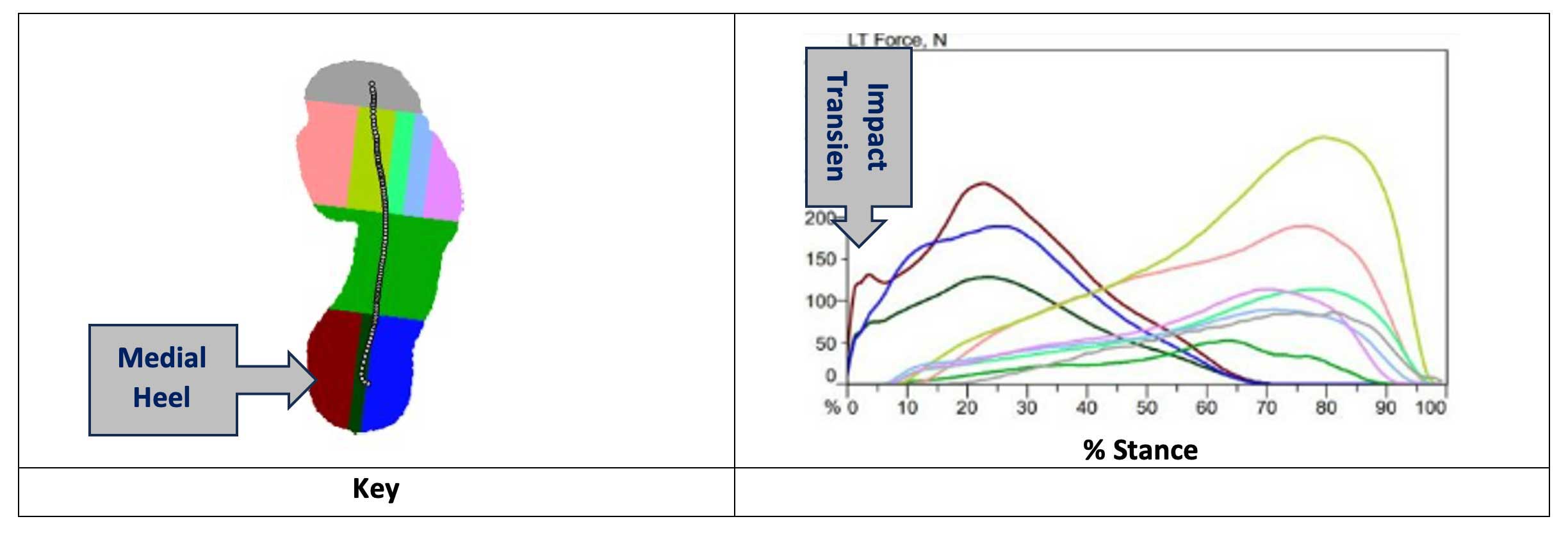
Figure 1: Displays a graphic representation of zonal shock, pointing to the early peak in pressure known as the “impact transient,” in this case through the medial zone of the heel.
The single support phase COP provides valuable insights into how our bodies handle the stresses of walking, running, and weightbearing activities. Given that walking and running, and weightbearing are the opposite of static, we can break the dynamic and variable events into groups, including pronation and supination, mediolateral shifting, and midsection crossover.
Understanding these dynamic events and patterns is crucial for addressing the repetitive microtraumas and wear and tear that our feet take, thanks to energy loss. In Figure 2, one can quickly identify the different morphologies of quick and slow loading of a foot or a particular region of the foot.
Through CAGA, we can utilize the quantified data to devise strategies to mitigate energy loss, ensuring that each step is as efficient and pain free as possible. Thus, the story of loading in gait analysis is one of continual adaptation and improvement, grounded in the truths of physics and biomechanics.
The ground reactive forces return energy to the system to help us propel our way through the gait cycle. Adding a significant cushion to this physics equation affects all 3 reactions that occur during impact. The materials classically used in shoes and insoles are largely foams and low durometer polymers, which allow the foot to sink in deeper and, without proper structure, allow for an increase in foot structure deformation. In other words, by providing cushioning as the foot sinks into the foam during contact, it allows more time for the foot to deform under vertical pressure. And that “sinking in time“ wicks energy from an energy-dependent activity, such as walking.
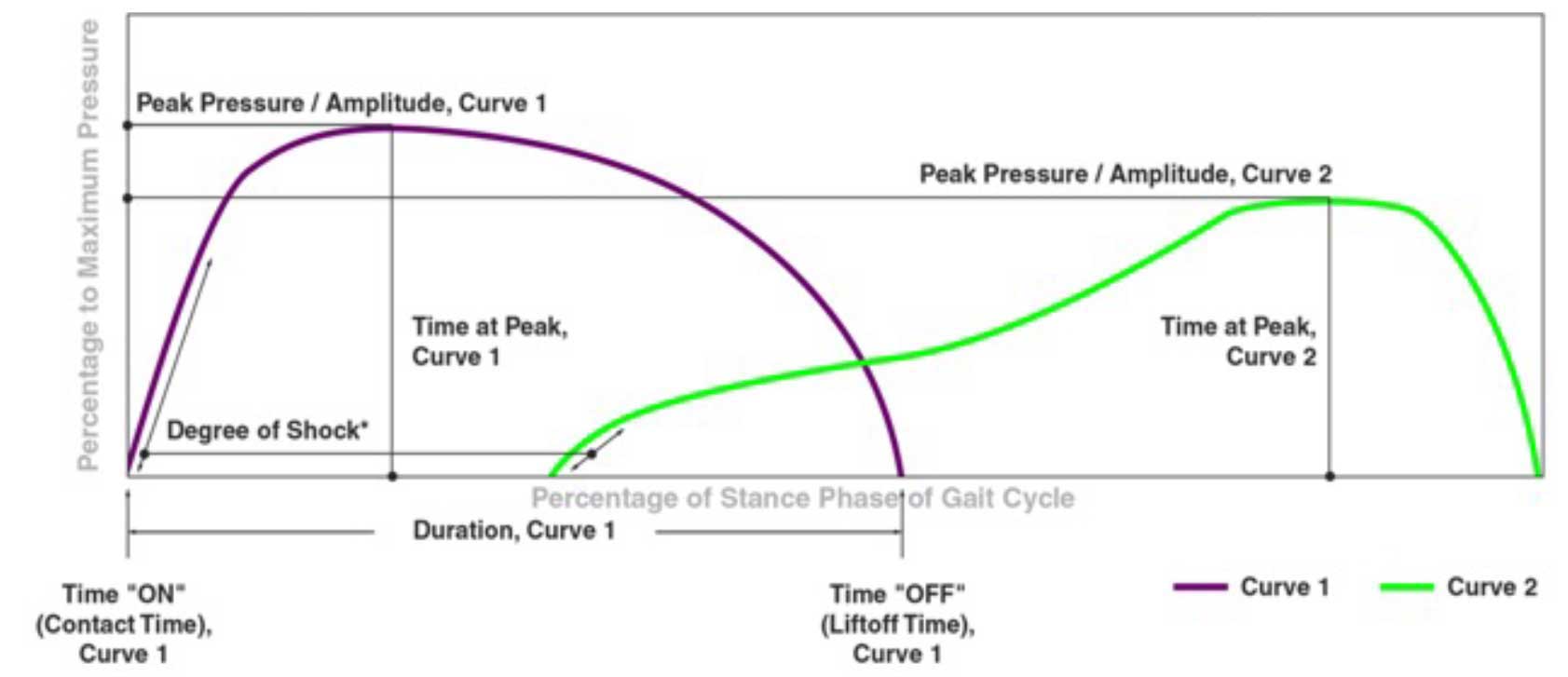
Figure 2. Degree of shock, or impact, for Curve 1 is greater, increasing more quickly, than Curve 2, which is slower loading in the displayed region of the foot.
So, the answer to foot management is not adding extra cushion, it’s managing the impact by providing structural support.
Please note that we are not saying that cushion is bad in minimal amounts, but adding to it carries the aforementioned complications and can have a destabilizing effect. An ideal analogy might be that of tying a pillow to a subject’s foot and then asking them to bear weight or walk.
Understanding the intricacies of ground reaction forces, peak pressure, and the center of pressure gait lines allows us to systematically address the dirty truths of walking, running, and basically all weightbearing activities. By identifying patterns like rearfoot shock absorption, pronation, and supination, we fine-tune care. As we continue to explore these “shocking” truths, more practical insights guide new ways to understand and improve human movement. Stay tuned for more of our golden nuggets on CAGA and advancing to the next generation of gait analysis.
- Segel J, Crawford S. Dirty Truth #3: What We Can’t See Is Key. Lower Extremity Review. 2025;17(5):XX.
- Segel J, Crawford S. CAGA 101: The 12 Dirty Truths Of Foot Mechanics: Introducing the 12 Dirty Truths Playbook: A New LER Series In Biomechanics and CAGA. Lower Extremity Review. 2025;17(2):36-37.
- Segel J, Crawford S. Dirty Truth #1: The Foot Is Not Symmetrical. Lower Extremity Review. 2025;17(3):22-24.
- Segel J, Crawford S. Dirty Truth #2: Realities of Center of Pressure in Dynamic World. Lower Extremity Review. 2025;17(4):22-26





The foot is not designed to be a force absorber but a force disperser. The foot does not lose the force created by gravity but disperses them transfer it to a forward movement.
Forefoot strike is best for dispersion and transferring forces to propel forward