









 By January Shoaf, ler Magazine Editor
When you’re in the middle of a major medical crisis, there can be a lot of information to process. And what if you’ve never even heard of an ankle foot orthosis (AFO), don’t know what it’s for, how it works or how to use it. I’ve been there. (But as LER Magazine’s editor, I had heard of an AFO.) I recently had a completely unexpected medical emergency that resulted in an extended hospital stay, physical therapy and a physical therapist handing me an AFO and saying, “Try this.” No explanation, not even how to put it on. This is the place that I am coming from in this review. While I did not have a stroke, I can relate to being a bit overwhelmed and uniformed.
Dr. Brown is a PhD-trained physical therapist who has been board certified as a neurologic clinical specialist by the American Board of Physical Therapy Specialties of the American Physical Therapy Association for 4 10-year terms and is a neuro-developmental treatment (NDT) trained therapist. She has done extensive research with individuals with stroke regarding their experiences with AFOs, which more than qualifies her as an expert on this subject. But more than that, her zeal for wanting every patient to understand what they need to know is evident in every page of her short book. It is perfect for a patient/client, or caregiver to read and really understand all that is being thrown at them. This book is great for other clinicians, such as physical therapists, or those who don’t necessarily prescribe or work with AFOs every day to feel more familiar and answer questions for their patients/clients.
The book was laid out well with extensive, yet easy to understand definitions written in a voice made for a lay person. From the very beginning, the title, “Brace Yourself”, while completely true, it also shows a bit of comedic relief. Because if you or a loved one has just had a stroke, and you are literally about to use an AFO, you need to ‘brace’ yourself. There’s a lot going on.
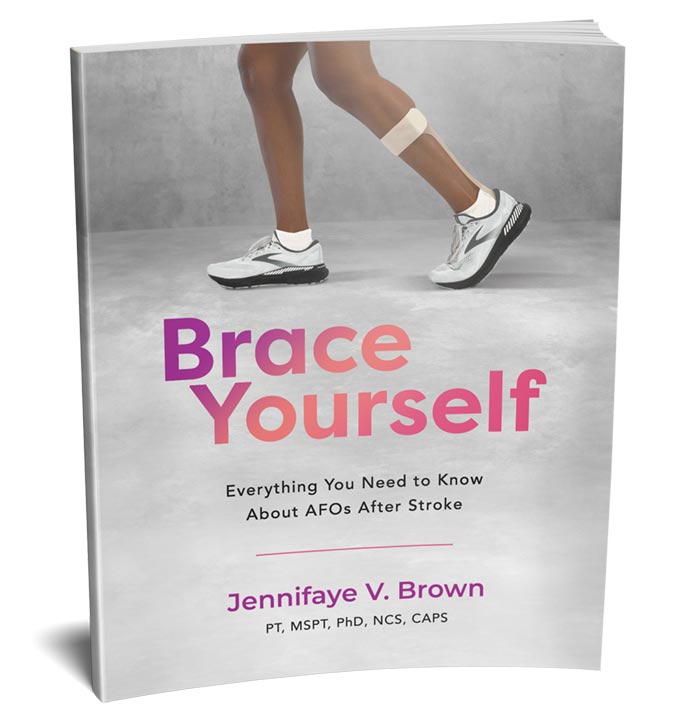 Dr. Brown begins simply by defining foot drop, which no one did for me when I was experiencing foot drop, so the sentiment is well received. But she continues by working through the definitions of an AFO and why you would need one. All of the definitions and explanations are perfect for a person with any neurologic or orthopedic diagnosis resulting in foot drop. The specific images the author chose break up the book in a way that makes it an easy read and the images are essential for the reader to really understand exactly what she is explaining.
If I had to point out a weakness in the book, the only possibility I could see is that there might be too much information. I think the table of contents solves this problem. The fact that you can skip around in the book if there are parts that don’t relate to you really solves this issue.
One of the most valuable parts of this book are the questions at the end that ask, “What should I ask my PT?” and “What should I ask my orthotist?” Additionally, Dr. Brown adds every detail of what to expect when getting an AFO. Overall, this book would be of great value to someone who needs it and should be in every physical therapy practice, rehab department, acute care hospital wing or floor with individuals who experience foot drop, and physician’s and orthotist’s offices.
You can order Dr Brown’s book from:
Amazon, Barnes & Noble, and jvbneuropt.com/book
Order an ebook (flipbook or PDF) or signed copy at:
jvbneuropt.com/book





UNDERSTAND WHAT YOU ARE SAYING. STILL WAITING FOR THE MEDICAL SYSTEM IN AUSTRALIA TO GET OUT OF THE DARK AGES TO KNOW WHERE AND HOW TO GET AND USE THESE AFOs. I HAD TO BUY MINE FROM THE USA IN 2018 AT A COST FOR DROP FOOT, NOT THE HOSPITAL, DOCTORS OR ANYONE I WAS UNDER KNEW WHAT IT WAS OR HOW TO PUT IT ON, NOT REAL GOOD WHEN IT HAD TO BE ME TO EXPLAIN TO THEM ALL WHAT TO DO AND NOT GOOD WHEN YOU ARE IN REAL PAIN. I AM GOING TO BUY THIS BOOK “BRACE YOURSELF” and this is my new bible to show all the UNINFORMED PEOPLE.